
The Dimond District looks and feels like a neighborhood that’s often in an ongoing state of flux. Farmer Joe’s has been a longtime anchor while many cafes, restaurants and bars move in and then out. There are, of course, exceptions. La Farine is veering towards its 20th anniversary there. And newer restaurants like Michauxnée Olier’s Willows & Pine (2023) and the Grand Lake Kitchen (2019) are still in business. When Hive, the Place to Bee, closed its doors on MacArthur in 2023, Hamza Ghalib and his brother Yaser opened Mohka House in its place.
Mohka House is one of many Yemeni coffee houses that seemed to appear in every Bay Area region overnight. The East Bay alone has at least a dozen, including Milyar on Adeline with its flashy rococo interiors and Old Oakland’s equally ornate Sana’a Cafe. I spoke with Hamza about his cafe and the sudden proliferation of his home country’s coffee in the region.
“Yemeni coffee is one of the best, if not the best, depending on who you’re talking to,” Hamza said. “It’s very popular on the East Coast but due to Covid, it slowed things down as far as trying to import everything.” He noted that for many years the war in Yemen, followed by the lockdown, made it difficult to export anything out of the country. “There’s a huge Yemeni population here,” he added. “If you walk into corner stores, gas stations—Yemeni people are in those industries.”
After the pandemic ended, there were fewer obstacles to get in the way of launching a coffee business. “Now it’s not as hard, even though it’s still pricey. You can be talking about $40 a pound, and that’s low to medium,” Hamza said. But the price of beans can go up to $100 a pound “depending on what coffee you’re serving and the market you’re serving to.”
Hamza went on to say that, “Yemeni coffee is well known for its full, earthy flavors and chocolatey aftertaste,” and is distinguishable by its small-sized beans. “The quality is second to none just because of the way it’s planted and harvested. It’s a long process.”
When I stopped by the cafe, I tried a cup of qishr, an unusual tea made from coffee husks. “That’s the shell of the coffee bean,” Hamza said. “There’s not even a half percent of caffeine in them. Typically, families drink it at night.”
Before they opened the cafe, the Ghalibs already had a business in the Dimond next door to the Hive. “It was sad to see them [the Hive] go because they’d been such great neighbors to me,” Hamza said. He told me that his store used to be a smoke shop and a bodega of sorts, but he added a kitchen. Mohka House makes many of its own baked goods next door, including a couple of Yemeni specialties.
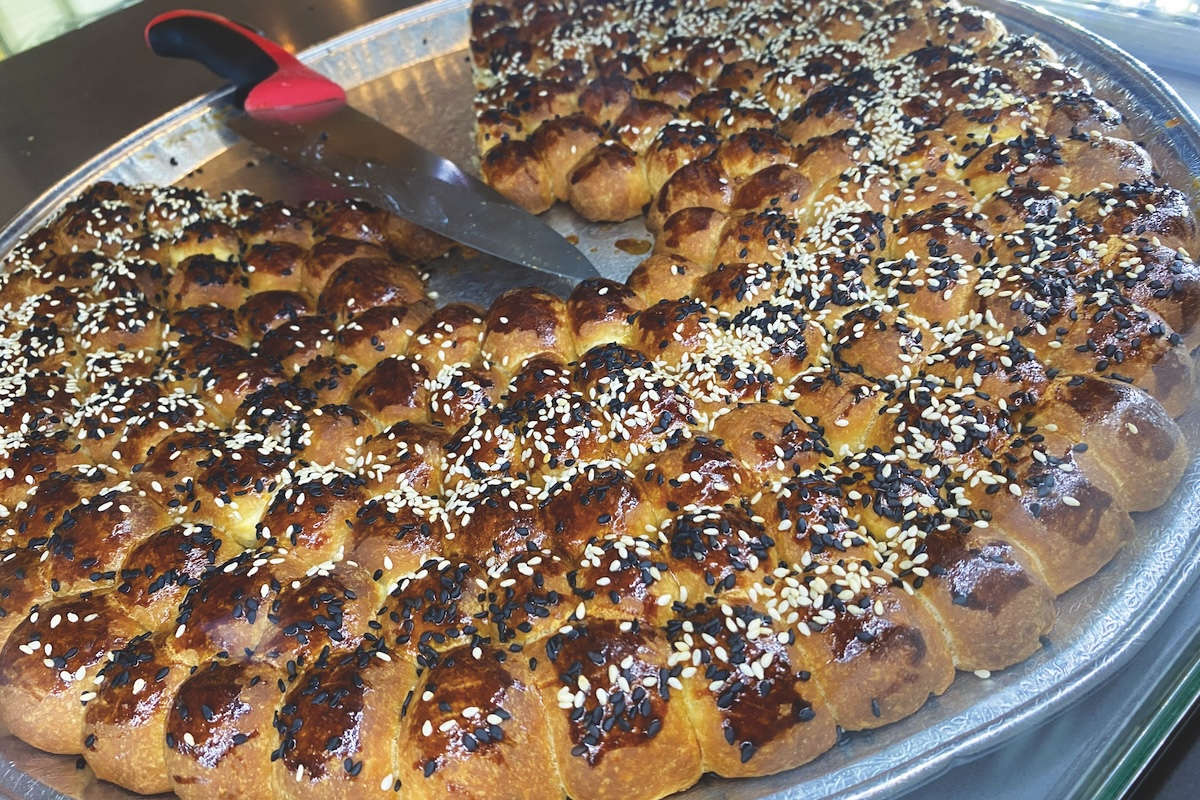
Sabaya and khaliat al nahl, both sweet, round breads, are served like large slices of pizza. I tried a slice of khaliat al nahl, or honeycomb bread. It resembles a pull-apart loaf with loose concentric circles of dough formed in the round. Inside, there’s a cream cheese sweetened on the outside by bold drizzles of honey. Sabaya forgoes the cream cheese in favor of butter. Both are dotted with sesame seeds. The honeycomb bread melts in one’s mouth when it’s hot from the oven. It’s like eating a piece of cheesecake embedded in a soft and pliable piece of cake-like bread.
Before going to sleep, Hamza said people will drink a couple of sips of qishr with either one of the breads. “Those sheets of dough are smeared with homemade Yemeni butter, eggs, and sprinkled with black caraway and sesame seeds,” he said.
For customers who’ve never tried Yemeni coffees, Hamza said, “Most of them have spices, either cardamom or clove or cinnamon, depending on what kind of coffee you’re getting.” The spices are mixed into the ground beans. After the delicate art of roasting is complete, it’s that unique mixture of spices that distinguishes one Yemeni coffee house from another.
Mohka House, open daily 7:30am to 7:30pm, 2139 MacArthur Blvd., Oakland. IG: @mohkahouse.