
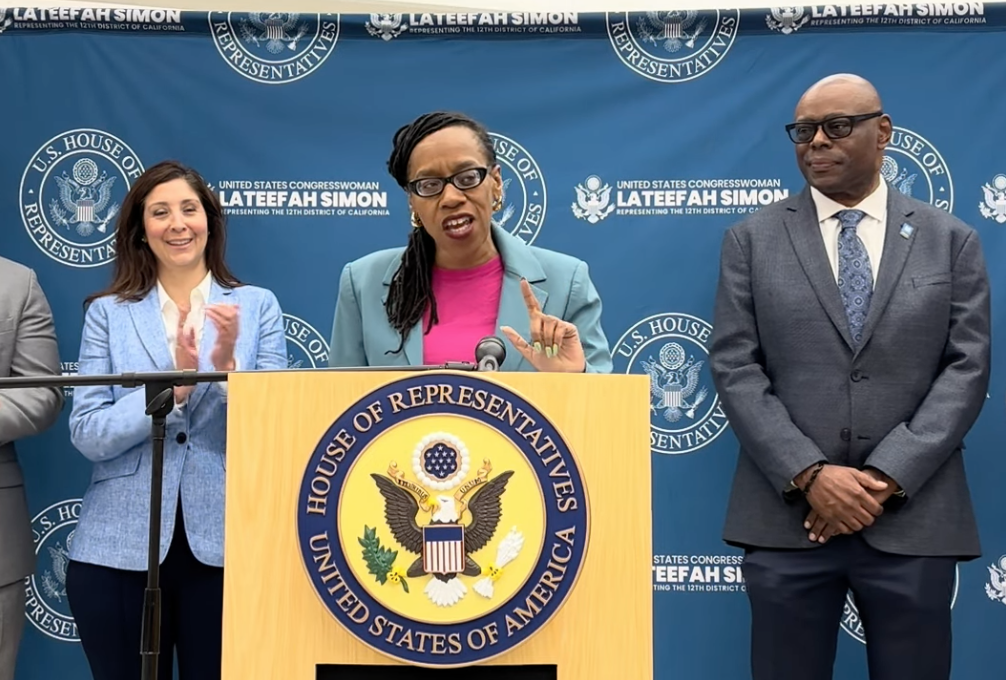
Last week, Rep. Lateefah Simon called a conference inside Oakland’s 19th Street BART station to introduce a federal bill that could have big implications for transit safety.
There, Simon, who represents Oakland and other East Bay cities in Congress, announced that she had introduced the Rapid Intervention and Deterrence for Enhanced Rider Safety Act, or the RIDER Safety Act, which would allow transit agencies across the country to tap federal crime prevention funds to pay for “transit support specialists” rather than exclusively law enforcement officers.
The focus of these jobs is de-escalation and crisis response for riders at risk of harming themselves or others, in the spirit of Oakland’s MACRO program, introduced in 2022, and BART’s ambassador and crisis intervention roles, created in 2020 while Simon was a member of the BART board.
The text of the bill, introduced in November and currently being debated in the Congressional Subcommittee on Highways and Transit, says that these unarmed roles will collaborate with law enforcement to deter and report disruptive behavior, assist with medical emergencies, and handle minor, noncriminal conflicts.
“We support all of our riders,” Simon said at the morning conference as riders walked by. “An integrated approach was desperately needed. And now we want to spread that model all over the nation. Transit ambassadors ease the burden on sworn officers, allowing them to focus on urgent safety and violent crime.”
Simon mentioned BART’s recent announcement that crime within the system had decreased by 41% over the last year, attributing that success in part to collaboration between sworn officers and transit ambassadors. BART had previously said that the drop was largely due to its new, modernized gates, but at the press conference, BART Board President Melissa Hernandez said it was “people, sworn officers and unarmed staff, working together that are making the biggest difference.”
“The RIDER Safety Act helps us expand our unarmed presence. Riders have been loud and clear that they want safety, cleanliness, and reliability. This bill helps us deliver the safest BART possible,” Hernandez said.
Victor Flores, a BART director who represents parts of Oakland, said the social work background of these civilian forces make a difference.
“In the last quarter alone, our team connected 300 people to services and conducted more than 1,600 welfare checks,” Flores said. “Safety is about presence, partnership, and ensuring all riders feel comfortable using BART.“
Specialists “better deliver assistance” to unhoused people
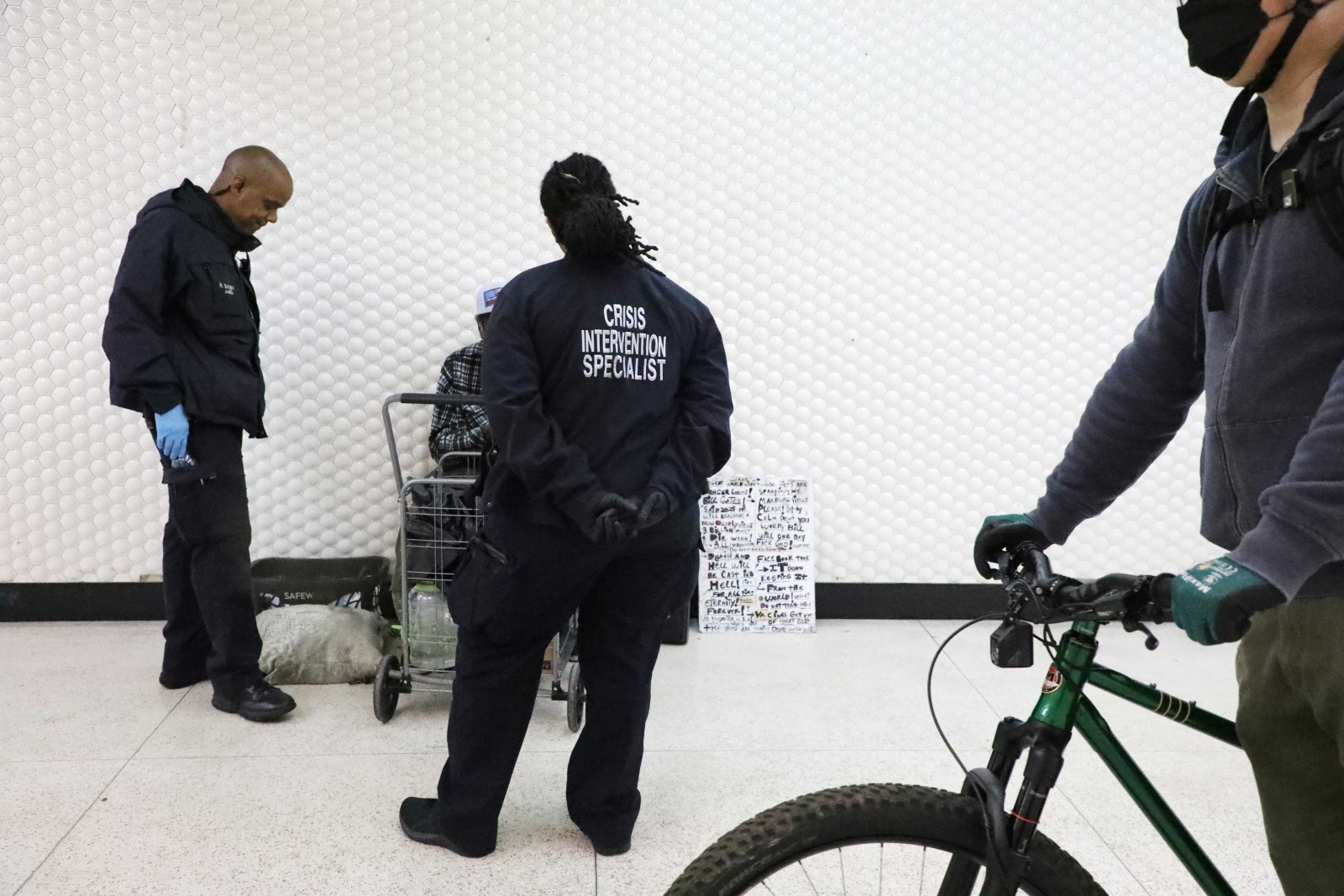 BART crisis intervention specialist Rahman Bagby, left, and other ambassadors speaking to an unhoused person in the Powell BART station in San Francisco. Credit: BART
That quarterly report, released on December 4, 2025, shows that police dispatch deployed a crisis intervention specialist — an ambassador — 206 times between July and September of last year. But that number is the tip of the iceberg. Another metric, Calls Diverted, tallies how many times a specialist deals with a situation on their own that would have previously gone to police dispatch, and was 2,591 for the quarter.
The report said that La Familia and Bay Area Community Services receive the most referrals from BART ambassadors among Alameda County providers.
Previous work by UCLA researchers on transit ambassador programs that focus on the unhoused found that these programs are typically more successful at providing referrals than police are.
In one 2021 study, scholars found that ambassadors had greater expertise on the needs of unhoused individuals and that the programs had cost-sharing benefits. “These collaborations focus on connecting those experiencing homelessness to the broader social service system, beyond what operators directly administer, which can better deliver assistance and support,” the researchers wrote.
A December 2025 study, focused on the Los Angeles-area Metro system, found that ambassadors spent the majority of their time de-escalating, administering Narcan to prevent overdoses, and orienting riders. They also found that while the ambassadors appeared to be “making a positive contribution to the system,” the program still needed many improvements, including training in conflict resolution.
“The contractor model, while quick to implement and iterate, created some employment drawbacks during the pilot phase, such as paying below living wages, lack of on-the-job resources, and reports of strenuous working conditions,” the report summary stated.
We asked BART spokesperson Alicia Trost whether the agency had created its own reports on the ambassador program, given that it is now one of the oldest in the country. She said there were no analytical reports but the agency did provide data in every quarterly BART report as a performance measure.
One of the most eye-popping pieces of data we saw from the last two years of reports is the number of wellness checks made in the winter months by these specialists. Between January and March 2024, ambassadors conducted 3,593 wellness checks, and during the same time period a year earlier, they conducted 4,195.
A body of research has established the deleterious effects of police encounters with people color, especially Black people, so any program that seeks to reduce the number of these encounters is likely to lead to reduce such negative outcomes. A report last year from the Center for Policing Equity, a Yale nonprofit research center, found that BART’s own police officers and other fare enforcement operations were having a detrimental effect on Black and Brown and low-income riders, by making them feel less safe.
At the conference on Friday, one of the agency’s crisis intervention specialists, Rahman Bagby, who said he’d worked as a train driver before, said he appreciated being part of a program he saw as “compassionate.”
“Many individuals we encounter face housing insecurity, substance use disorder, and mental health challenges,” Bagby said. “Those struggles make them human. We meet people with humility and end every contact with respect. Safety is a civil right, and everyone’s civil rights should be respected.”
AC Transit director Joel Young said at the conference that if the bill passes, the agency would seek to hire unarmed ambassadors on its bus-rapid transit line that runs from downtown Oakland through International Boulevard to San Leandro.
“*” indicates required fields