
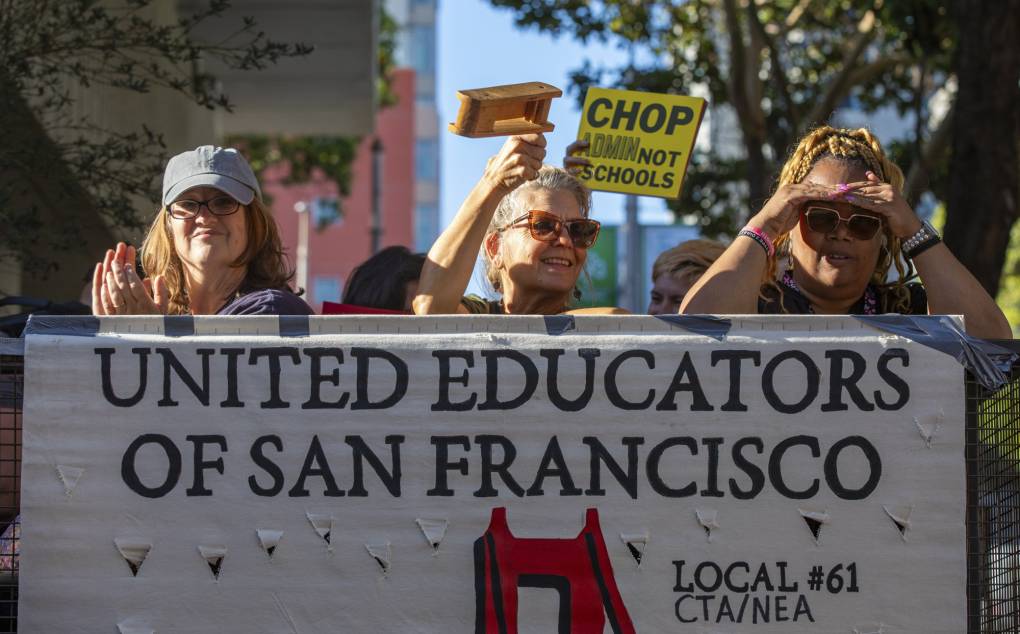
In 1979, then-Mayor Dianne Feinstein was integral to negotiating the end of the strike. Logan said city officials would likely also feel the heat to get involved this time around. “Your local elected politicians are going to feel huge pressure first to try and avoid a strike, and then if a strike were to happen, to make sure that it’s over as quickly as possible,” he said.
Mayor Daniel Lurie told KQED’s Political Breakdown last month that he was not involved in the negotiations but would step in if Su requested his office’s support.
The 1979 strike finally ended with a deal for a 15.5% wage hike and promise to rehire 700 teachers — close to the 15.7% raise and promise to rehire all teachers that the union initially proposed.
Logan said if a strike comes to pass in 2026, he similarly expects to see “the school district moving closer to the position that the union is asking for.”
“If a strike were to happen, within days, politicians would be saying, ‘This has to end,’ and school district officials would be under enormous pressure to bargain a settlement with the union,” Logan said.
Can children technically attend school during a strike?
Yes, they can — unless schools are closed. And according to SFUSD, closures can only happen if the Board of Education authorizes Su to enact them.
On its website, SFUSD describes closing schools as “a last resort,” but it says they’ll be necessary if the district “cannot safely operate schools during a strike.”
If your child were to attend school during a strike, they would be supervised, but the statewide California Teachers Association union said the replacements watching them may be “unqualified” as educators.
If parents support the strike, how can they show it?
UESF’s Hutchinson-Szekely said that parents have “so much influence,” especially when emailing or calling school board members and district leadership.
Parents can also attend school board meetings on Tuesday nights and speak during public comments.
Another way to show support for the strike, Hutchinson-Szekely said, is by leaving positive comments online or by sending an encouraging message to a union member, she said.
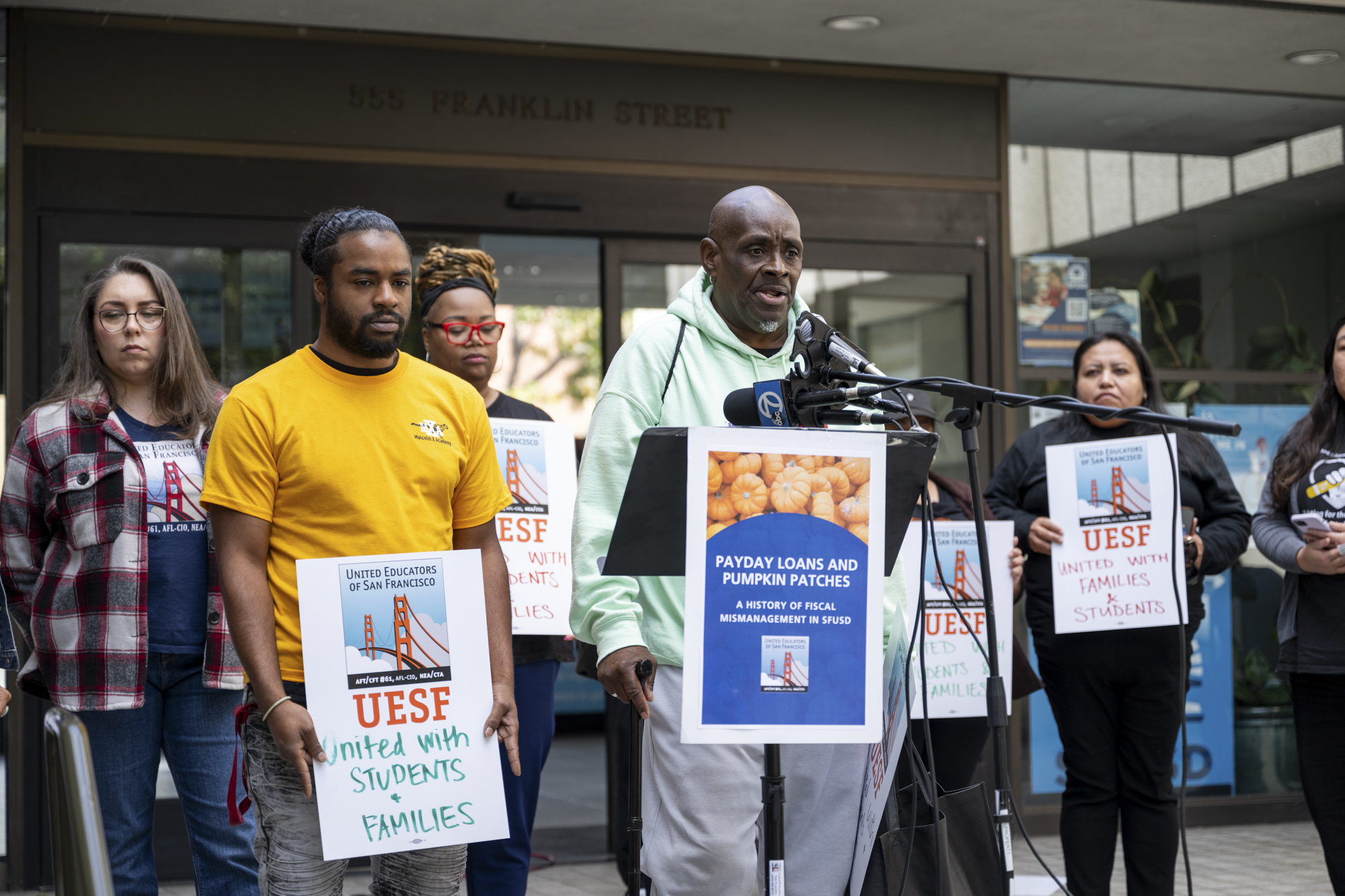 Glen McCoy, a grandparent of two San Francisco Unified School District students, speaks during a press conference held by the United Educators of San Francisco outside of the district offices in San Francisco on Sept. 16, 2024. (Beth LaBerge/KQED)
If there is a strike, UESF says all members of the public — including parents — are welcome to show up in person and contribute in various ways. For example, UESF is seeking volunteers to “adopt a picket” at a school they’re connected to, and perform tasks such as coordinating food and drink deliveries for picketers, collecting donations and providing child care support.
Hutchinson-Szekely also encouraged families to talk to students about “what it means to be in solidarity with the staff.” She said this may involve instigating conversations about how schools operate, and talking with children about how “chronic underfunding and understaffing are more disruptive in the long term.”
“We’re just hoping that kind of discussion can happen within families, and emphasizing that the inconvenience is temporary,” she said. “But the impact of under-resourced schools lasts for years.”
What does ‘crossing a picket line’ actually mean?
Families sending students to school during a strike
The CTA says that as a parent or guardian, “you’ll have to decide if you want your child in this environment” of a school that’s in the middle of a strike.
“A strike is most powerful when students do not attend school, because this puts financial pressure on the district to negotiate with educators or lose more money from the state,” the statewide union’s guidance for families reads.
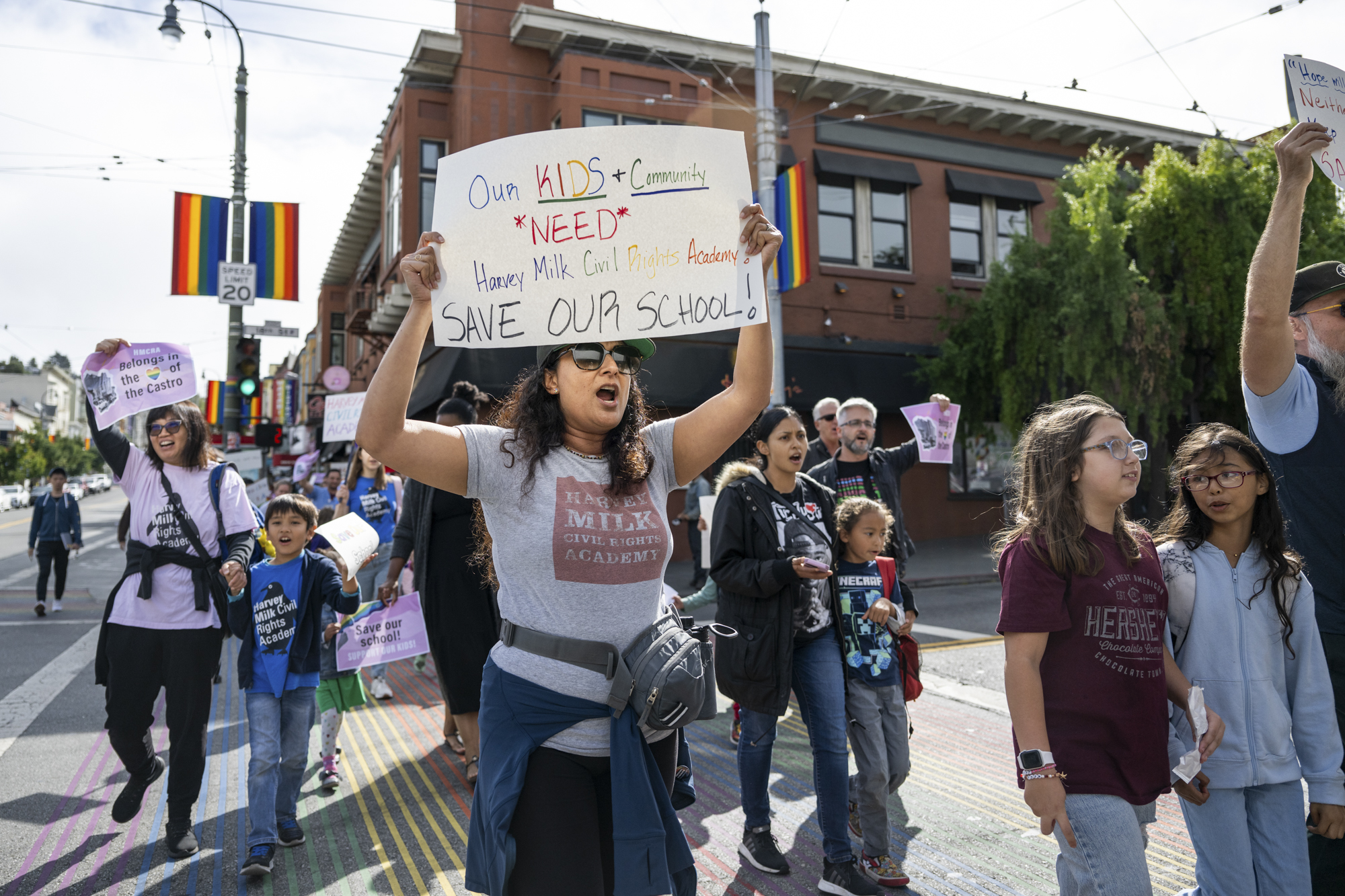 Monica Becker (center), a parent of a former student, marches alongside teachers and students from Harvey Milk Civil Rights Academy to Harvey Milk Plaza in the Castro neighborhood of San Francisco on Oct. 9, 2024, to protest against the potential closure of the school. (Beth LaBerge/KQED)
Volunteers teaching in schools during a strike in the absence of teachers
The National Parent–Teacher Association guidance to local branches also states that “PTA should not man the classrooms” unless “possibly for a day in the absence of advance notice of a strike.”
“Not only is manning of classrooms inconsistent with PTA efforts to obtain a qualified teacher in every classroom, but personal liability may be incurred,” the notice reads. “If the school administration intends to keep the schools open during a teacher walkout, it should develop a corps of volunteers outside the PTA structure.”
What options do working families have for child care during this time?
If San Francisco schools close because of a strike, parents could end up in a logistical bind when it comes to their children. And right now, options for additional child care aren’t certain.
UESF has invited parents to bring their children and join picket lines, and the union also said it is in contact with community partner organizations that are “assessing their capacity” to expand child care offerings throughout the school day.
The San Francisco Beacon Initiative works with local nonprofits — including the YMCA of Greater San Francisco and the Boys and Girls Club — to run after-school programs at 27 SFUSD schools, including all of the district’s middle schools and its highest-need elementary schools.
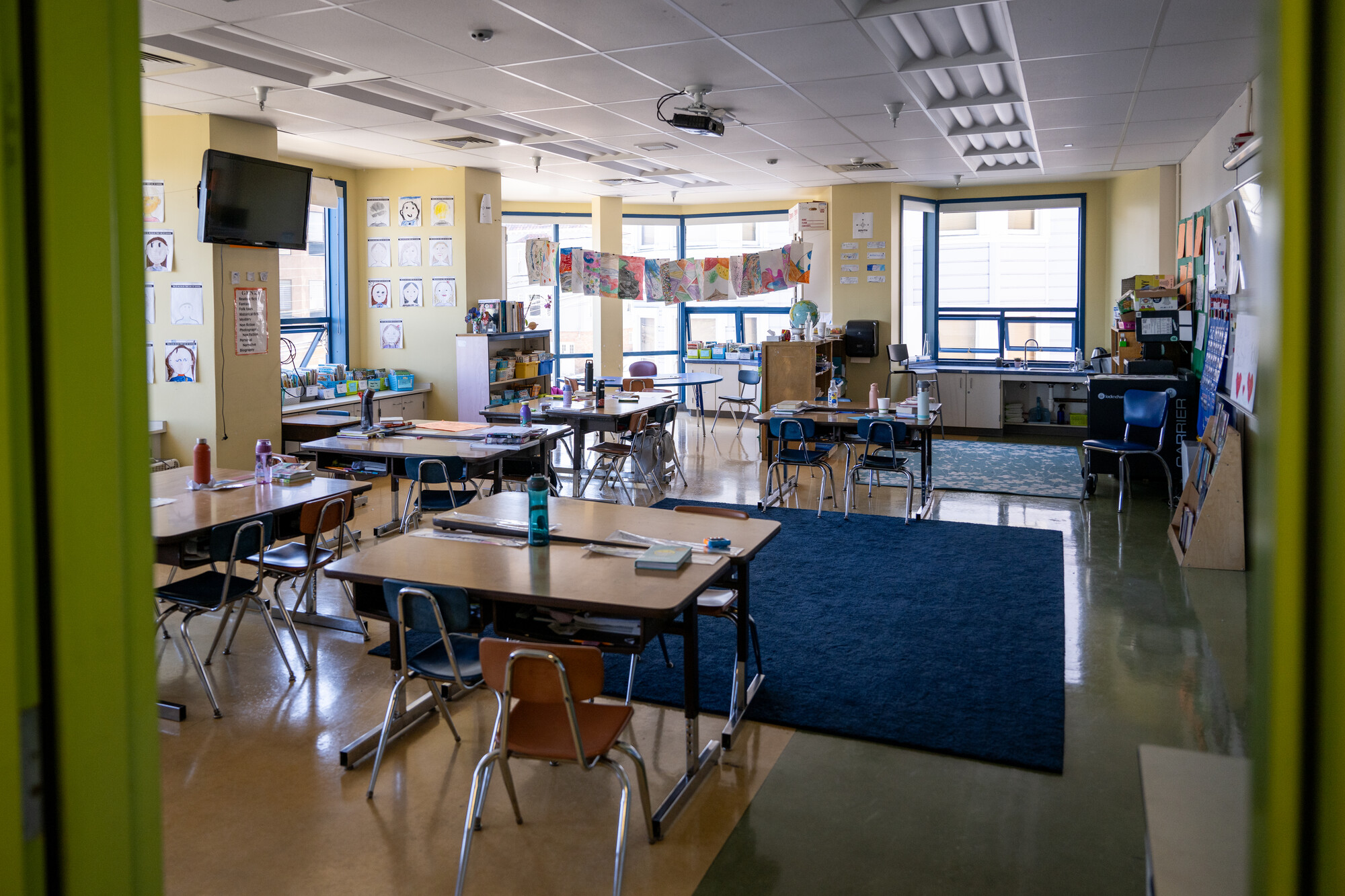 A classroom at Yick Wo Alternative Elementary School in San Francisco on Oct. 23, 2024. (Beth LaBerge/KQED)
Sally Jenkins-Stevens, the Beacon Initiative’s executive director, said that all these partners are looking into the feasibility of offering all-day care for students, though any services they can provide would likely be for some of the children already enrolled in their after-school programs.
So far, only Real Options for City Kids, which operates at Visitacion Valley elementary and middle schools, as well as El Dorado Elementary School, has confirmed that it can extend its care. And that’ll be a fraction of its students — about 40, compared with the 300 they provide after-school programming for, according to Jenkins-Stevens.
Other organizations, she said, are simply limited by space. Many use campus facilities, and it’s unclear whether they would be able to access those if schools close.
The Boys and Girls Club, which runs Malcolm X Academy and Carver elementary schools’ programs, is looking into using its clubhouses, said Jenkins-Stevens — and other partners could explore using city libraries or recreation centers, like they did to operate “community hubs” during the COVID-19 pandemic.
UESF said it is also looking for churches, libraries and recreation centers that could open up facilities, and it might rely on community organizations, parent leaders and educators to operate them.
What about families who rely on free meals at school?
So far, the district has not said how it plans to handle breakfast and lunch distribution.
For children who participate in after-school programs, San Francisco’s Department of Children, Youth and Their Families provides daily snacks and suppers, and it has already asked its partner organizations if they can serve as meal distribution sites in the event of a strike, according to Jenkins-Stevens.
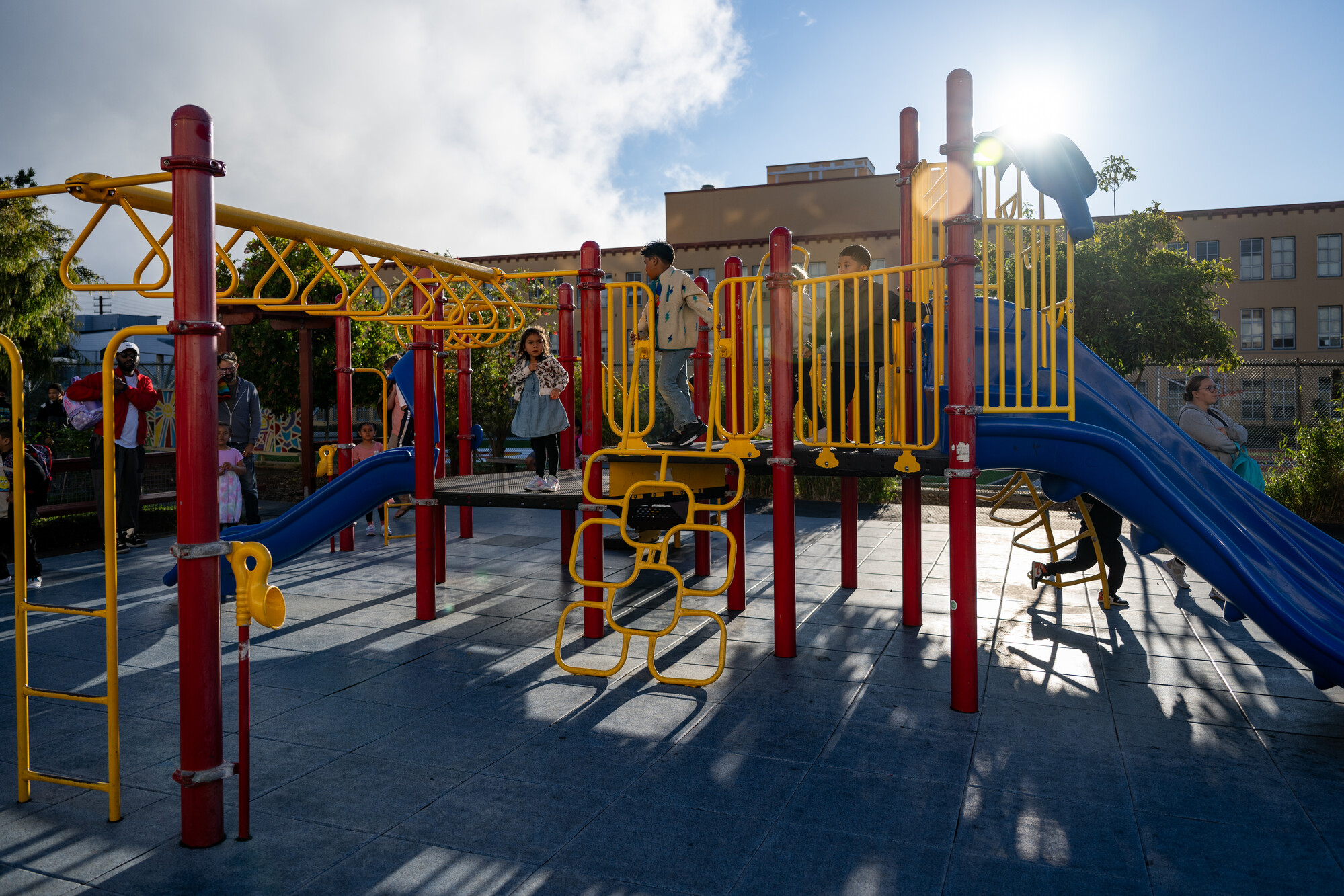 Students at Sanchez Elementary School in San Francisco arrive for their first day of the school year on Aug. 18, 2025. (Beth LaBerge/KQED)
KQED has a thorough guide on how to find and use a food pantry near you in the Bay Area, including San Francisco resources like:
San Francisco County also provides some food assistance, including:
KQED’s Carly Severn contributed to this report.