
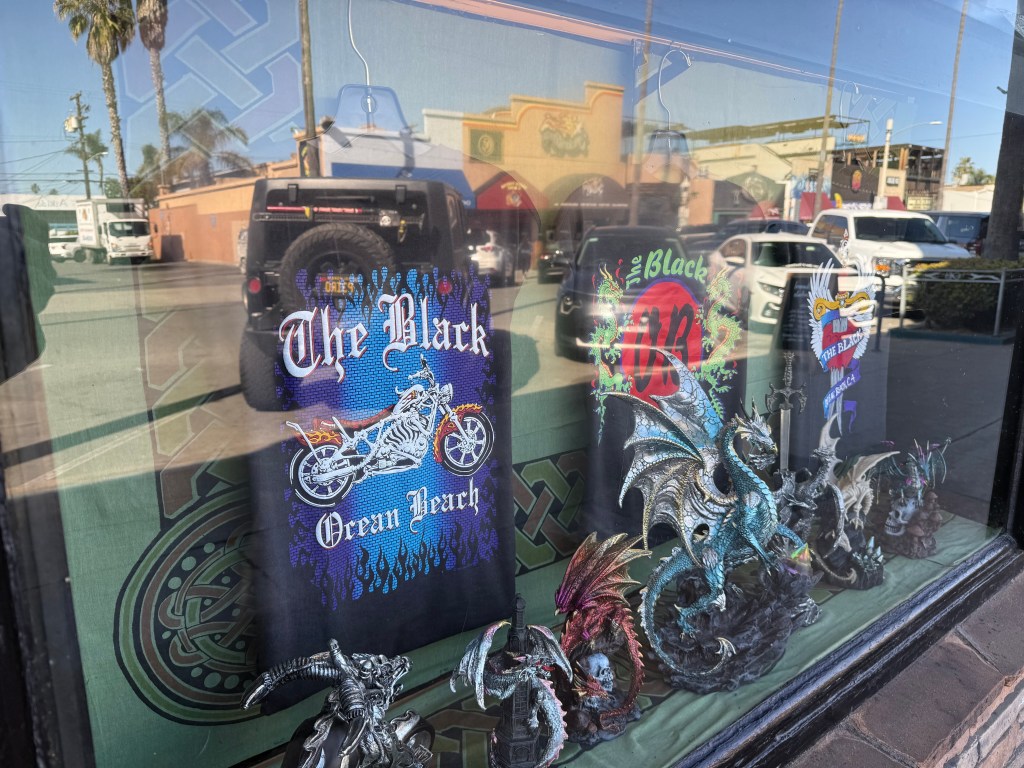
The Black is closing.
For OBecians and many other San Diegans, these words need no explanation. But for any reader who does, here is the rundown. The Black is an Ocean Beach store that opened 57 years ago and became a hub of, and symbol for, resistance. As a Target moved in down the street and as real estate prices jerked up, The Black continued to sell the goods that made it increasingly unusual in a changing neighborhood.
These goods include tobacco and other kinds of smoking paraphernalia, flip-flops, decor, OB T-shirts, salty bumper stickers, Buddha and Ganesha figurines, incense, tie-dye everything.
No longer.
Its owner, Kurt Dornbusch, announced this week he is retiring and closing the store. “After 57 years in OB, Kurt is officially retiring, closing this chapter with deep gratitude for this community,” the store’s social media post said.
It was a decision he was mulling over for several years, as suggested by a 2024 report in the Point Loma OB Monthly. “Dornbusch, who is about to turn 63, said he’s starting to think about retirement, although he has no successor in mind.” He started working at The Black in his teens and became the owner in 1981, about five years in.
“I’m looking to get it all in order,” he told that reporter. “I still love working here.”
On Tuesday morning, Dornbusch was too busy for an interview or even to answer questions, instead focusing on his customers. A few people had popped in for the first time to see the landmark in person — and were surprised to hear it will be closing — but the majority were there to pay homage, shop the 40% off closing sale or stock up.
Shannon Lamoureux, 48, was standing outside, taking it in before stepping inside. She planned to shop for jewelry, plus a souvenir for a friend. A beanie, perhaps. She was more than a customer. Since 2020, she has been a vendor, making water pipe pokers and roach clips and selling them there.
“I came to thank him,” she said, of Dornbusch, whom she called her No. 1 customer. “He was a big part of my business.”
Lamoureux grew up in San Diego and used to come to The Black with her parents when she was a girl.
“It’s kind of a staple of Ocean Beach, you know? When you think of Ocean Beach, you think of The Black,” she said. The Black, she said, might be even more famous than Ocean Beach itself.
Inside, the vibe wavered between hope and resignation, or, to invoke The Dead, somewhere between “Hang it up and see what tomorrow brings,” and “Although the stars have shifted, we’re not lost / The westward rolling breeze decides our course.”
One of the shoppers made his own poetry. “Everything comes and goes. Nothing is permanent. Everything changes,” said Jonathan Castro, a 40-year-old artist who goes by the name Juda Lynx. “It’s time for movement and change on earth, you know?” Amid “cataclysms,” Castro views The Black as one of the “jewels.”
“It’s peace. It’s welcoming. It’s non-judgment,” he said.
Some shoppers wondered aloud why the store was closing, even if the owner is retiring. Was the lease up? Does Dornbusch rent or own the space? And they wondered what will replace it.
Castro said he hopes for something “at least at the same frequency, or higher.”
Another man who was buying two Grateful Dead stickers, a longtime Ocean Beach resident who is about as old as The Black and who shared only his first name, Boyd, because he did not want to anger his neighbors with his comments, said he hopes the space will not stay vacant.
“What I don’t want in OB is another dead space that no one rents. Newport is full of those,” he said. “The rent’s too high on Newport Avenue.”
Seeing The Black close is a reminder of how much Ocean Beach has already changed, he added. “We’re gentrified. When a house costs $5 million, $4 million, $3 million, and everybody drives around in Teslas and flips you off for driving 25 on the street, OB is not the cool OB that it was, even 15 years ago. Let alone 20 years ago. We’ve changed. Money talks.”
The shop’s last day is undetermined. An employee said staff were told it would close in about a month, but as she eyed the 40-something-person line that wove around the racks and shelves, she reconsidered.
“At this rate, I don’t know.”
Staff reporter George Varga contributed to this report.