
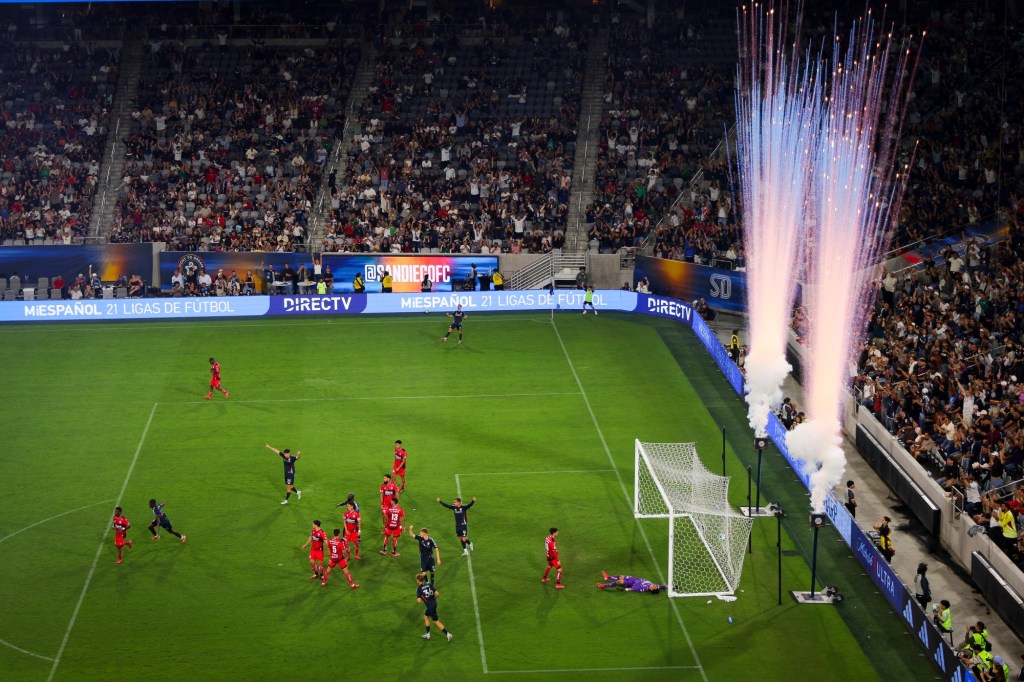
Forty-four years after equestrian events were held on what is now Fairbanks Ranch Country Club’s golf course, the Olympics will return to San Diego as part of the 2028 Summer Games in Los Angeles with soccer matches at Snapdragon Stadium in Mission Valley.
LA28’s announcement of group stage and knockout round venues for the men’s and women’s tournaments was made in an emailed release at 4 a.m. Tuesday and followed by a noon press conference at the stadium.
“This is a huge moment for our city and everyone who believes in the unifying power of sports,” Mayor Todd Gloria said at the Snapdragon event. “San Diego is ready for the world stage. We are a sports city, we are a soccer city and we are without question a global city.”
No specifics were revealed – which games or which gender – only that stadiums in six cities have been added to Pasadena’s Rose Bowl, which will host both finals: San Diego, San Jose, St. Louis, Nashville, New York and Columbus, Ohio.
The match distribution per venue is expected to be announced in April, when tickets go on sale, although the tournament draw won’t take place until a few months before the competition.
The ideal matches for Snapdragon would be the women’s semifinals, since the women’s tournament, which features full national teams, is considered more prestigious in the Olympics than the men’s, which is an under-23 tournament except for three overaged players per team.
There’s a chance that could happen, since organizers said the plan is for teams to start east with group play and progressively work their way west to minimize travel. PayPal Park in San Jose holds only 18,000, presumably making 35,000-capacity Snapdragon Stadium the more viable venue for the high-profile women’s semis.
The downside of the semis is that it would likely mean fewer foreign visitors infusing money into the local economy as opposed to the group stage, since fans won’t know if their team advances that far until a few days before.
“We’ll get what we get, and it’s going to be fantastic,” said SDSU athletic director John David Wicker, who served as logistics manager at the University of Georgia’s Sanford Stadium during the 1996 Olympic soccer tournament. “I think it will be later in the tournament, obviously, since we’re so close to L.A. But what exactly that is, I don’t want to speculate.”
In 2028, the women’s tournament will expand to 16 teams while the men’s will shrink to 12, part of a campaign to achieve gender equity among the 15,000 athletes at the 2028 Summer Games.
The 2024 Olympics used a similar format, with the finals and bronze medal matches in Paris and everything else in six other venues spread across France.
Initially, speculation was that the 2028 group stages and knockout rounds would be restricted to the West Coast to keep athletes in the same time zone as the Los Angeles Games. Tuesday’s announcement expanded the tournament 2,500 miles east.
“Bringing Olympic football group stage and knockout matches to stadiums across the United States means more fans will witness this global event and experience the Olympic spirit firsthand,” Shana Ferguson, LA28 chief of sport and games delivery officer, was quoted in the news release.
It comes, though, at the expense of the full Olympic experience for the athletes themselves. Part of the fun is walking in the Opening Ceremony, living in the Olympic Village, eating in the dining hall with fencers and rowers, attending other events when yours is completed, soaking up the host city’s atmosphere with your family.
All six additional venues are Major League Soccer stadiums. All are relatively new or, in the case of New York, still being built. Snapdragon Stadium, which also houses the NWSL’s San Diego Wave, opened in August 2022.
“My guess is they saw what we saw,” said Tom Penn, the CEO of MLS expansion franchise San Diego FC. “When we came and evaluated this market from afar, we just saw that something special happens with soccer and this community.
“We went through a very diligent process to define our brand and define how we could become authentically San Diego’s team, and all the research we did came up with one statement: Soccer thrives in San Diego.”
Because of potential sponsorship conflicts, stadiums will be identified by their location during the Olympics. So, San Jose Stadium instead of PayPal Park and San Diego Stadium instead of Snapdragon Stadium.
It’s a back-to-the-future moment for Mission Valley. The previous football and soccer venue there, opened in 1967, was originally called San Diego Stadium. It was renamed Jack Murphy Stadium in 1981 after the local sportswriter who lobbied for its construction, then Qualcomm Stadium in 1997, and SDCCU Stadium from 2017 until its demolition in 2020.
FIFA, soccer’s international governing body, and the Los Angeles Olympic organizing committee will take control of the venue several weeks before, covering existing sponsorship signage (including the Snapdragon Stadium signs) and replacing it with Olympic-themed décor.
Wicker said all sponsorship contracts included clauses allowing marks to be covered if the stadium hosts major events like the Olympics or World Cup.
Normally, carving out several weeks with no events would be difficult in the summer. But MLS is shifting to the international calendar in 2027, and the July 14-28 Olympics would fall at the start of the 2028-29 season. The NWSL is expected to take a midseason break, since dozens of players will be on Olympic rosters.
Registration for the initial Olympic ticket lottery is open now through March 18. The first ticket drop is scheduled for April, although there is some confusion as to whether that will include events outside of Los Angeles.
“From day one, we said we wanted to build a stadium for the entire community of San Diego,” SDSU’s Wicker said. “We wanted all of the events that you could possibly get. … We built this building to bring not only local events but international events, concerts, dirt shows, all the events so our community had a place to come together and celebrate what we are, who we are, and also have the world come to us and celebrate as well.”