
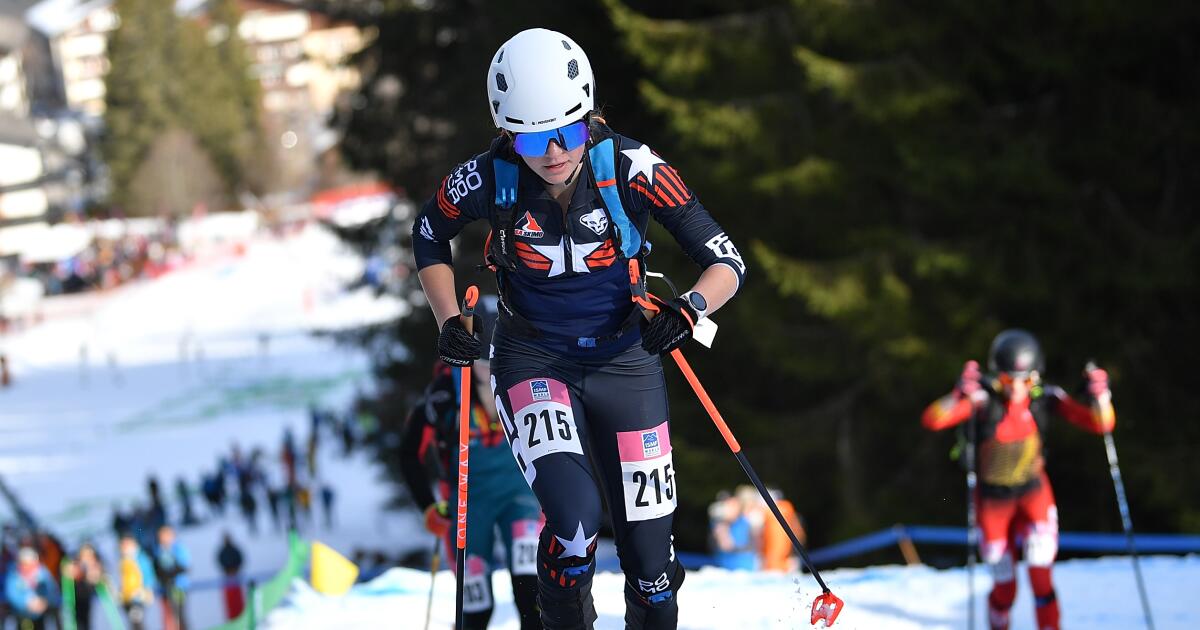
MILAN — The only new sport at the 2026 Milan-Cortina Olympics has rustic roots.
Ski mountaineering, often referred to as “skimo,” combines two disciplines that have been around since people started strapping boards to their boots to schlep through the snow, both up and down hills as quickly and efficiently as possible.
The Olympic version is a fast-paced race that typically lasts three to four minutes. It’s a combination that consists of an ascent with skins — grippy, removable strips competitors use on the bottom of their skis — a section of steep terrain in which competitors carry their skis, and a final fast descent on a manicured, gate-marked slope featuring jumps, bumps and banked turns.
In a sense, it’s skiing without chairlifts.
“It attracts those who enjoy physical suffering,” said Sarah Cookler, head of sport for USA Skimo. “There’s definitely a mental attitude that goes along with that.”
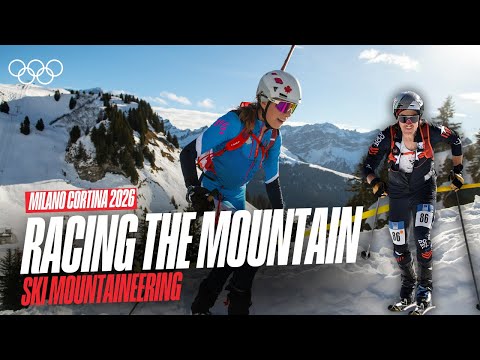
The men’s and women’s sprint competitions take place Feb. 19 at the Stelvio Ski Centre in Bormio, with each field consisting of 18 competitors who race in three heats of six. The top three from each heat, plus the three fastest who didn’t automatically qualify, advance to the semifinals. Those races consist of six competitors each. The two fastest from each semifinal — plus the two next-best times — move on to the six-racer final.
The athletes climb approximately 230 feet in elevation on the ascent portion of the race — about 2½ times the elevation gain of “Heartbreak Hill” in the Boston Marathon.
“What’s unique to ski mountaineering is having the skill and fitness to descend while you’re tired, fatigued and hypoxic,” Cookler said.
On Feb. 21, the second-to-last day of the Olympics, there will be a skimo mixed relay with 12 teams from 12 different countries. Teams of male and female competitors will race on longer courses than the sprints, with two ascents and two descents. Each member of the team will take two laps on the course, in alternating order.
Equipment plays an important role in skimo. Whereas cross-country skis are long and narrow, the skimo version are almost like kids’ skis — up to 150 centimeters for women and 160 for men. The boots are ultra-light and carbon, with a single lever that switches each from walk mode to ski mode (so they have an alpine-skiing rigidity for the descent). The bindings allow for toe-only attachment on the climb, and heel lockdown for skiing down the hill.
The skins feature synthetic fibers that allow for smooth sliding in the forward direction, but provide grip so the skis don’t slide backward. At the top of the climb, competitors remove those and put them away with the speed and efficiency of a NASCAR pit crew.
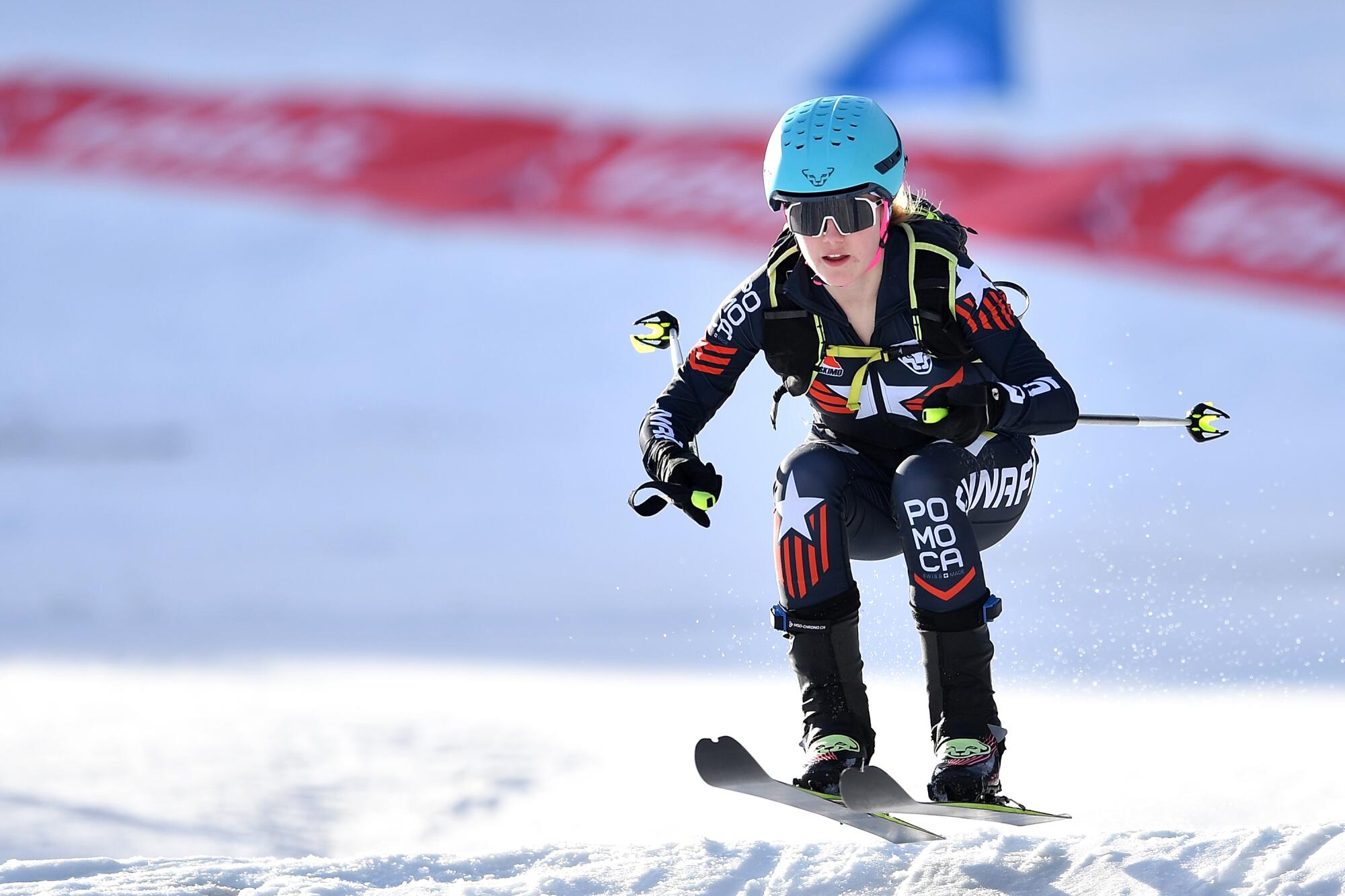
Leys Carson of the United States competes in the ISMF ski mountaineering world championships in March 2025.
(Valerio Pennicino / Getty Images)
A realistic finish for the U.S. team would be in the top 10, with potential for a top-five performance. The strongest countries tend to be France and Spain.
It’s a beastly undertaking, even though the Olympic course is a scaled-down, spectator-friendly version of much more grueling skimo courses. The traditional skimo format is an individual racing against the clock, not in a cluster of competitors, and courses have elevation gains typically ranging from 1,640 to 2,300 feet. The descent is often in out-of-bounds, ungroomed areas, which tend to be much more challenging to navigate.
“Anytime a sport gets Olympic inclusion, it helps bring visibility and growth,” Cookler said. “We’d love to see the longer disciplines included in the future.”
U.S. Olympian Cam Smith described the longer versions as a “more in-wild-mountains-off-the-ski-resorts event where you’re climbing up and skiing down in wild places and on technical ridges, on peaks, couloirs, all that good stuff.”
Speaking to Nick VinZant on the “Profoundly Pointless” podcast, Smith explained: “You might use crampons. You might use ice axes. You might have roped sections where you’re traveling on a rope in a more exposed area. … It’s definitely a wild mountain sport.”
The modern version of skimo was popularized in the 1980s and got a boost in the 1990s with the advent of the European championships. The first world championships were held in France in 2002. Five years later, the International Ski Mountaineering Federation was founded, and that organization has been recognized by the International Olympic Committee.
“Every gold medalist will be the first gold medalist,” Smith told the podcast. “Every silver medalist will be the first silver medalist. Everyone on the start line will be part of the sport in the Games.
“It will be really exciting to show to the world for the first time.”