
For The Union-Tribune
Soup with benefits. That’s how I like to think of these three recipes from the new restaurant Cherryfish in Pacific Beach, helmed by executive chef Marcus Twilegar. We’re deep into soup season right now, and it’s also almost time for Super Bowl parties, where finger food is everything. Serve them together and you’ll have blissed-out guests.
The soup in question is the richest miso soup you may ever have enjoyed. It’s related by name only to the salty, tofu cube-studded broth you usually get at middling sushi restaurants or just-add-water packets in grocery stores. Twilegar’s miso soup is matched by two finger-food dishes you’ve probably also developed familiarity with: edamame and shishito peppers. But these are a level above. In separate but joyful ways, they are distinctive flavor bombs. And all three dishes have the added benefit of being very easy to make.
Both Twilegar and Jan Tejada, his chef de cuisine (and longtime BFF) are Filipino and their food is strongly influenced by the Filipino flavors they grew up with.
 Chef Marcus Twilegar of Cherryfish in Pacific Beach enhances his miso soup by deploying two flavor-bomb finger foods alongside it. (K.C. Alfred / The San Diego Union-Tribune)
“Back in the day the Japanese invaded the Philippines, so a lot of the Philippine food is based off that and Spanish food,” Twilegar explained. “So, for us, it was easy to implement some of those flavors into our food. We love chili garlic crunch and put it on pretty much everything we eat. We eat silog bowls, which is rice and leftover meat. Basically, here we just elevate something we eat daily.”
Let’s start with the appetizers. Twilegar and Tejada have created an edamame dish that, if it were more difficult to make, would still be worth it for all the spicy, earthy crunch. And as much as you may love chili garlic crunch, wait until you get the umami of black garlic paste wrapped in it.
You start with cooking the edamame. Use fresh if you can find it. Frozen is available at most grocery stores. Just boil the edamame in a large pot of water and then strain the pods and place in an ice bath for about five minutes to stop cooking. That also gives them their glorious bright-green hue. Then you make the sauce — a mix of chili garlic crunch (Twilegar prefers S&B Crunchy Garlic with Chili Oil, but you can use your favorite) with black garlic paste and avocado oil.
Now to get the edamame soft but crunchy, so the soybeans jump easily out of the pods, you will need to heat the edamame in a little avocado oil in a pan, then add a couple of tablespoons of water to the pan and cover briefly to steam the pods. All the liquid should be absorbed. Now add your sauce and stir so that every pod is enveloped by the sauce, then serve.
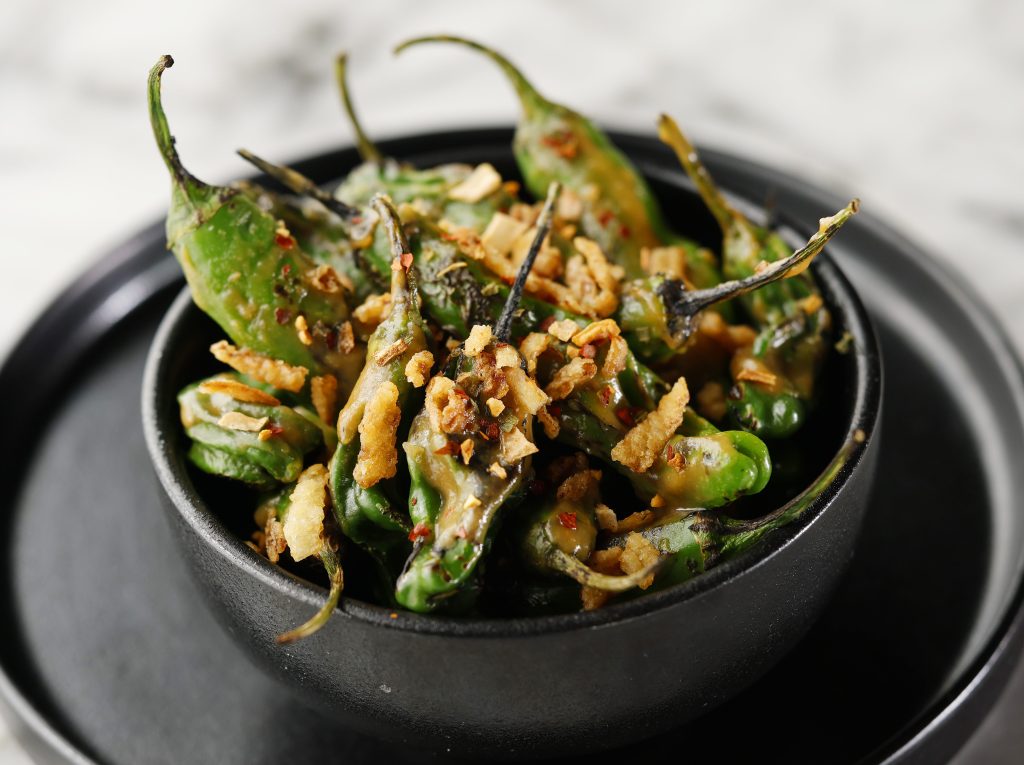
The Miso Glazed Shishito Peppers are just as easy and just as yummy. You may find yourself sucking off all the sauce before eating the peppers — the sauce is that good. If you’re unfamiliar with some of the ingredients, no worries, you can find them at local Japanese markets like Mitsuwa or Nijiya. Shishito peppers are usually mild, but you may find a hot one or two. I’ve seen them on shelves at Trader Joe’s as well as the Japanese markets. Cherryfish’s shishitos are stir-fried, then bathed in a spirited sauce of shiro miso paste, soy sauce, rice vinegar, sugar, sriracha sauce and salt. Honestly, I’d make this sauce to top grilled chicken or salmon, too.
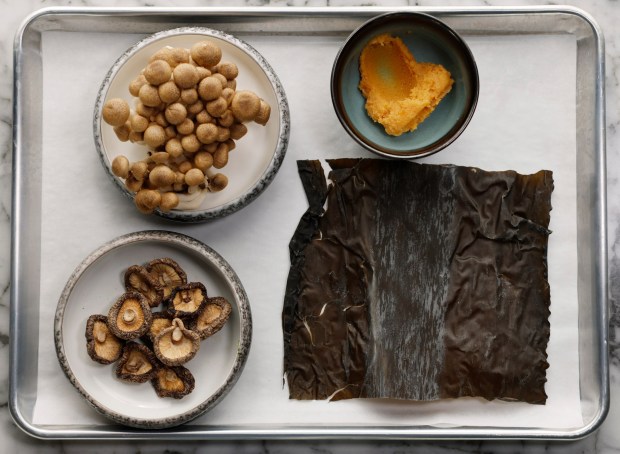 Ingredients for Miso Soup rely on first making a dashi stock: water, rehydrated shitake mushrooms, chopped scallion greens and kombu, edible kelp. (K.C. Alfred / The San Diego Union-Tribune)
That’s where you start — whisking all those ingredients together. Then you prepare the shishitos. You can certainly place them in a hot frying pan or wok with avocado oil and blister them. Or you can do what the chefs do: skewer them and grill them over the fire until evenly blistered. After that, you just place them in a bowl and mix them with the glaze. Looking to zhuzh them up a bit for a party? Top them before serving with those little fried onions you use to top casseroles at Thanksgiving. If you can’t find them in your local market, check 99 Ranch. I see bags of fried shallots there all the time.
Finally, the Miso Soup. Now this is a bit more effort than the edamame and shishitos, but not much, and totally worth it. In fact, you’ll likely want to make a double batch of the dashi — or stock — to freeze and use to make more soup later.
“Dashi is often overlooked by a lot of people,” said Tejada. “It’s like French cuisine, though. One of the main things about French cuisine is they have really great stocks. It allows you to make great sauces.
“Dashi is the same concept. You do dashi right and you’ll have a really great soup.”
In fact, think of it as an ingredient for dishes like braised short ribs or a creamy butternut squash soup.
The dashi is made with water, rehydrated shitake mushrooms (no slicing needed since they’re just for the dashi), chopped scallion greens and kombu.
Kombu is edible kelp that comes in small dry sheets. It provides a deep, savory umami flavor released by cooking. It’s easy to find in Asian markets.
“When you cook with it, make sure it’s dry and very firm,” Twiligar explained. “Then prep it by dipping it in steaming water for a minute to cleanse it. Then it’s ready to rehydrate.”
Heat up the water, mushrooms, scallion greens and cleansed kombu for up to 15 minutes until just before it boils. Turn off the heat and strain the solids. Reserve the stock.
Twilegar add beech mushrooms to his miso soup. Unlike thick and stocky shitakes, beech mushrooms have long, skinny stems and smallish caps. Twilegar marinates them briefly in avocado oil, salt and ground black pepper. Then he stir fries them until they’re lightly toasted to bring out more flavor. Drain on a paper towel and get ready to make the soup.
Fill a pot with all but one cup of the dashi. Use that cup of dashi to dissolve the shiro miso paste. Then add that mixture to the rest of the dashi. Add tofu cubes (be like Twilegar and briefly grill the tofu) and wakame seaweed (a species of kelp with a sweet, strong flavor). Heat it up to just before boiling and it’s ready to serve.
For Tejada the richness of the soup, thanks to the dashi, is that it’s more substantial that what you get in typical Japanese restaurants.
“It’s like a hug, a warm hug,” he said.
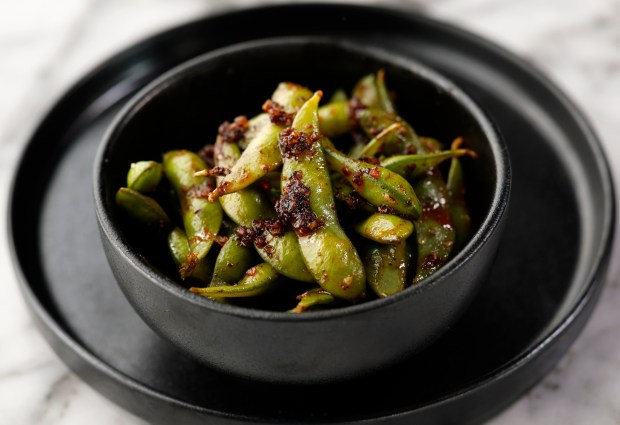 Edamame in Black Garlic Chili Crunch. (K.C. Alfred / The San Diego Union-Tribune)
Edamame in Black Garlic Chili Crunch
Makes 4 cups
INGREDIENTS
2 quarts water
32 ounces fresh or frozen edamame in pod
2 quarts ice water
1/3 cup chili garlic crunch (prefers S&B Crunchy Garlic with Chili Oil, but others are fine)
1 tablespoon black garlic paste
3 tablespoons avocado oil
Salt and pepper to taste
More water as needed
DIRECTIONS
1: Bring water to a boil in large pot. Boil edamame for 5 minutes. Strain and put into an ice bath to halt cooking. Remove from ice bath after 5 minutes or until cool. Set aside.
2: In a bowl, mix chili garlic crunch, black garlic and 2 tablespoons avocado oil. Set aside.
3: In a pan heat remaining tablespoon of avocado oil and add the edamame. Once heated up, splash about 2 tablespoons of water in pan over edamame and cover for 1 minute to steam so the texture — soft but crunchy — is achieved. Add 4 tablespoons of the black garlic crunch mixture. Stir until evenly incorporated. Serve.
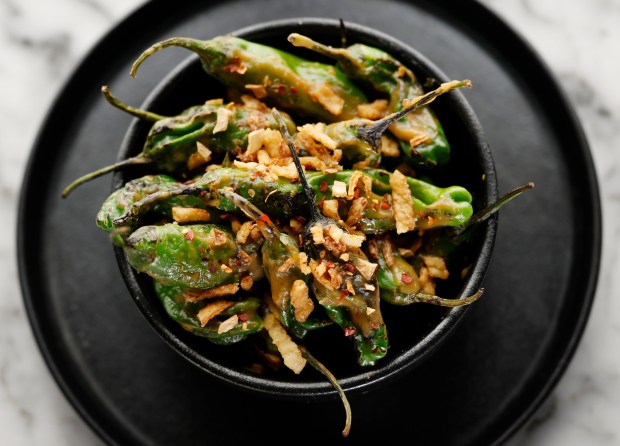 Miso Glazed Shishito Peppers. (K.C. Alfred / The San Diego Union-Tribune)
Miso Glazed Shishito Peppers
Makes 5 to 6 cups
INGREDIENTS
4 tablespoons shiro miso paste
4 tablespoons soy sauce (or tamari)
2 tablespoons rice vinegar
2 tablespoons sugar (or maple syrup or honey)
1/2 teaspoon sriracha sauce or fermented chili sauce
1/2 teaspoon salt
1 pound shishito peppers, washed and patted dry
4 tablespoons avocado oil
Salt and pepper to taste
Crispy onions or shallots for garnish (easy to find at 99 Ranch Market)
DIRECTIONS
1: Make the glaze: In a bowl, whisk together miso, soy sauce, vinegar, sugar, sriracha and salt. Put in a storage container.
2: Make the shishitos: Place frying pan over medium high heat. Heat 4 tablespoons oil. Add the shishito peppers. Stir well to blister evenly.
3: Once you attain your desired blister level, pour in the glaze. Mix it well until your desired consistency. Season with salt and pepper to taste. Serve on a platter for sharing.
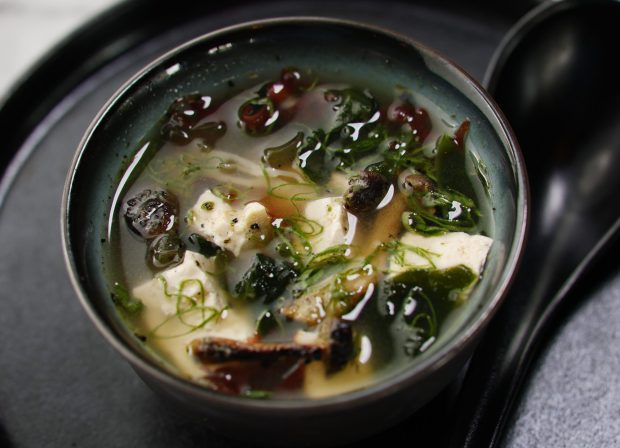 Miso Soup. (K.C. Alfred / The San Diego Union-Tribune)
Miso Soup
Makes 4 to 5 cups
INGREDIENTS
5 cups water
8 pieces dried whole shiitake mushrooms, rehydrated in cool water until soft
4 tablespoons finely chopped scallion greens (keep the whites for the dashi)
1 sheet kombu
1 cup brown beech mushrooms, sliced from the stems
2 teaspoons avocado oil
1 teaspoon salt
1 teaspoon ground black pepper
1/4 cup shiro miso paste
1 cup soft tofu, cut into 1/2-inch cubes
2 tablespoons dried wakame seaweed
DIRECTIONS
1: Make the dashi: Add 5 cups water to a pot. Add rehydrated shiitakes, scallion trimmings and kombu. Put on medium heat for 10 to 15 minutes until just before the water boils.Turn off the heat. Strain the solids and keep the dashi stock.
2: Prepare brown beech mushrooms: Marinate mushrooms in 1 teaspoon oil, salt and pepper for five to 10 minutes. Drain the mushrooms and stir fry until slightly toasted. Set aside on a plate with a paper towel.
3: Make the miso soup: Add all but 1 cup dashi to a pot over medium heat. In a separate bowl dissolve all the miso with that 1 cup dashi. Then pour it in the dashi stock. Add the tofu cubes, beech mushrooms and wakame seaweed to the stock. Heat it to just before boiling. Serve immediately in a bowl. Top with scallions.