
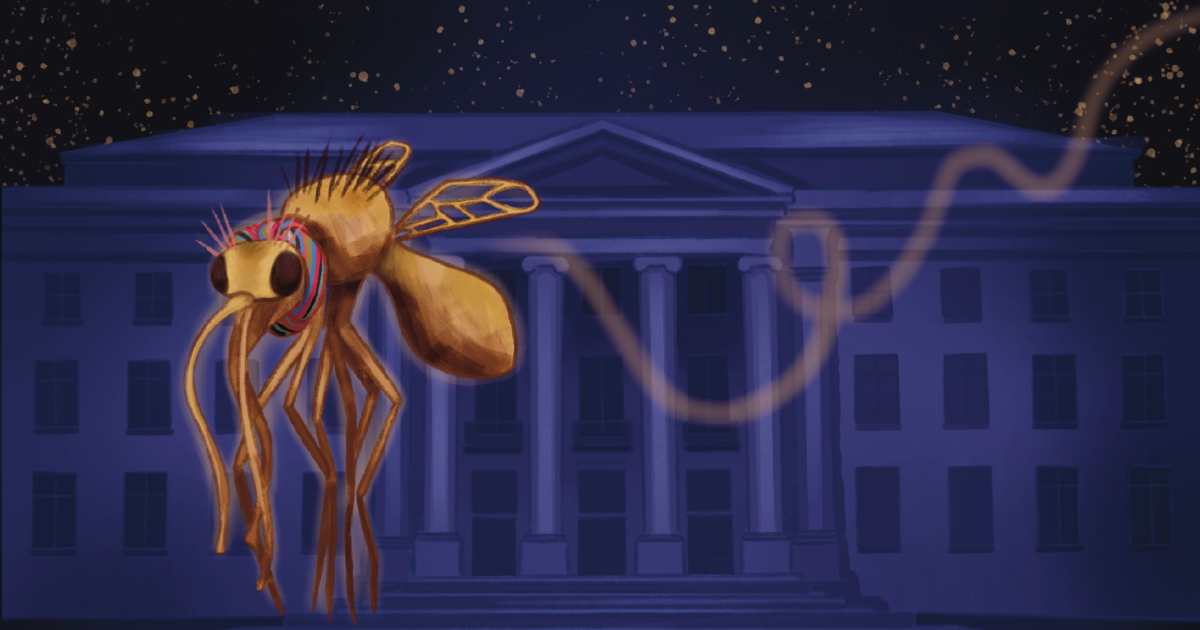
The night before the Turning Point USA, or TPUSA, event Nov. 10, I arrived at Sather Gate and saw a 5-foot-tall cardboard mosquito sculpture.
I was feeling nervous, excited and resolutely opposed to the cruelty embodied by TPUSA’s event, which continued the legacy of a man who claimed that the Civil Rights Act was a “huge mistake,” that trans people are “an abomination” and that the Palestinian ethnicity doesn’t exist. Three fellow would-be art installers and I met to hang the mosquito and, allegedly, put posters on Sather Gate to create a spectacle protesting that dehumanization.
To hang the sculpture, we needed to get a carabiner tied to a ribbon over Sather Gate. I figured I’d attempt a few tosses and get either lucky or disillusioned with my athletic ability, but on my first try, it sailed just over the arch. As we celebrated and strategized about attaching the mosquito, I felt invigorated. I couldn’t stop the TPUSA event or make anyone reject its cruelty, but the university couldn’t make me accept it, either.
They did try, though. That was where the felony vandalism charges came in.
The four of us were arrested abruptly — and, in some cases, roughly. Two out of the group had bruises where the UCPD officers shoved them against the stone wall on the bridge across Strawberry Creek. After about 20 minutes of us sitting handcuffed against that wall, the cops announced we’d be taken to Santa Rita Jail on suspicion of felony vandalism. They also told us that jail was somewhere we should be afraid to go. “You need to learn your lesson,” one said. I was rapidly learning many lessons about the American carceral system, but most were buried under intense uncertainty and fear. I, in turn, tried to bury this under jokes and discussions of classic rock with my acquaintance-rapidly-turned-friend as we rode in the back of the cop car during the drive to Santa Rita.
We arrived around 2 a.m. The intake process was disorienting, and I wasn’t sure what to expect until a cop led me to a cell and I saw four strangers and two of my friends in a roughly 6-by-12-foot space. The floor was covered in trash and oddly colored stains, the metal toilet directly faced the door, which had a window, and the air conditioner was blasting so hard that the cell felt colder than the night outside. That was when I understood the cruelty we were facing.
We didn’t see our fourth friend at first — they were in an isolation cell. They were brought to our shared cell after about two hours, but minutes later I was put in isolation instead. Both of us had told the cops we used they/them pronouns, but only I explicitly said I was transgender, so I assume we were initially mixed up before I was put in isolation under a “protective custody” policy for trans inmates.
I spent the next 12 hours hungry, exhausted and cold. When I changed cells, no one told me I should bring the food I was given when I first entered jail, and I wasn’t given more. The harsh fluorescent lights made sleep difficult, and even through my jacket and long pants, the concrete floor and benches sucked away my body heat. My own shivering kept me awake as I lay down.
I thought about how I was facing these conditions in response to pieces of paper and an attempt to hang a mosquito sculpture.
The severe response to our protest fits a pattern of university repression, which is often harshest against people refusing to accept our institutions’ dehumanization of Palestinians through complicity in Israel’s ongoing genocide. Last semester at UC Berkeley, Peyrin Kao was suspended after going on a hunger striking in support of Palestine; across the Bay, the Stanford 11 were arrested after occupying a campus building to demand their university divest from the Israeli genocide; they now face more than three years in prison, or $329,000 in restitution payments, for alleged damages that Stanford’s facilities director testified were worth less than $10,000.
This punitive approach defines the U.S. carceral system, especially solitary confinement — which more than 100,000 people in the country are enduring every day. My experience was harrowing and barely a fraction of the vast cruelty our institutions accept as routine.
However, I also saw the impact of refusing to accept cruelty. After my fellow arrestees and I were released on bail after 14 hours and 30 minutes, I learned people — many of whom were acquaintances or strangers — had scrambled to locate us in the jail system and contact a bail support organization to get us released. Some waited for hours to meet us with food, water and clothes. In the following weeks, people supported us with everything from groceries to connecting with others who’d been arrested. This solidarity was immensely meaningful, especially contrasted with our treatment by UCPD — and UC Berkeley’s administration, which is putting my three fellow arrestees through disciplinary proceedings.
I graduated last year, so I can speak openly about the case now. The Alameda County District Attorney’s office rejected the felony vandalism charges. But my friends are facing more punishment from the university without any acknowledgement of the inhumane conditions they already endured.
Being arrested was awful. But as much as I remember the cold isolation of a cell, I also think of the electric freedom of throwing a carabiner and the undramatic, but vital, warmth of friends and strangers’ support. As students or community members, we have agency. This was made clear to me after so much of mine was temporarily taken. We don’t need to do UCPD or President Donald Trump’s work for them and silently comply while oppression intensifies. We can refuse to abandon each other and act in solidarity to build a kinder world — across classrooms, jail cells and beyond.