
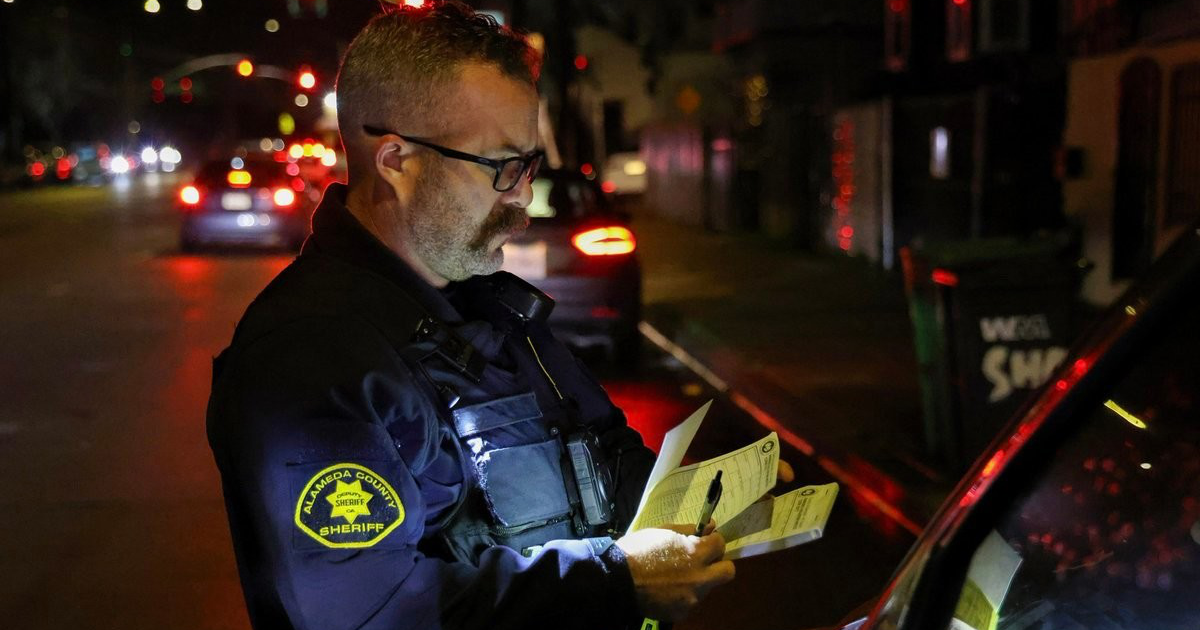
Even as several declare themselves sanctuaries, counties in the Bay Area are sending personal information about incarcerated immigrants to the federal government. In return, they’re getting millions of dollars from the Department of Justice through a program that critics argue violates state law.
In 2024, California counties and the state’s prison system received more than $59.4 million from the little-known State Criminal Alien Assistance Program— more than any other state, and more than the next seven states combined, according to the most recently available DOJ data (opens in new tab). Some Bay Area counties received more money for jailing undocumented immigrants than entire states. From 2015 to 2024, California took in $728 million in SCAAP funding.
According to the Department of Justice (opens in new tab), which administers SCAAP, the program reimburses states and counties “for incarcerating undocumented criminal aliens with at least one felony or two misdemeanor convictions for violations of state or local law.” In exchange, counties must share a list of the name, date of birth, country of origin, and date of incarceration for every person in jail or prison that year. A private company helps the federal government identify undocumented people on the list.
Critics say that cooperation with the feds violates the 2017 California Values Act, which established the “sanctuary state” and bars cooperation with immigration authorities. San Francisco and Santa Clara counties have forgone SCAAP money since 2016.
San Mateo County Sheriff Kenneth Binder, who was sworn in last November, said that although the previous sheriff applied for SCAAP cash, the office “has declined the 2024 award of the grant and has no intentions of applying for future SCAAP funding.”
With the Trump administration’s immigration crackdown in full swing, some Bay Area counties are saying they’ll back out of SCAAP. But even under pressure from residents, other counties don’t appear inclined to give up the free federal cash.
Is it legal?
The federal government created SCAAP in 1994 (opens in new tab), partially in response to California Gov. Pete Wilson’s complaints that the state was forced to pay to jail undocumented immigrants. According to the LA Times (opens in new tab), Wilson threatened to leave a shackled undocumented prisoner on the doorstep of a federal prison if California didn’t receive reimbursement.
In 2024, 35 of the 58 California counties received SCAAP money, along with the state’s prison system.
California has the nation’s largest estimated population of undocumented people: 2.9 million, according to a 2023 Migration Policy Institute analysis (opens in new tab). But its dominance in SCAAP funding is still disproportionate compared with other states that also have large immigrant populations.
For decades after the program’s creation, SCAAP wasn’t controversial in California. To most sheriffs, it was a paperwork chore that came around every September and covered part of the budget. It flew under the radar of pro-immigration activists.
The Obama (opens in new tab), Biden, and first Trump (opens in new tab) administrations all proposed cutting SCAAP. Sen. Dianne Feinstein defended the program and even pushed to expand it (opens in new tab) to cover the cost of jailing undocumented people who were charged with a crime.
When Donald Trump was first running for president, some in the San Francisco public defender’s office noticed SCAAP money came with strings attached.
“There was this pressure and expectation from [Immigration and Customs Enforcement] that you have to work closely with them,” said Angela Chan, assistant chief attorney at the public defender’s office. According to Chan, the feds expected that sheriff departments receiving SCAAP funding would respond to requests to hold undocumented people upon their release from jail so that ICE could detain them. “Under the Obama administration, they were adding more conditions when it came to getting SCAAP reimbursement.”
Chan in 2016 helped convince Mike Hennessy, San Francisco’s sheriff at the time, to pull out of SCAAP. “He was a very reasonable person to work with,” she said. “He shared a lot of our values around immigrant rights.”
Chan went on to help write the California Values Act (opens in new tab). The bill, passed in 2017, sharply limits how much police can cooperate with federal immigration enforcement.
“SCAAP violates the letter of the law,” Chan said. She points to language in the act that prohibits California law enforcement from sharing “personal information … about an [undocumented] individual,” including the person’s name, which is required under SCAAP reimbursement requests.
Nonetheless, millions of dollars pour into the state each year. California Attorney General Rob Bonta said he is committed to upholding the California Values Act while appearing to sidestep the controversy.
“California has made a conscious decision not to assist with the Trump administration’s destructive mass deportation campaign by limiting the use of its resources for federal immigration enforcement — and courts have upheld that choice as a lawful exercise of state power,” Bonta said in a statement. “That said, we are unable to provide legal analysis on participation in specific programs.”
Who even knows they’re in SCAAP?
Some sheriffs have said they didn’t know their counties were receiving SCAAP money. In July 2025, Santa Cruz County’s new sheriff, Chris Clark, said he hadn’t known (opens in new tab) the county participated in the program and pledged to discontinue it.
A representative of the Sonoma County Sheriff’s Office said the county in no way cooperates with the federal government to identify undocumented people. When told that the most recently available records indicate that Sonoma County received SCAAP money, he expressed surprise and said he would look into whether the sheriff still participated in the program. The office did not respond to further requests for comment.
Activists recently pressed Marin County (opens in new tab) and Alameda County to discontinue their participation in the program.
In Marin, activists packed a Jan. 20 Board of Supervisors meeting and dominated public comment with demands that the county back out of SCAAP. Some carried signs bearing a photo of Renee Good, the Minneapolis woman fatally shot last month by ICE officers.
At the next meeting a week later, Marin County Executive Derek Johnson read a statement defending the use of the money. “SCAAP is a long-standing administrative reimbursement program that helps offset certain jail costs months after incarceration has occurred,” he said. The county has no apparent plans to stop taking the money. The Sheriff’s Department did not respond to requests for comment.
At an Alameda Board of Supervisors meeting that same day, Alameda Sheriff Yesenia Sanchez acknowledged the community pressure to leave SCAAP. “I’ve been committed to looking into that,” she said but declined to promise anything further.
In 2024, Alameda County was the second-largest recipient of SCAAP money in California after Orange County, receiving $1.2 million. But if the county were to stop receiving the funds, making up the difference would likely prove difficult — the county’s latest budget shortfall, $105.7 million, was its largest in recent years.
For its part, the Trump administration doesn’t appear keen on continuing to send tens of millions a year in SCAAP funding to California. In February 2025, just after Pam Bondi became attorney general, she outlined a directive (opens in new tab) to deny DOJ funding to sanctuary jurisdictions. She ordered a 60-day pause on SCAAP and other funding to California, but the order was overturned by a federal judge in San Francisco, and the money kept coming.
In July, Bondi’s office sent letters to counties (opens in new tab) that don’t receive SCAAP funds, including San Francisco, and asked that they hand over immigrants’ identifying information anyway, for free.
Where does the data go?
SCAAP critics worry that the information local law enforcement provides to the federal government in exchange for funding could lead to ICE detaining undocumented people after they’re released from a local jail or state prison.
Public defenders and immigration attorneys in the region could not confirm any case of a SCAAP reimbursement request leading directly to an immigrant’s detention. But they remain concerned that it might’ve happened without their knowledge, or could happen.
”We don’t believe that it is an appropriate role for any county in California to act as an agent of, particularly this administration’s, ICE programs,” said Kate Chatfield, executive director of the California Public Defenders Association.
At the meeting in Marin, Johnson said SCAAP “does not involve immigration enforcement, does not authorize cooperation with ICE operations, and does not require real-time reporting or notification for immigration purposes.”
Chan disagrees that SCAAP reporting never includes “real-time” reporting on individuals while they’re incarcerated. “It depends how long that person is in local jail,” Chan said. “Certainly there can be people [counties] report to ICE through SCAAP reimbursement who are still in their custody.”
Chatfield doesn’t think the information shared via SCAAP is as harmless as the Marin County executive contends. “ They want this information for some reason,” she said. “No, I can’t point to cases where they’ve used [SCAAP information to detain people]. But clearly they want counties to act as a dragnet for information. … They’re asking sheriffs to be data brokers, to be selling people’s data.”
Chatfield noted that the money Marin County receives from SCAAP represents just 0.67% of the sheriff’s annual budget. “So they’re willing to sell out their nonresidents for pennies.”