
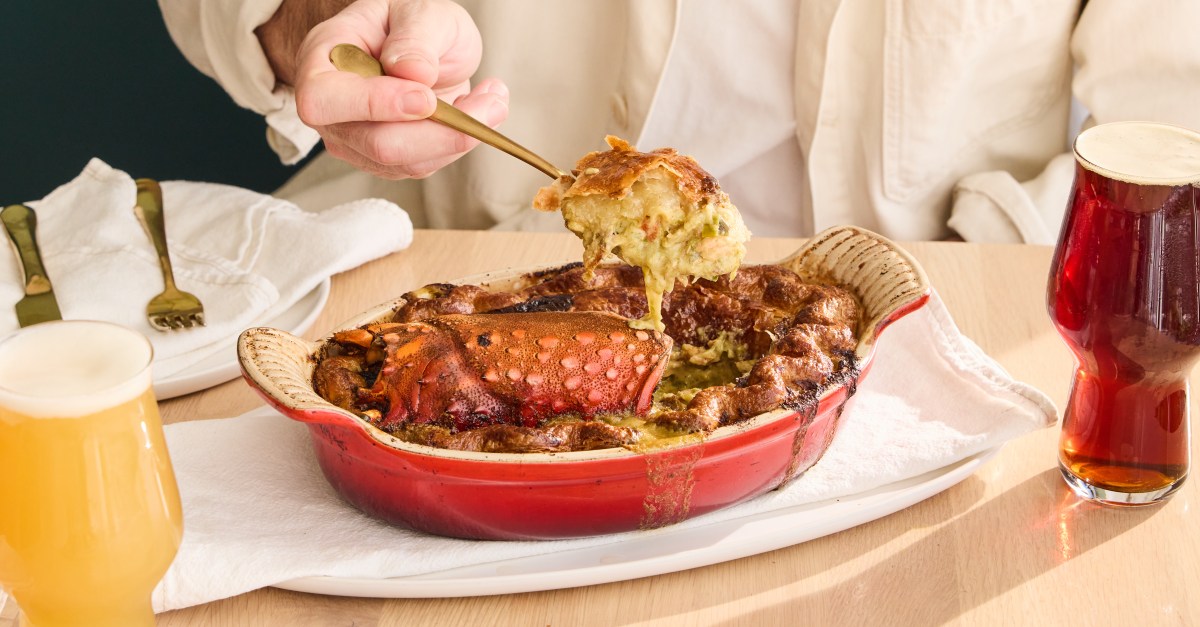
Natasha Price and Tatiana Ettensberger never really imagined being “the British restaurant” in Los Angeles. Three months after opening their neighborhood bistro-cafe in Los Feliz, the childhood friends-turned-business partners are the grateful, extremely busy owners of one of the city’s hardest-to-get-into new restaurants. During evening service, would-be diners arrive right before 5 p.m. in hopes of scoring one of the tables held for walk-ins, while online reservations — released every two weeks at midnight — are snatched up almost instantly.
By night, the restaurant offers a rustic, meat-heavy menu that draws heavily upon the British culinary canon with a deconstructed take on fish and chips (battered skate and salt-and-vinegar fries get sold separately), a rotating meat pie for two, and sticky toffee pudding. In the daytime, Wilde’s also serves a perfectly crumbly scone, pork sausage rolls, and a focaccia-based bacon bap, one of the various terms for breakfast sandwich used in the United Kingdom. To a less trenchant observer, Wilde’s might appear to be an elevated take on an old-school English drinking tavern, albeit one with a well-curated natural wine list replacing ale and other types of beer.
“We want it to be clear it’s not a British pub,” says Ettensberger, who oversees the beverage program. “That was never the hope.” Instead, the pair describe the menu as California cuisine with a strong English through line inspired by Price’s upbringing; she was born in England and her parents immigrated to Los Angeles when she was young. A similar, decidedly British slant informs the cooking at Tomat in Westchester, which celebrated its first anniversary last fall, as well as the temporarily closed Café 2001, previously located in the Arts District.

Eton mess and sticky toffee pudding. Kort Havens
Long stereotyped as boring and bland, British cuisine has begun to make waves across the United States. In 2024, TikTok creators like Britney Miller and Millie Hart began to popularize dishes like Sunday roasts and jacket potatoes online. Over the last few years, restaurants such as Lord’s in New York and Little Beast in Seattle have opened across the United States, with the country’s bar scene following suit in the form of Irish pub renaissance. Even the ultra-touristy Downtown Disney is getting in on the action with an upcoming 1960s-style London gastropub led by Gordon Ramsay. Now, the trend has finally reached the Los Angeles restaurant scene, offering diners more distinctive options than Ye Olde King’s Head in Santa Monica and West Hollywood’s Cat & Fiddle. In typical California fashion, however, local and global influences are shaping how the U.K.’s foodways manifest on plates across town.
All three of Los Angeles’s new British-influenced restaurants take cues from St. John Bread & Wine, the London restaurant considered to be one of the foremost pioneers of contemporary British gastronomy. Founded by Fergus Henderson and Trevor Gulliver in 1994, the original location in Smithfield reintroduced modern-day Britons to their country’s historically rustic, nose-to-tail approach to cooking through its spin on French and Italian culinary traditions. In 2019, the restaurant announced plans to open in Los Angeles by way of Culver City’s Platform shopping mall, though the U.S. expansion never materialized after the pandemic began.
“The food there is incredibly thought out and beautiful,” Price says, adding that St. John is a “beacon” for Wilde’s. The Los Angeles-raised, predominantly New York-trained chef also cites the influence of London’s Rochelle Canteen for its “slightly more feminine” approach to cooking — the Shoreditch restaurant, open since 2004, is owned by Henderson’s wife Margot and her business partner, Melanie Arnold. Today, the kitchen is run by the couple’s oldest son, Hector. “What they did is similar to what Chez Panisse did [in Berkeley]. Super local ingredients, very seasonal menu.”
For Natalie Dial and Harry Posner, the married co-owners of Tomat in Westchester, St. John has both personal and professional significance. Beyond serving as inspiration for their seasonal restaurant, it’s the first place Posner took Dial when she visited England while the pair dated long-distance. Posner, the restaurant’s chef, also celebrated his 21st birthday there: “It’s the first place that I recommend [in London], always.” At Tomat, the baked-to-order madeleines on the dessert menu are the most overt nod to St. John, which is famous for its take on the delicate French sponge cakes.
In the case of Giles Clark, the British-born chef behind Café 2001, St. John has served as a vital training ground at multiple points in his career. During university, he staged at the restaurant during spring holidays, later going on to work there full time under head chef James Lowe. When Lowe went on to found the early 2010s London culinary collective The Young Turks, Clark worked for the group during their 2012 residency at the Ten Bells, a historic pub in the city’s Spitalfield neighborhood. The casual, fairly seasonal menu he serves at Café 2001 has primarily been informed by the years he spent cooking in Japan, though the influence of St. John can be felt in dishes like a pork tripe, trotter, and English pea soup served at the restaurant last spring.

Cafe 2001. Cafe 2001
Clark says the cooking at Café 2001 has been shaped, in some part, by nostalgia for his homeland. “Tripe and pea soup sounds quite like a St. John thing, even if it was never on the menu at St. John,” he says. For a time, the restaurant served ham and egg with chips and mushy peas, a classic English brunch dish. In the last year, Café 2001 has also hosted a handful of evening pop-ups featuring experimental art, music and poetry with local artist David Horvitz and his U.K.-born wife, the curator Zanna Gilbert; for these events, Clark has leaned into serving more traditionally English dishes like Scotch eggs, sausage rolls, and toasties.
“If we think about St. John, it’s actually a collage of a lot of European cooking,” Clark adds. “Fergus took from places like Scandinavia, France, and Italy and repackaged it in an English way. It’s kind of genius. The way he served and presented [food], it felt English, even if he was pinching dishes from other cultures.” Somewhat unsurprisingly, what we now call modern British cuisine is actually a mélange of continental influences. But to Clark, the minimalist approach of British food seems to be more aligned with Japanese cooking, rather than French or Italian. “With English cooking, there isn’t the same beauty, but there’s a similar internal way of thinking and appreciation for ingredients. There’s the same poetry of cooking.”
While the menus at Wilde’s, Tomat, and Café 2001 are not British in a strictest sense of the word, a few recurring themes emerge upon closer look. All three places are guided by the hyperseasonal, ingredient-obsessed emphasis found at modern London restaurants like St. John; the Eagle, the world’s first gastropub (decades before the term was reduced to mere kitsch), as well as an inspiration for Price; and the now-closed Clove Club, where Posner worked for a brief stint before the pandemic. “As an American coming in, so much of [London’s dining scene] was about the ingredients themselves,” Dial says, reflecting on the time she spent living in the city during graduate school. “The color of the egg yolks — I have yet to see an egg in America that looks like that.”
Unlike California seasonality, where the constant sunshine and fertile soil result in year-round availability of ripe fruits, vegetables, and other ingredients, British seasonality is dictated by the country’s colder climate and relatively short growing seasons. “We would have asparagus for a month, max,” Posner says, of cooking in London. “Here, if you have an ingredient for only a month, people would be like, ‘Where’s my thing? I was just starting to get used to cooking with it.’ In England, when it’s gone, it’s gone — [chefs have to] move onto the next thing.”

Pastries and sausage rolls at the daytime bakery and cafe. Emily Ferretti

Battered sea bass and mint. Kort Havens
From Clark’s point of view, the limitations of agriculture in the British Isles lead to the creation of something understated but beautiful. “Vegetables taste so different in the winter because of the really hard frost,” he explains. “You have six weeks of asparagus in the spring, six weeks of strawberries. It makes for a different way of thinking about those ingredients.” Over here in Los Angeles, he says, chefs have to almost manufacture that sort of culinary restraint due to the abundance of locally sourced produce, meat, and seafood.
The other distinguishing factor in these restaurants is the nose-to-tail approach to butchery, including the embrace of offal. At Wilde’s, Price and her chef de cuisine Sarah Durning are working toward an in-house whole hog program with Peads & Barnetts. Currently, pork shows up in the coppa di testa, a crackling and celeriac salad, sausages (in the bangers and mash at dinner and daytime-only sausage rolls), and other specials like pork chops. For Clark, Peads & Barnetts has also been a great help in bridging the gap in sourcing at Café 2001. The family-owned farm in San Diego County raises Berkshire pigs, a heritage British breed. “We don’t have the same offal culture and we don’t have game here, but that pork is super special, “ he adds. “It’s been the base of a lot of good things at the cafe.”
Before opening Tomat, Posner discovered he couldn’t get the English-style cuts of beef he wanted to serve at the restaurant. As a result, the back-of-house team butchers all of its meat and seafood in-house, typically starting with whole or partial animals. On the menu, the British approach to butchery and a few cultural staples — a unique take on fish and chips, plus lamb with mint jelly and sticky toffee pudding — combines with Persian (Posner is half-Iranian), Japanese, and occasional Scandinavian influences. While Tomat’s typical clientele is still quite averse to anything served on the bone, Posner continues, he’s managed to introduce offal in the form of black pudding (listed simply as “housemade sausage”) on the breakfast menu and a recent steak-and-kidney pie special. “Some people love it, but [sales are] nowhere near enough to be a sustainable thing,” he says.
Across town in Los Feliz, Price and Ettensberger are surprised by how excited people have been about their particular interpretation of British cuisine. Plenty of U.K. expats have already stopped by Wilde’s, with many leaving pleased after enjoying comforting classics like Welsh rarebit — a childhood staple for Price — and their spin on sticky toffee pudding. To Ettenberger, the warm reception also seems reflective of how newer London restaurants like Anna Tobias’s Café Deco and Max Rocha’s Café Cecilia have gained significant cultural cachet across the pond, thus increasing the public’s general familiarity with dishes like Welsh rarebit and Eton mess.
At the same time, the pair don’t want to feel confined by a particular genre. After all, it can be easy to slide into kitsch, especially when it comes to more traditional pub fare like shepherd’s pie and Sunday roast.
“Our hope is that as the menu continues to evolve with the seasons, guests can really start to see the real emphasis on the ingredients and the rusticity,” Ettensberger says. “This is the core of how we think, rather than, ‘What is the most British thing we can put on the menu?’”

Brunch at Tomat. Ashley Randall