
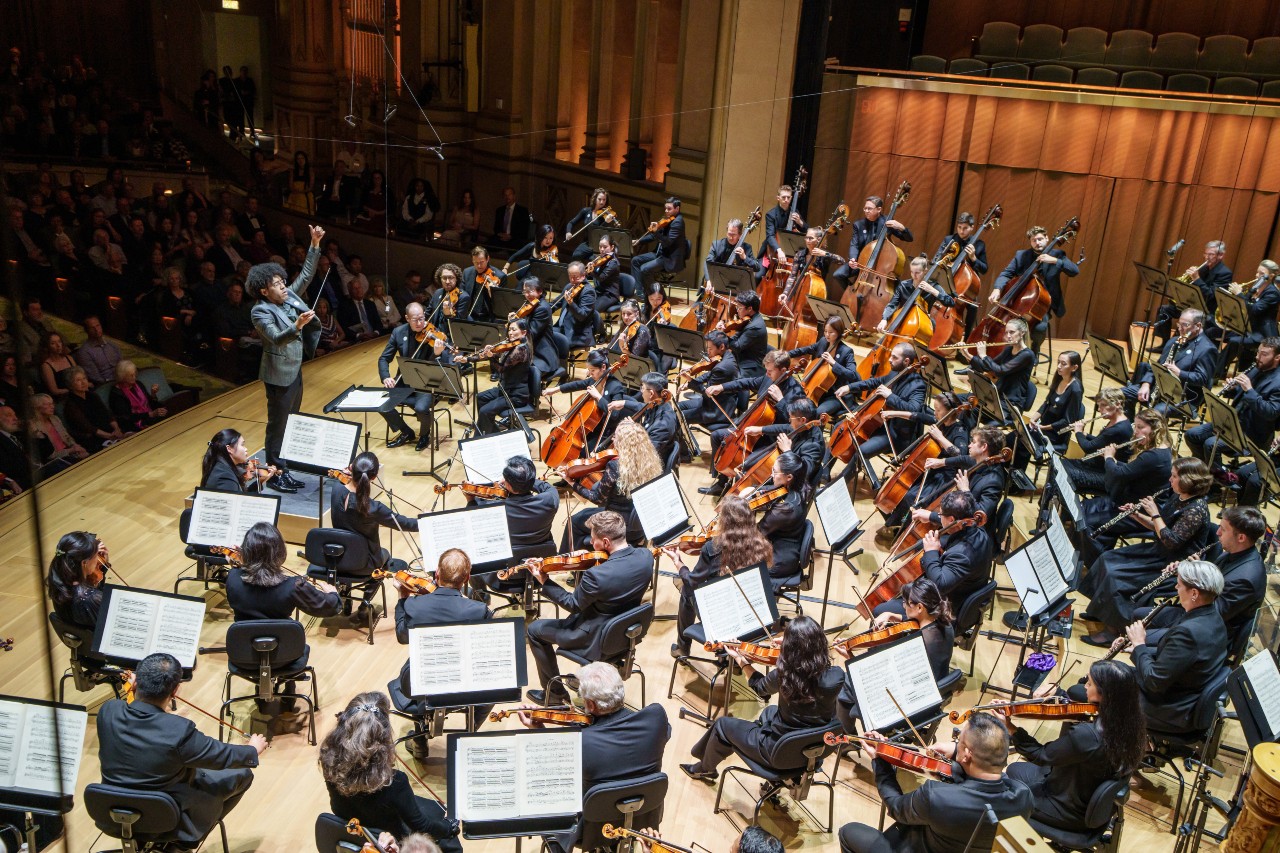
 Rafael Payare conducts the San Diego Symphony Orchestra. (File photo by Todd Rosenberg/San Diego Symphony)
One thing is true about Gustav Mahler’s Seventh Symphony, given an appropriately dizzying performance Saturday by Rafael Payare and the San Diego Symphony Orchestra in Jacobs Music Center: It demands to be played recklessly, feel unhinged, like a ship in a storm. Eighty minutes of feverishly interrupted motion — it’s the least commercial of Mahler’s ten symphonies.
Least commercial means least conventional. Least conventional means least played. And least played means more rehearsals since it has to be nerve-wracking to pull off a symphony so prescriptively unsettling.
The Seventh, written in 1905, turns away from the rapturous directness of an audience’s emotions, which most of his other nine symphonies possess. They emphasize one or more extra musical elements — a narrative program, a breathlessly well-developed leitmotif, and a quieting mid-work pause of immense sustained feeling, say, the testimonial intimacy of the Fifth’s Adagietto to his then-new wife, Alma.
Five movements comprise the Seventh’s journey — the first and the fifth are grandiose and rocky; the second and fourth are serenades, both labeled “Nachtmusik,” more atmospheric than melancholic; in the middle, a Scherzo plays hide and seek with its shadow self. It seems to me the symphony is haunted by some purpose it can’t quite articulate. A real test for Payare’s seventh season at the orchestra’s helm.
In his first six symphonies, Mahler crafted wildly original movements: quoting folk songs and march tunes, lingering on long supple melodies, widening the spaciousness of the symphony so its halls and listeners might sit longer with him, bathing in his sounds. His romantic style with twinges of religious solemnity reigned. Many adore the heroic wonder he achieves, for example, the bell-ringing joy of the Fourth Symphony’s last movement, a Germanic vision of Heaven, sung by a boy or an adult female soprano.
The Seventh pushes at boundaries. Mahler lets go of unified development and prefers, in the outer movements, to rush at his ideas willy-nilly. The whole ripples with agitation, more thrusting peaks than lyrical valleys, a pace frenzied by slowing down and speeding up, what I call musical roughhousing. It’s fair to echo most critics who say the symphony is an experiment in disintegrating motion: A surfeit of themes comes and goes too quickly to feel companionable yet that’s the sensibility Mahler wants the Seventh to have.
That heedlessness Payare brought to life more decisively in the big outer movements, less in the middle three. Of the former, the first so-called tragic movement was best. Using the baton like a whip, Payare’s long reach seems to fling orchestral sections at one another as the themes get passed around. The brief, jagged tenor horn solo, piercingly played by Kyle Covington, disturbs the placid opening measures; the horn motif is then airmailed from horn to winds to trombones and trumpets, stirring a hornet’s nest of turmoil.
I was impressed that not only was the orchestra attuned to Mahler’s shape-shifting at once but, following Payare to a T, the musicians embodied the sudden transitions with precision. Perhaps the unifying quality resides, in part, with the new white oak hardwood floor that spreads and sustains the bottom rumble and hurrying energy into some two hundred soles.
Payare drove the orchestra to the “tragic” climax with an uncompromising propulsion. Much of that heft colored the Rondo-Finale whose theme returns — revoiced, stated, pulled back — four times. The Seventh’s ending romp for me is messy; though that theme seeks hope and glory, its narrative jumble struggles to find home. It seems impossible to give this tilt-a-whirl finale its justice because Mahler’s writing is too in love with instability. Even San Diego’s finest tried but just couldn’t wrestle the beast to comply.
I was occasionally excited by the two serenades, the “songs of the night.” In the first, the orchestra lacked the swing and sway the coy march theme needed. Such ease is hard to get right when Mahler breaks the dancing meter with foresty horn calls and trumpet responses. I couldn’t decide whether Payare captured the campiness of the music or Mahler failed to make the night music humorously convincing. In the second serenade, the orchestra, with its gentle waves of mandolin tremolo, played the tender two-step warmly, tiptoeing dreamily toward midnight.
In the waltzy Scherzo, violist Chi-Yuan Chen played his solos with touching lyricism, which nicely contrasted with the orchestra’s playful but restrained backbeat. At times, Payare pushed the tiring musicians to keep up but the order didn’t always land. Other parts did land, at least, enough for some in the audience to give each movement a smattering of applause, that is, until the fireworks of the finale brought them to their feet, the way all grand symphonies end.
Cultural critic and memoirist, Thomas Larson, archives on his website nearly 500 publications over the past 30 years, including his longform feature stories for the San Diego Reader. His new book, On Listening & Not Listening — a multipart essay on the relentless noise in American culture, media, and politics from the listener’s perspective — is due later this year from Bloomsbury.
READ NEXT