
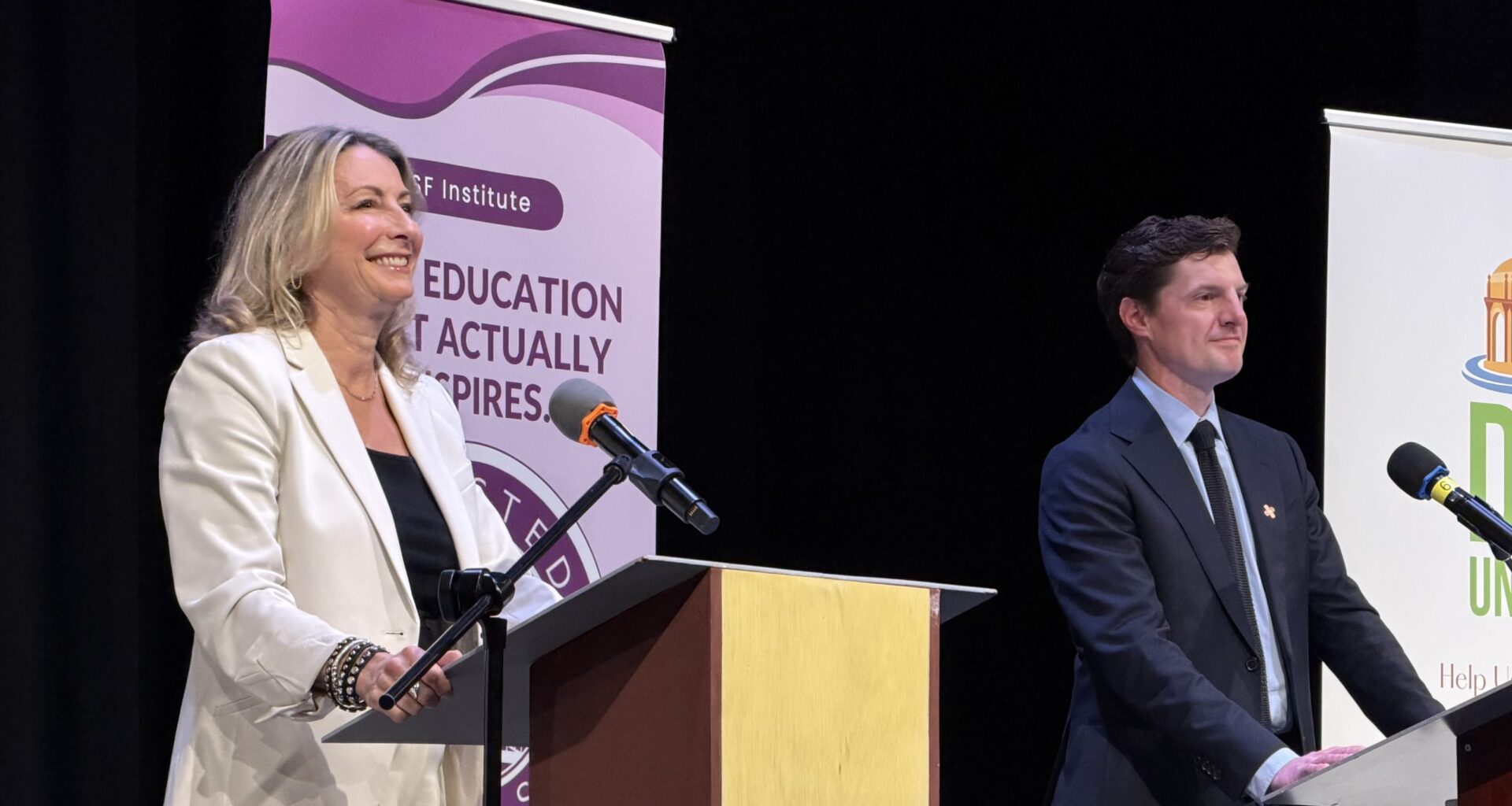
In the first debate between the two candidates for San Francisco District 2 supervisor on Tuesday evening, housing was the most contentious topic.
Though candidates Stephen Sherrill and Lori Brooke also spent large parts of the debate talking about cars and public safety, their answers on housing drew the most audible response from the crowd of about 200 people gathered at Convent & Stuart Hall, who leaned older and whiter.
They were there to figure out who to vote for in June 2’s special election to serve for the remainder of Catherine Stefani’s term, after Stefani departed for the State Assembly in December 2024. The debate was moderated by Tara Moriarty, the sheriff’s department spokesperson, and questions were provided ahead of time.
Whoever wins in June will only be guaranteed the seat until November, when another election will happen for a fresh four-year term, though political observers say that if June’s winner is victorious by a large enough margin, competitors will likely drop out.
Brooke, a longtime neighborhood organizer, criticized the city’s recent upzoning plan, which allows taller, denser housing in the city’s north and west, including on commercial streets like Lombard and Chestnut in District 2. The plan was voted through 7-4 in December and is meant to satisfy state requirements for more housing.
“Those bright, sunny, walkable commercial corridors can now have six to eight stories on it. This was a wrong plan. It should never have been approved,” Brooke said, to loud claps, whistles, and cheers from the audience.
District 2, made up of the wealthy Marina, Pacific Heights, Cow Hollow, and Presidio Heights neighborhoods, is generally more reticent to allow new housing in the area.
The area had 1,465 units of new housing construction since 2005 — about 3 percent of the city’s total 52,711 during that period.
Neighborhoods United SF, which Brooke co-founded, is part of a coalition currently suing the city to block the upzoning plan.
Sherrill, who was appointed District 2 supervisor by outgoing Mayor London Breed in December 2024, voted for the plan. But at the debate, as he has previously, he distanced himself from it, pointing out that the upzoning was mandated by the state. If he hadn’t voted for it, he said, the state would have taken over San Francisco’s ability to approve new housing, essentially allowing buildings of any height to be built anywhere.
“Just saying no and risking a state takeover of local zoning can lead to devastating, devastating consequences to this city,” Sherrill said. “I don’t think it’s appropriate to just light yourself on fire and risk absolute disaster and catastrophic consequences.” He also got claps — but they were noticeably quieter.
Brooke pushed back on Sherrill, saying that state takeover wasn’t the “real issue.” That, she said, were YIMBY state laws — the ones that required upzoning and allowed a 25-story building to be proposed on the current site of the Marina Safeway right by the waterfront.
This did not let Sherrill off the hook. “My opponent says he doesn’t like [the Marina Safeway development], which is good, but he is endorsed by the very senator and the YIMBY organizations that wrote and championed the laws that made it possible,” Brooke said. Unlike Sherrill, she said, she would push back strongly against Sacramento.
Sherrill, for his part, said, “I absolutely urge our state representatives to reform some of these laws.”
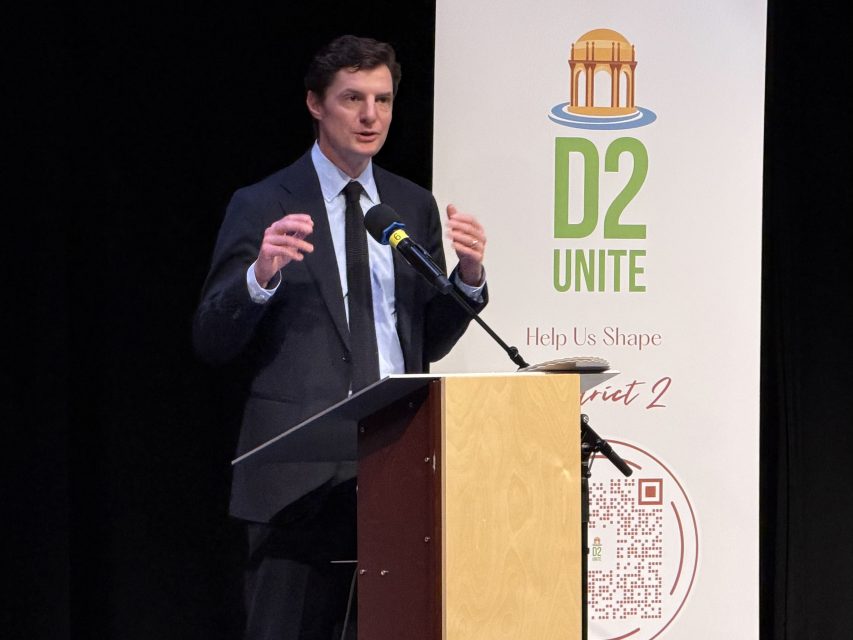 Stephen Sherrill introduces himself to the audience at a District 2 candidate debate on Feb. 3, 2026 at Convent & Stuart Hall. Photo by Io Yeh Gilman
Throughout the debate, hosted by D2Unite and ConnectedSF Institute, Sherrill emphasized his moderate bona fides and his connection to Mayor Daniel Lurie.
“I think we’ve all seen what happens when we have alignment on the Board of Supervisors, a pragmatic, moderate, thoughtful Board of Supervisors with a pragmatic, moderate mayor,” Sherrill said.
“When we see the reset that we’ve seen in City Hall, when we see the reset in San Francisco on the rise, it’s about results,” he added, echoing language often used by the mayor, who has endorsed Sherrill.
Brooke, meanwhile, pitched herself as an “independent voice” in City Hall.
“I bring independence, I bring very deep knowledge of this community, and I do know my way around City Hall,” she said. As president of the Cow Hollow Association and a co-founder of other groups, she was on the front lines of quality of life issues in the district, like parking, graffiti, clean streets, and more, she said.
“We’re kind of like a shadow supervisor,” she said. “We take the first hit of what people need.”
As of Dec. 31, Sherrill is backed by almost twice as much money ($300,000) as Brooke ($160,000). All of Brooke’s donations have been from individual donors, contributing $500 or less. Sherrill’s campaign, meanwhile, has also been backed by $17,000 from GrowSF, a moderate political action committee.
Cars and Drugs
Other questions focused on street safety and drugs.
Both Sherrill and Brooke said they think drug dealers with prior convictions should serve mandatory jail time. (“Thank you,” said Moriarty.) Both also agreed that fully staffing the police department was a high priority.
But Sherrill and Brooke took slightly different approaches when asked what the city should do about the handful of mentally ill and drug addicted people that congregate on Chestnut Street.
Sherrill said the city needs to employ conservatorships more, which would allow the city to mandate drug treatment. “It is not compassionate to leave people sitting out there,” he said.
Brooke wants the city to use its existing tools, including 5150 holds, in which a person is held involuntarily for up to 72 hours because they pose a danger to themself or others, but ultimately said she also supports expanding conservatorships. “Conservatorships should be a tool of last resort,” she said.
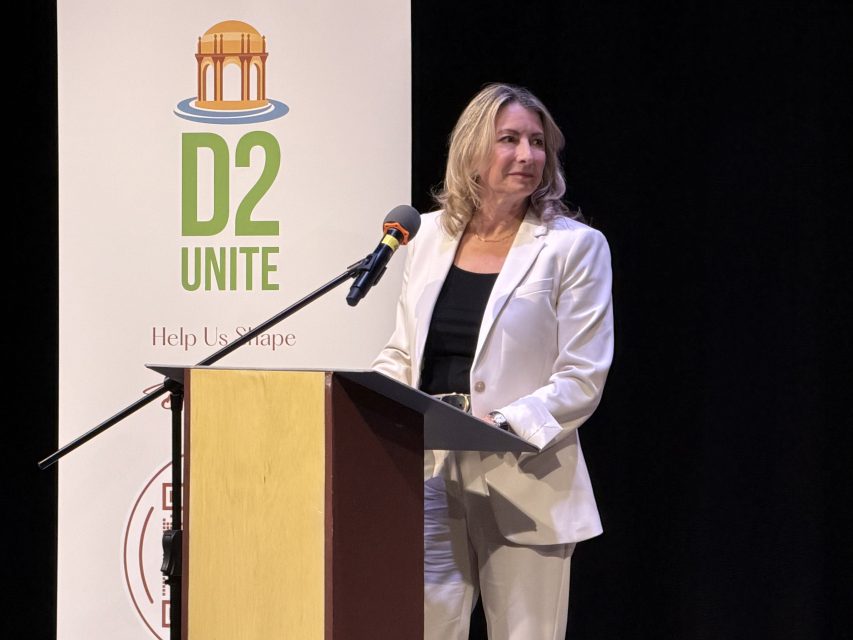 Lori Brooke listens at the first District 2 debate at Convent & Stuart Hall on Feb. 3, 2026. Photo by Io Yeh Gilman
Another big topic: transportation. Both candidates agreed that Market Street should be reopened to cars (a few people booed, then some cheered). They also both agreed that new housing developments should include more parking.
The city should not prioritize any “single mode” of transportation and should give “appropriate” weight to other forms of transportation, Brooke said, pointing to frustrations over traffic and parking. The city’s “transportation decisions,” she said, have become “less about neighborhood actual function and more about transit ideology.”
Sherrill was more supportive of Muni.
“A fully functioning Muni is so important,” he said. “For every rider who’s getting on that 1X [bus line], that’s one car you don’t have to fight with over a parking spot.”
Ultimately, though, perhaps what voters were looking for was a candidate connected to the district. The first questions of the debate were about how long the candidates had lived in San Francisco and District 2 (11 years for Sherrill, 31 years for Brooke).
The last question was: “What is your favorite D2 tradition?”
“D2 does Halloween really well,” Sherrill said, naming streets with iconic trick or treating. “You know what my favorite is, though, is the Chestnut Street parade with all the strollers.”
Brooke said that every Christmas morning, she goes to the Buena Vista, a bar near Fort Mason, for an Irish coffee and joins a group on a “march through North Beach.”
“The cool thing about it is that you see the same people year after year there,” she said. “It’s just a remarkable city. I just love it.”