
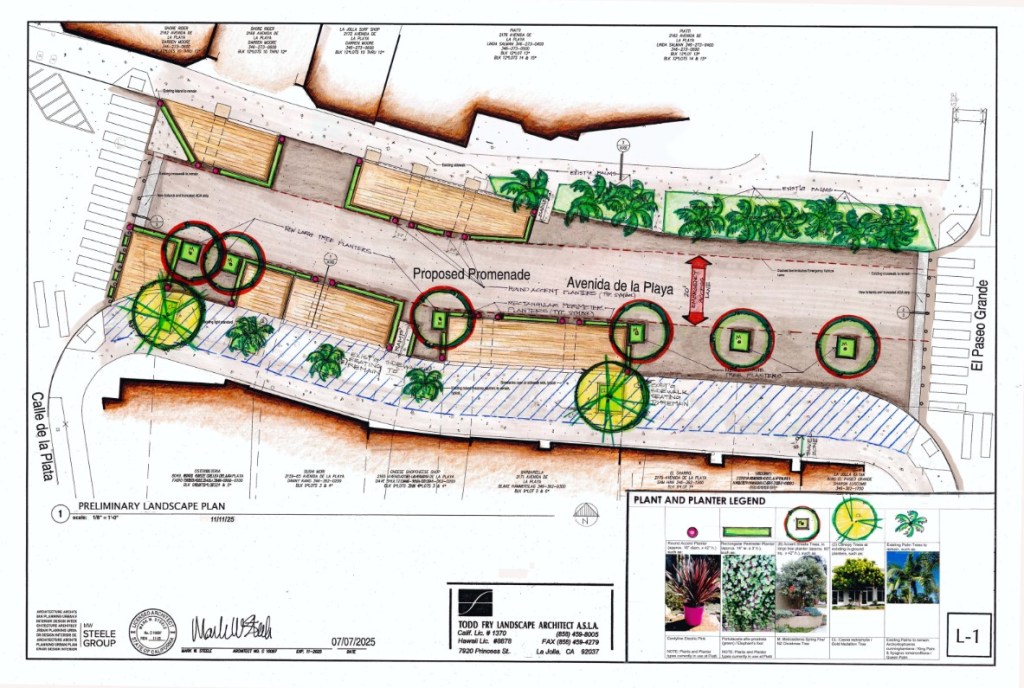
As it stands now, organizers of Promenade de la Playa, the permanent outdoor dining fixture on Avenida de la Playa in La Jolla Shores, are required to provide an estimated 11 parking spaces to replace public spots taken by the program. But if a proposed change to the city of San Diego’s Land Development Code passes, they might not have to.
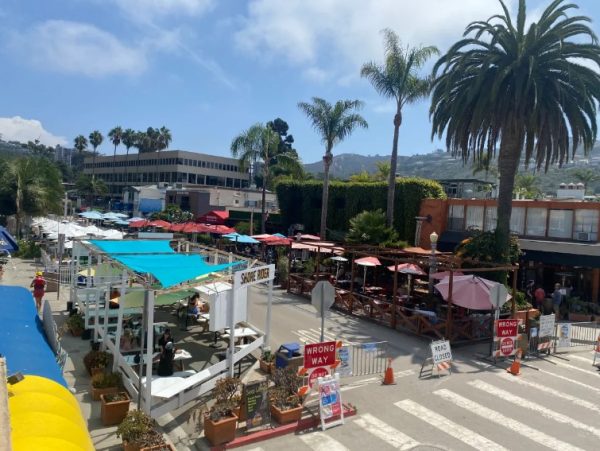 The outdoor dining program on Avenida de la Playa in La Jolla Shores is pictured in September 2023. (File)
A right-of-way permit making the outdoor dining program permanent was approved Aug. 6 by the San Diego Development Services Department and by the Transportation Department soon after. Organizers were given two years from that date to provide the replacement parking spots and complete other work related to the promenade.
“Our permit is twofold: One, it applies to the promenade, which is strictly constructing the promenade — not the streetaries [on-street dining areas] within the promenade, but just the promenade work. … The second part is the parking,” said Phil Wise, who spearheaded The Shores outdoor dining project and has worked to keep it alive since.
“We’re going to split the two, and we will wait and see about the parking until we know about the parking. Why do it if we don’t need to do it? Plus, it’s really expensive.”
Wise and others have proposed creating the replacement spaces by reducing the width of a sandy berm that divides the Kellogg Park parking lot on the west side of Camino del Oro. It is the same location as in a plan that received narrow support from the La Jolla Shores Association in August 2024. The plan originally was for 24 spaces.
The promenade will refine a street closure that has been in effect for nearly six years on Avenida de la Playa between El Paseo Grande and Calle de la Plata and create an “al fresco” pedestrian walkway to go with the restaurant use.
The Promenade de la Playa team is working on paperwork to submit to the city that will include plans and drawings for things such as signs, bollards, trees and shrubs, removal of on-street lines and improvements to outdoor dining spaces. Not every business will use a streetary, but those that do must send in individual plans.
That section of Avenida de la Playa has been off-limits to vehicles during certain hours since July 2020 to allow restaurants to provide seating on the street. The program originally was intended to assist restaurants amid COVID-19-related restrictions on indoor dining, but it has remained long past the end of those restrictions due to its popularity.
The organizers might not need to replace the 11 lost parking spaces because of a proposed Land Development Code change that is part of San Diego’s annual update of regulations for development and use of property, including zoning, subdivisions and other related activities.
The amendment in question would help implement California Assembly Bill 2097, signed by Gov. Gavin Newsom in 2022, which prohibits minimum parking requirements for developments within a transit priority area, or TPA, defined as within a half-mile of a major existing or planned transit stop.
It would clarify that a requirement to replace public parking removed for streetaries, promenades and other outdoor dining on streets in the “beach impact area” — areas closest to the coast — “applies only when located outside the transit priority area.”
Promenade de la Playa falls within a TPA.
The item, as part of a lengthy list of proposed amendments, was approved Jan. 27 by the Community Planners Committee, which consists of leaders of local planning groups around the city.
The planned amendment on replacement parking “would make the Land Development Code consistent with state law, making it clearer to understand and implement,” Seth Litchney, deputy director of housing policy and environmental analysis in the city Planning Department, previously told the La Jolla Light.
Exactly how much impact it would have on La Jolla at large remains to be seen, although much of coastal La Jolla and the area surrounding UC San Diego’s campus are within a transit priority area.
“Since property owners would need to submit applications to implement promenades and streetaries, it is speculative to guess how this change could be used in the future,” Litchney said. “However, it could also make it easier for more businesses in these areas to choose to establish more outdoor dining and gathering spaces. …
“A development using the streetaries, active sidewalks or outdoor dining regulations in the transit priority area is not anticipated to be required to provide replacement parking. However, an applicant may also elect to opt into any new regulations adopted.”
However, several hoops must be jumped through before the code change can be implemented.
It next will appear before the city Planning Commission and the City Council’s Land Use & Housing Committee in the first quarter of the year. The full council is expected to take a final vote during the second quarter.
And then there is the matter of California Coastal Commission regulations established in 2023 — and consented to by the San Diego City Council — requiring establishments closest to the beach to replace any public parking spaces taken by street dining.
According to correspondence from Development Services Department staff shared with the Light, the Land Development Code update related to Promenade de la Playa would not apply until it is incorporated into the city’s Local Coastal Program and certified by the Coastal Commission.
Joshua Smith, a spokesman for the commission, said the agency wouldn’t be able to comment on the issue until the city has submitted a proposed amendment to its Local Coastal Program.
So as of now, the promenade team would have to provide the replacement parking spaces. But it can, at the risk of the two-year window in its right-of-way permit expiring, wait to do that until a decision is made on the code amendment.
Wise said the team intends to wait, though he added it has the option to extend the time period by 180 days. A city web page says a public right-of-way permit “may be extended 180 days if it is determined that circumstances beyond the applicant’s control prevented the completion of the work.”
Fundraising for the promenade is continuing, though a larger push awaits city guidance.
Participating restaurants have given $100,000 toward the costs of planning, permitting and running the Shores street dining program, Wise said, including $50,000 from one restaurant he did not identify. A local resident contributed $150,000, Wise said, and a friend of his who lives in South Carolina and at a condominium in La Jolla’s Windansea neighborhood gave $2,500. Other funding has come from county grants.
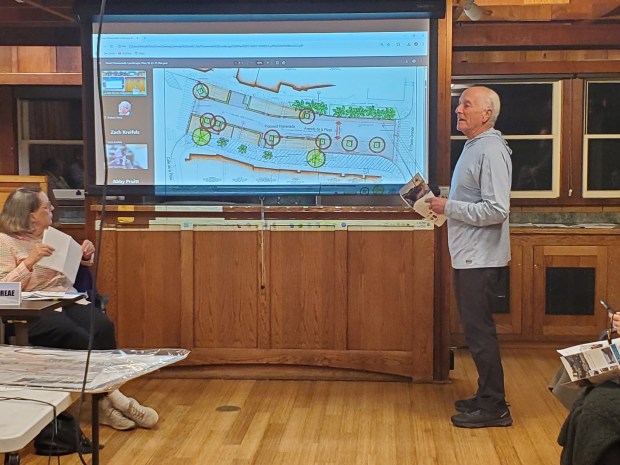 La Jollan Phil Wise presents a landscaping plan for Promenade de la Playa to the La Jolla Shores Association on Nov. 12. (Ashley Mackin-Solomon)
Wise said an additional $500,000 likely will be needed to complete the promenade pedestrian walkway and other upgrades and secure any replacement parking.
“I have the contract for the contractor to begin the promenade work … I’m ready to sign up,” Wise said. “We just need to make sure all the restaurants are lined up with the streetary permits.
“We’re juggling all these balls, and we’re not in control of them. We’re just in control of our own stuff.”
He hopes the questions will be resolved “sooner, not later,” he said. “Because I want to retire.” ♦