
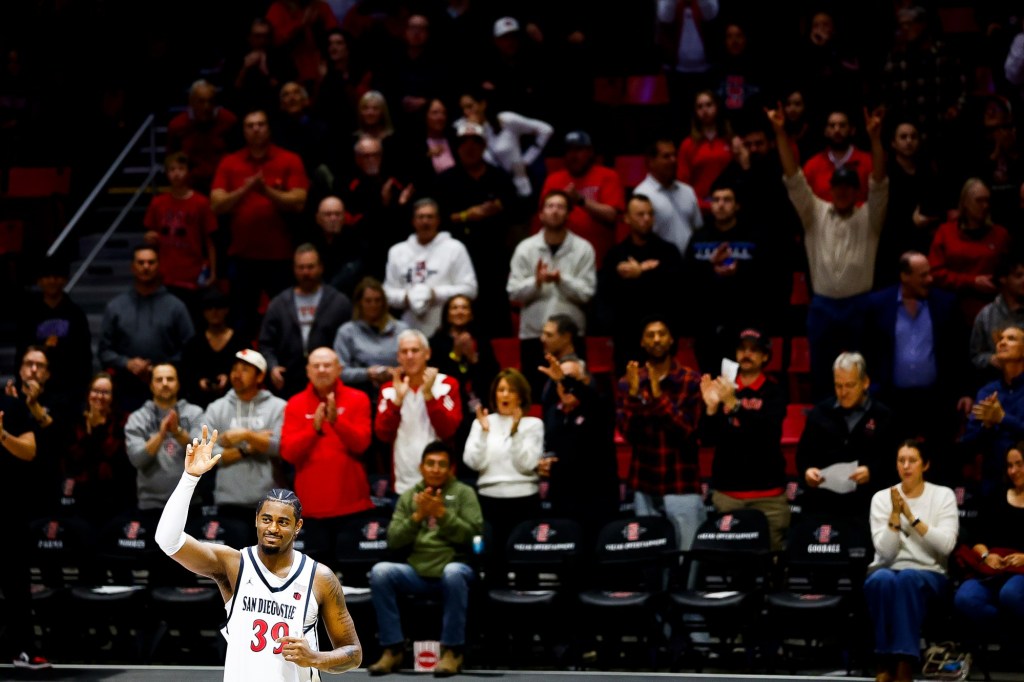
Three thoughts on San Diego State’s 72-63 win against Wyoming on Tuesday night at Viejas Arena:
1. Heating up
Reese Dixon-Waters changed his jersey number and his last name in the offseason, and he recently started working with a sports psychologist, all with the intent of changing the narrative and becoming a more consistent, reliable player in his final season of college basketball.
It’s starting to work.
Dixon-Waters, who blew hot and cold for much of his career, has become arguably the most consistent (if not the best) player in the Mountain West, scoring in double figures in his last 12 games and averaging 14.1 points while shooting 40.8% on 3s in his last 11 against Division I opposition.
That’s up from 11.5 points and 33.3% during the nonconference.
“He’s a good player, man,” Wyoming coach Sundance Wicks gushed after the 6-foot-5 senior guard dropped a season-high 23 points on the Cowboys while attempting just 10 shots. “He’s offensively gifted, right? … There’s tough shot takers and tough shot makers. When you’re a tough shot maker, you don’t need an offense for that.”
Dixon-Waters has always been like that, almost to a fault. He prefers to shoot off the dribble instead of curling off screens and receiving a pass, embracing the challenge of the fallaway jumper while wearing a defender, regularly practicing that instead of the more traditional approach of firing stationary shots to calibrate your stroke.
It’s an odd situation: Coaches actually have to beg him to hunt open shots.
“Everybody really gets on me for not shooting the open ones on the catch and shoot, so I’m trying to do that a lot more,” Dixon-Waters said. “To me, a lot of the shots that somebody would say are difficult, aren’t. I grew up playing a certain way, so for me it’s a lot easier.
“You can’t play basketball and be wavering and thinking about if your shot’s going in or not. Every time I shoot the ball, I think it’s going in. I don’t get frustrated if it doesn’t, but I think it’s going in beforehand.”
The evolution of his game was on display in the past week, scoring 16, 19 and 23 points while shooting 61.3%, a preposterous number for a jump shooter.
He’s taking more open shots on designed plays. He’s also recognizing that opposing teams are anticipating his dribble pull-up — “my favorite shot,” he says – and countering that by attacking the rim to draw fouls. Tuesday night, he shot a career-high 12 free throws.
He’s also more conscious of when he shoots.
“A few games ago, I was sitting for five minutes and I came down, first time, and shot a dribble pull-up,” Dixon-Waters said. “Nobody else touched it. We just played hard defense. And then coming down and just jacking up a dribble pull-up is not a good shot.
“Obviously, if it goes in, nobody can say anything, and I have that mindset. But it’s a gift and a curse to think like that sometimes. I’m just trying to be better at knowing time and score, and the flow of the game.”
2. Bad beat
If you didn’t see the game’s final minute, you’ll probably be able to re-live it soon on the “Bad Beats” segment on Scott Van Pelt’s “SportsCenter.”
What’s a bad beat? For the uninitiated, it’s gambling parlance for when an unfortunate set of events in the closing moments transforms a certain win against the point spread into an unconscionable loss.
Here was the situation Tuesday: The Aztecs were up 15 inside a minute to go, and most sportsbooks had them as 12-point favorites (and a few at 11.5). So if you bet on the Aztecs, you were poised to win.
Then Wyoming’s Uriyah Rojas made a running bank shot, was fouled and made the free throw with 48 seconds left – 72-60.
The Aztecs ran the shot clock down before Taj DeGourville launched a deep 3 that missed … only for Miles Byrd to grab the offensive board with 25 seconds left. The shot clock reset, but because there was no change of possession, it reset at 20 seconds instead of the usual 30.
That left a five-second differential, meaning the Aztecs couldn’t run the clock out to end the game. DeGourville launched another 3 that hit the rim and bounced over the backboard, stopping the clock at 7.3 seconds.
Had it been a normal scramble for the rebound, the Cowboys might not have had enough time to get downcourt for a shot. With the fortuitous stoppage, they inbounded the ball and pushed it ahead against a disinterested Aztecs defense, and Rojas found Adam Harakow for an open 3 from the left wing with 1.3 seconds left.
The ball nestling into the net was greeted with the unique mix of cheers and groans in Viejas Arena that, to the gambling crowd, can mean only one thing.
If you bet on the Aztecs -12, you lost. If you bet on Wyoming +12, you won.
“It’s a Bad Beat on ESPN, I know that much,” coach Brian Dutcher joked afterward. “If you’re a gambler, you’re not very happy. But I don’t worry about that. … It wasn’t like we were trying to run it up on them. We were just playing the shot clock, and we took a shot.
“The game’s over and our guys were relaxing, and they rose up and made a 3. That’s what happens in basketball.”
3. Sheer wackiness
The Mountain West ranks 31st out of 31 Division I conferences in close games, defined as one-possession or overtime. Through Tuesday, only eight of 68 conference games this season qualify, or 11.8%.
But the few that do have been epic in their sheer wackiness.
There was SDSU’s triple-overtime win against Boise State after blowing a 24-lead, then getting a 3 in the third OT from a guy (Jeremiah Oden) who should have fouled out but didn’t because of an officiating gaff.
There was SDSU’s 70-69 loss at Grand Canyon when BJ Davis, its best free-throw shooter, missed the front end of a one-and-one and the Antelopes got a (gift) call with 1.8 seconds left for game-winning free throws by Makaih Williams.
There was Nevada’s overtime win against Grand Canyon six days later, when the Antelopes led by three and had one of its best free-throw shooters miss a pair … followed by Williams fouling a guy attempting a 3 at the buzzer to force OT.
The latest, UNLV at Fresno State on Tuesday night while the Aztecs were handling Wyoming, might top them all.
It was already a crazy game, with 63 fouls, six technicals, 80 free throws and 14 lead changes. Then this happened with 6.3 seconds left and the Rebels up three:
Rebels guard Al Green was intentionally fouled by the desperate Bulldogs. Except Fresno State issued a coach’s challenge, claiming Green had swung his arm and hit his defender in the neck.
The officials reviewed the video and deemed it a flagrant foul, meaning Green would shoot two free throws first, then Fresno State would get two and the ball.
Green made both, putting the Rebels ahead 96-91.
They lost 98-96.
The math: Seven points in six seconds.
The Bulldogs made the flagrant foul free throws, then got a deep 3 from David Douglas Jr. with 1.5 seconds left. The Rebels still had the ball, but Howie Fleming Jr. panicked instead of calling timeout and chucked the inbounds pass the length of the floor … and out of bounds at the opposite end.
In that situation, possession changes at the point of the pass, giving Fresno State the ball under its basket.
The Bulldogs drew up a play for Jake Heidbreder, who calmly drained an open 18-footer on the left baseline at the buzzer and was mobbed by students spilling out of the Save Mart Center stands.
The Wild, Wild Mountain West.