
By Bo Tefu and Antonio Ray Harvey | California Black Media
California Launches Study on Mileage Tax to Potentially Replace Gas Tax as Republicans Push Back
California lawmakers are moving forward with a study to explore a mileage-based tax as a potential replacement for the state’s traditional gas tax — a shift supporters say is driven by declining fuel tax revenues as more drivers switch to fuel-efficient and electric vehicles.
The research, tied to Assembly Bill 1421, would extend and support work by the state’s Road Usage Charge Technical Advisory Committee through 2035.
Under current law, California depends heavily on revenue from the gas tax to fund roads, highways, and infrastructure, but those revenues are projected to shrink as electric vehicle use grows and overall gasoline consumption drops. The mileage study would look at a “road charge” system where drivers pay based on how many miles they drive, rather than how much gas they buy.
The bill does not yet enact a new tax. Instead, it extends the study and advisory work until 2035 and would have the Legislature receive findings and recommendations, with a report due by Jan. 1, 2027.
Republicans in the California Legislature have been vocal in their opposition. Assembly Republican Leader Heath Flora criticized the proposal.
“We already pay the highest gas taxes in the nation. Now Sacramento is talking about adding a new tax for every mile people drive,” Flora said. “Piling on another tax right now shows just how out of touch politicians in Sacramento are with the reality working families face.”
The plan has drawn broader GOP criticism from leaders outside the Legislature as well. California Republican gubernatorial candidate Steve Hilton called a mileage fee “absolutely outrageous” and said, if elected, he would veto the tax, adding that tracking and charging drivers for every mile is unacceptable.
Supporters say the study is a pragmatic response to long-term funding challenges.
On the Assembly Floor on Jan. 29, Assemblymember Lori Wilson (D–Suisun City), the bill’s author, said that California’s transportation funding is “becoming less stable, less equitable, and less sustainable as more drivers switch to fuel-efficient and zero-emission vehicles.”
“Drivers using the same roads often pay different amounts for that use,” Wilson continued. “Low income and rural commuters who must drive farther and less efficient vehicles can pay more while others contribute less despite roadway impacts.”
Wilson and other supporters contend that a per-mile road charge could ensure that all drivers contribute fairly to the costs of maintaining roads, regardless of the type of vehicle they drive.
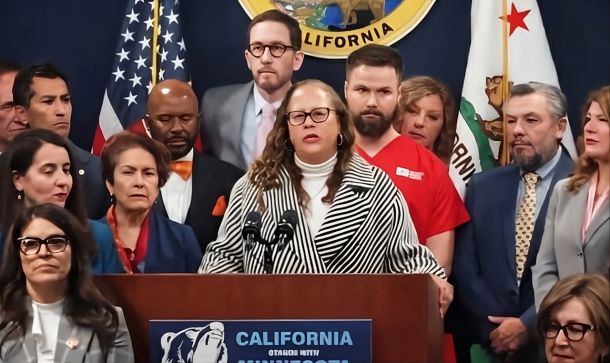 Sen. Laura Richardson (D‑San Pedro) spoke on behalf of the California Legislative Black Caucus at a Jan. 26 news conference condemning the fatal shooting of Minneapolis nurse Alex Pretti and other civilians by federal immigration agents, including U.S. Customs and Border Protection and ICE, in Minneapolis, Minnesota. (Screenshot)
Black Caucus Members Join Legislative Democrats to Condemn Fatal Shootings by Federal Agents
Led by Assembly Speaker Robert Rivas (D–Salinas) and Senate President Pro Tem Monique Limón (D–Santa Barbara), California Democratic lawmakers, including members of the California Legislative Black Caucus (CLBC), held a news conference in Sacramento on Jan. 26 to address recent fatal shootings of civilians by federal immigration agents in Minnesota and California.
Lawmakers expressed concern and outrage over the killings of Alex Pretti, a Veterans Affairs ICU nurse, and Renee Nicole Good, a poet, writer, and mother of three.
Sen. Laura Richardson (D–San Pedro) spoke on behalf of the CLBC, criticizing federal immigration enforcement practices and calling for accountability.
Richardson, who said she was previously married to a police officer, argued that Immigration and Customs Enforcement (ICE) and U.S. Border Patrol agents are not “making sure lawful activity is occurring.” She invoked the words of civil rights leader Dr. Martin Luther King Jr. to condemn what she described as public silence in the face of injustice.
“We are Californians. We are Americans, and we will not be silent. We will be here every time, every day, until this stops,” Richardson said.
Assemblymember Mark González (D–Los Angeles) recalled the names of people who were allegedly shot in January during enforcement operations involving ICE or U.S. Border Patrol agents.
On New Year’s Eve, Keith Porter Jr., 43, was allegedly shot and killed by an off-duty ICE agent in the Northridge neighborhood of Los Angeles. Authorities said the confrontation occurred outside an apartment complex after the agent alleged Porter fired celebratory gunshots into the air.
“What’s been happening there is not isolated. It’s part of a dangerous pattern of federal power turning inward on the people it claims to serve,” González said.
Following the news conference, Democratic lawmakers announced a slate of legislative proposals aimed at increasing oversight and limiting the involvement of state law enforcement in federal immigration enforcement.
During the briefing, Rivas described the fatal incidents as an “assault on the American right to life” and characterized federal agents’ actions as a form of “out-of-control violence.”
On Jan. 6, Assemblymember Isaac Bryan (D–Ladera Heights) introduced Assembly Bill 1537, titled “Peace Officers: Secondary Employment.” The bill would prohibit California peace officers from taking secondary employment, contract work, or volunteer roles with the U.S. Department of Homeland Security (DHS), its contractors, or any entity involved in immigration enforcement.
“Right now, California’s law enforcement officers can take second jobs with ICE,” Bryan, a member of the CLBC, wrote in a Jan. 27 Instagram post. “AB 1537
As California Hits Aging Milestone, State Releases Its Fifth Master Plan for Aging
On Jan. 27, California released its Fifth Master Plan for Aging Annual Report,titled “Focusing on What Matters Most,” outlining the state’s progress and priorities as its population rapidly grows older.
The report, issued by the California Health and Human Services Agency (CalHHS), provides updates on the Master Plan for Aging’s “Five Bold Goals”: housing, health, inclusion and equity, caregiving, and affordability.
The report comes as Californians aged 60 and older now outnumber those under 18 for the first time, a demographic shift expected to accelerate over the next decade.
“California’s Master Plan for Aging started a powerful movement that is shaping the future of aging in our state for generations to come,” Gov. Gavin Newsom said in a statement, calling the initiative a “future-forward” model delivering real results for older adults, people with disabilities, and their families.
Launched in 2021, the Master Plan for Aging takes a “whole-of- government” and “whole-of-society” approach, coordinating state agencies, local governments, community organizations, and private partners. The annual report highlights significant milestones, including more than 100 California communities joining AARP’s Age-Friendly Network and $4 million in state funding awarded to local organizations to develop aging and disability action plans in 30 communities statewide.
The report also underscores California’s leadership at the national level, noting that dozens of states have followed its example and that federal legislation inspired by the plan was reintroduced in the U.S. Senate in December 2025.
CalHHS Secretary Kim Johnson emphasized the plan’s focus on equity and resilience amid ongoing challenges.
“The Master Plan for Aging continues to provide a vision, a focus, and a platform for collaboration,” Johnson said. “Equity is at the center of all that we do.”
Looking ahead, the report notes that by 2030, one in four Californians will be age 60 or older, positioning the Master Plan for Aging as a central framework for meeting the state’s long-term social, economic, and health needs.
The full report is available at aging.ca.gov.
“Victory” for Voting Rights: Weber and Bonta Hail Judge’s Decision on Huntington Beach I.D. Law
California Attorney General Rob Bonta and Secretary of State Shirley N. Weber hailed a major legal victory for voting rights after the California Supreme Court declined to review a challenge brought by the City of Huntington Beach against the state, effectively ending the city’s attempt to impose voter identification requirements in municipal elections.
The high court’s action leaves intact a Fourth District Court of Appeal ruling that struck down Huntington Beach’s voter ID law, known as Measure A, finding it unlawful and preempted by state law. By rejecting the city’s petition for review, the Supreme Court has fully resolved the case in favor of the state, concluding litigation initiated by Bonta and Weber on April 15, 2024.
Measure A amended the Huntington Beach city charter to purportedly authorize voter identification requirements at polling places for municipal elections beginning in 2026. State officials argued the measure conflicted with California election law and was adopted without evidence of voter fraud in the city. Courts at every level agreed, rejecting the city’s claims that such requirements were necessary to protect election integrity.
“Today’s victory makes one thing crystal clear: No city in our state, charter and non-charter alike, is above the law,” Bonta said. “All along, Secretary of State Weber and I have maintained that Huntington Beach’s voter ID policy is illegal, and now, the state’s highest court has weighed in and agreed with us. Measure A won’t be taking effect — ever.”
Bonta also criticized city leaders for promoting unfounded concerns about election security. “Huntington Beach’s leaders have been parroting the Trump Administration’s talking points by questioning the integrity of our elections,” he said. “In court, the City’s allegations were resoundingly rejected. I remain fully committed to protecting the right to vote from baseless attacks.”
Weber emphasized the broader implications of the ruling for voters statewide.
“Today the California Supreme Court declined to review the Fourth District Court of Appeal’s decision prohibiting the City of Huntington Beach from implementing illegal voter identification requirements,”
Weber said. “As California Secretary of State, I have a responsibility to ensure that every eligible Californian can exercise their constitutional right to vote, and I take that duty seriously.”
Weber added that state law clearly supersedes local efforts to impose additional voting barriers.
“Attorney General Bonta and I have held steadfast that state law preempts the City’s attempts to impose illegal voting requirements on eligible voters and that Huntington Beach’s Measure A is unlawful,” she said. “This is another victory for California, for voters, and for democracy.”
The decision reinforces California’s uniform election standards and affirms the state’s authority to protect access to the ballot box across all jurisdictions.
Trump’s White House Pushes to Control L.A. Wildfire Recovery
The White House is moving to take control of wildfire recovery efforts in the Los Angeles County area, issuing an executive order that would shift rebuilding permit authority from state and local governments to the federal government following the January 2025 Palisades and Eaton fires.
The executive order signed Jan. 27 by President Donald Trump directs federal agencies to explore regulations that could override California and municipal permitting rules for homes and other structures destroyed in the fires. Land-use and rebuilding permits have traditionally been handled by cities and counties, making the move an unprecedented federal intervention into disaster recovery.
“I want to see if we can take over the city and state and just give the people their permits they want to build,” Trump told the media when signing the order.
The Palisades and Eaton fires destroyed about 16,000 homes, businesses, and other structures across Pacific Palisades, Altadena, and surrounding areas. According to local data, roughly 4,700 applications to rebuild have been submitted, with about 2,000 approved so far. Officials say the pace of rebuilding is consistent with recovery timelines from other major wildfires in California, where reconstruction often takes several years.
Gov. Gavin Newsom and Los Angeles Mayor Karen Bass quickly condemned the order, stating that it is unnecessary and legally questionable. Disaster recovery experts echoed those concerns, pointing to constitutional limits on federal authority over land-use decisions.
Trump’s order calls on the Federal Emergency Management Agency (FEMA) and the Small Business Administration to consider allowing builders to self-certify compliance with health and safety regulations to receive federal approval.
The dispute has become another flashpoint in the ongoing political battle between Trump and Newsom. The governor has requested $33 billion in federal disaster aid that has not yet been approved, while survivors continue to face challenges related to insurance payouts, high rebuilding costs, and legal disputes tied to the cause of the fires.
“Instead of finally sending to Congress the federal relief Los Angeles needs to rebuild from last year’s firestorms, Donald Trump continues to live in fantasy land,” Newsom wrote on X.
Bass said the White House could speed recovery by approving disaster aid and pushing insurers and lenders to support affected residents.
Trump’s order calls for draft regulations within 30 days and final rules within 90 days.
Gov. Newsom, AG Bonta to Local Law Enforcement: You Have Authority to Investigate Federal Agents
Gov. Gavin Newsom and California Attorney General Rob Bonta issued a bulletin Jan. 27 reminding state and local law enforcement agencies that they have the authority to investigate potential violations of state law committed by federal agents, even when federal authorities do not cooperate.
The guidance, released by the California Department of Justice (DOJ), emphasizes that local and state police have concurrent jurisdiction in cases involving federal officers and are not required to defer to federal investigations. The bulletin follows recent federal officer-involved shooting deaths in Minnesota and California.
The bulletin states that federal and state law enforcement have long worked together on investigations that can result in both federal and state charges, but recent actions by the federal government have raised concerns about obstruction and a lack of transparency. California officials say those developments require state and local agencies to be prepared to assert their legal authority.
“Especially when a fatal shooting occurs, no one should be allowed to rush in, seize evidence, and control the narrative before state and local law enforcement have lawful access,” said Newsom. “Transparency isn’t a talking point; it’s a legal and moral requirement.”
Bonta said federal agents do not have absolute immunity from state criminal prosecution and warned against claims suggesting otherwise.
“Let there be no question: State and local law enforcement in California have authority to investigate potential violations of state law, even when those violations are committed by federal agents,” said Bonta. “Federal courts have long recognized that federal agents do not have absolute immunity from state law prosecution.”
The bulletin advises agencies that states have primary authority to investigate and prosecute violations of state criminal law, including cases involving federal officers. It also notes that the California DOJ is available to assist local agencies and can seek court orders to preserve evidence or secure access to crime scenes if needed.
California officials pointed to a Minnesota case in which a Trump-appointed federal judge ordered the federal government not to destroy evidence amid allegations that federal authorities interfered with a state investigation into a fatal shooting involving a federal officer.
The move comes amid broader legal battles between California and the Trump administration over federal law enforcement practices. In recent months, Bonta has led or joined court filings challenging federal deployments and enforcement actions, while Newsom has opposed what state leaders describe as unlawful federal overreach.
The DOJ encouraged Californians to report alleged misconduct by federal agents through its online reporting portal, saying the state stands ready to investigate and, where warranted, pursue charges under the California Penal Code.
Cracking Down on Human Trafficking, California DOJ Announces 120 Arrests
The California Department of Justice (DOJ) announced on Jan. 26 that 120 people were arrested during a coordinated, multi-county law enforcement operation aimed at disrupting human trafficking and connecting survivors with support services.
The arrests stem from Operation Stand On Demand, a six-day effort conducted from Jan. 19 through Jan. 24 across San Diego, Sacramento, Tulare, and Fresno counties. It involved more than a dozen state and local law enforcement agencies working together to target individuals involved in sex trafficking, including traffickers and buyers.
“This operation reflects an ongoing commitment by California law enforcement to target those who fuel trafficking and exploitation,” said Attorney General Rob Bonta.
According to the California DOJ, 87 arrests were made for loitering, 25 for solicitation, and eight for pimping and pandering. Officials said the operation focused on reducing demand for commercial sexual exploitation while prioritizing a survivor-centered approach.
“It’s a coordinated, multi-county law enforcement effort focused on disrupting sex trafficking, holding perpetrators accountable, and connecting survivors with support,” said Bonta.
San Diego County accounted for the majority of enforcement activity during the operation. District Attorney Summer Stephan said law enforcement agencies worked around the clock to identify and arrest individuals attempting to purchase sex.
“Our officers, in less than one week during this operation, took action, not words, by working around the clock and arresting and citing 105 people who thought that they were going to go out and buy a human being like they’re a hamburger or a slice of pizza,” Stephan said.
San Diego County Sheriff Kelly Martinez chimed in.
“Communities like Santee and San Marcos, which were part of this operation, face unique vulnerabilities tied to transportation routes, student populations, and employment opportunities,” she said.
Bonta said the arrests are part of broader statewide efforts to combat human trafficking. Since 2021, the Attorney General’s Office said its human trafficking task forces have led to more than 900 arrests and connected more than 1,000 survivors to services and resources.
“Human trafficking is a complex, devastating crime, but when we work together, we can make a real difference, and this operation is proof positive of that fact,” Bonta said.
California DOJ officials said similar operations will continue as part of the state’s ongoing strategy to combat human trafficking and protect vulnerable communities.
Related