
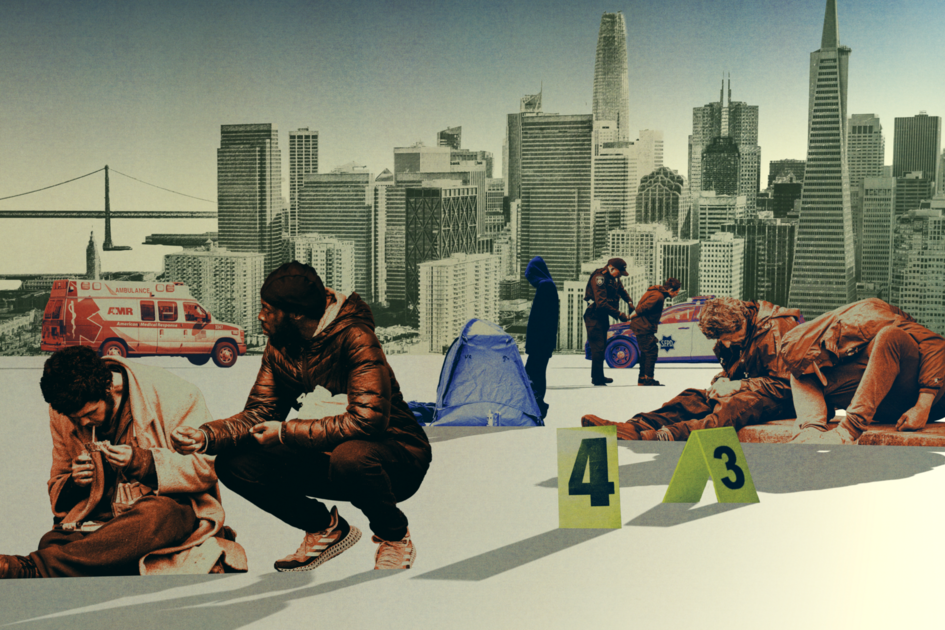
The coroner’s office struggled to keep up.
During a 24-hour-span on Aug. 8, 2023, nine people in San Francisco died from drug overdoses, eight of them from fentanyl. Eight were collected from apartments across the city. One was found on the street across from City Hall.
That month, drugs killed 88 people. By the end of 2023, the annual overdose death toll was 810, the highest ever recorded.
Downtown was dotted with sick and dying people, in wheelchairs or wrenched in the familiar fold or splayed out on the cold concrete. Local heroes, artists, neighbors, friends, and relatives lost their lives. In the face of so much death, public health experts were befuddled, and political careers crumbled.
August 2023 would mark peak destruction of a fentanyl epidemic that has gripped not just San Francisco but the U.S. Since then, the trend has turned as the city has made progress in preventing the worst of the drug’s impacts.
Yet fentanyl’s death grip on the city has not fully loosened.
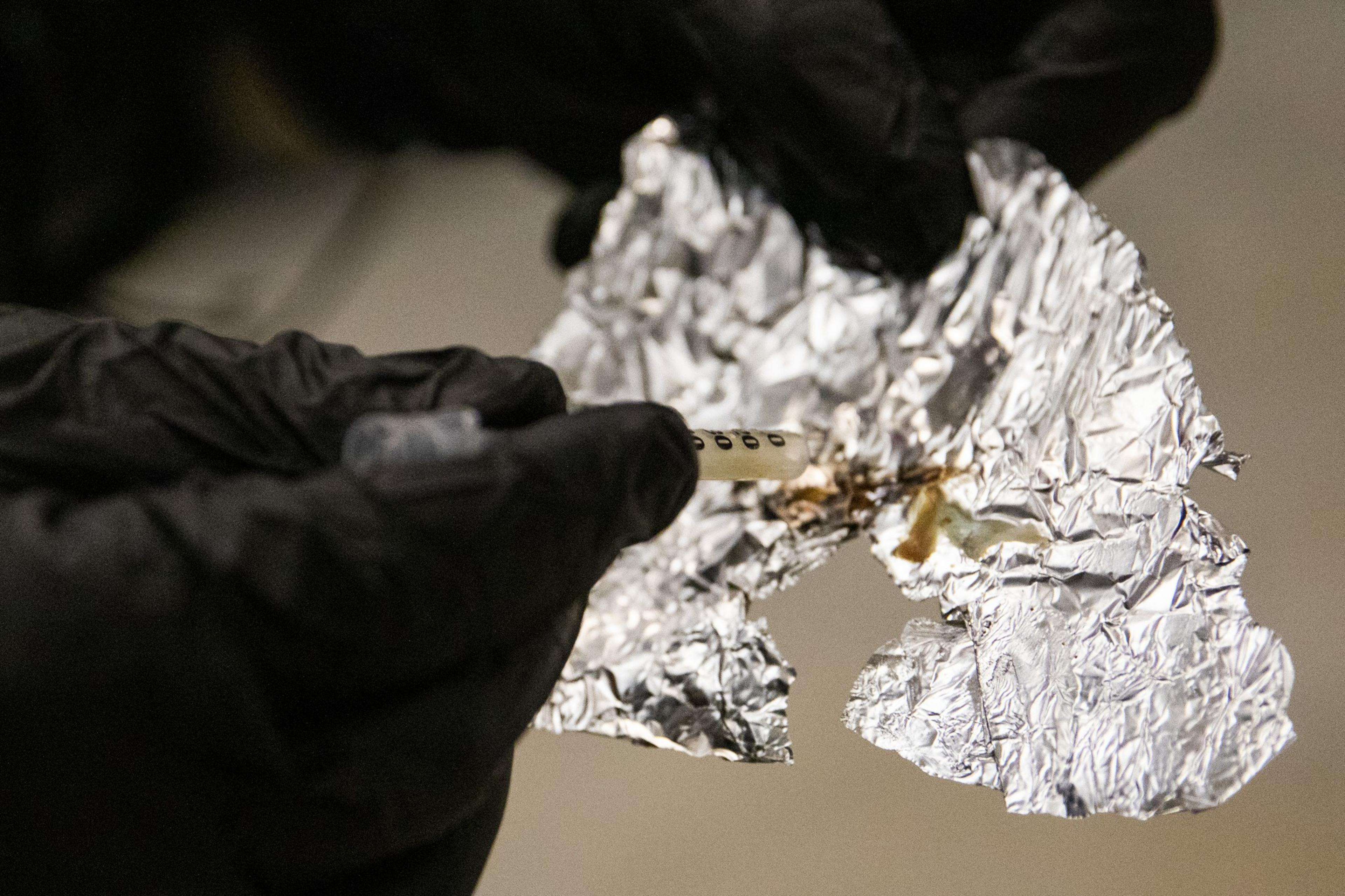 A BART police officer displays fentanyl he confiscated while patrolling the Civic Center BART Station. | Source: Jessica Christian/SF Chronicle/Getty Images
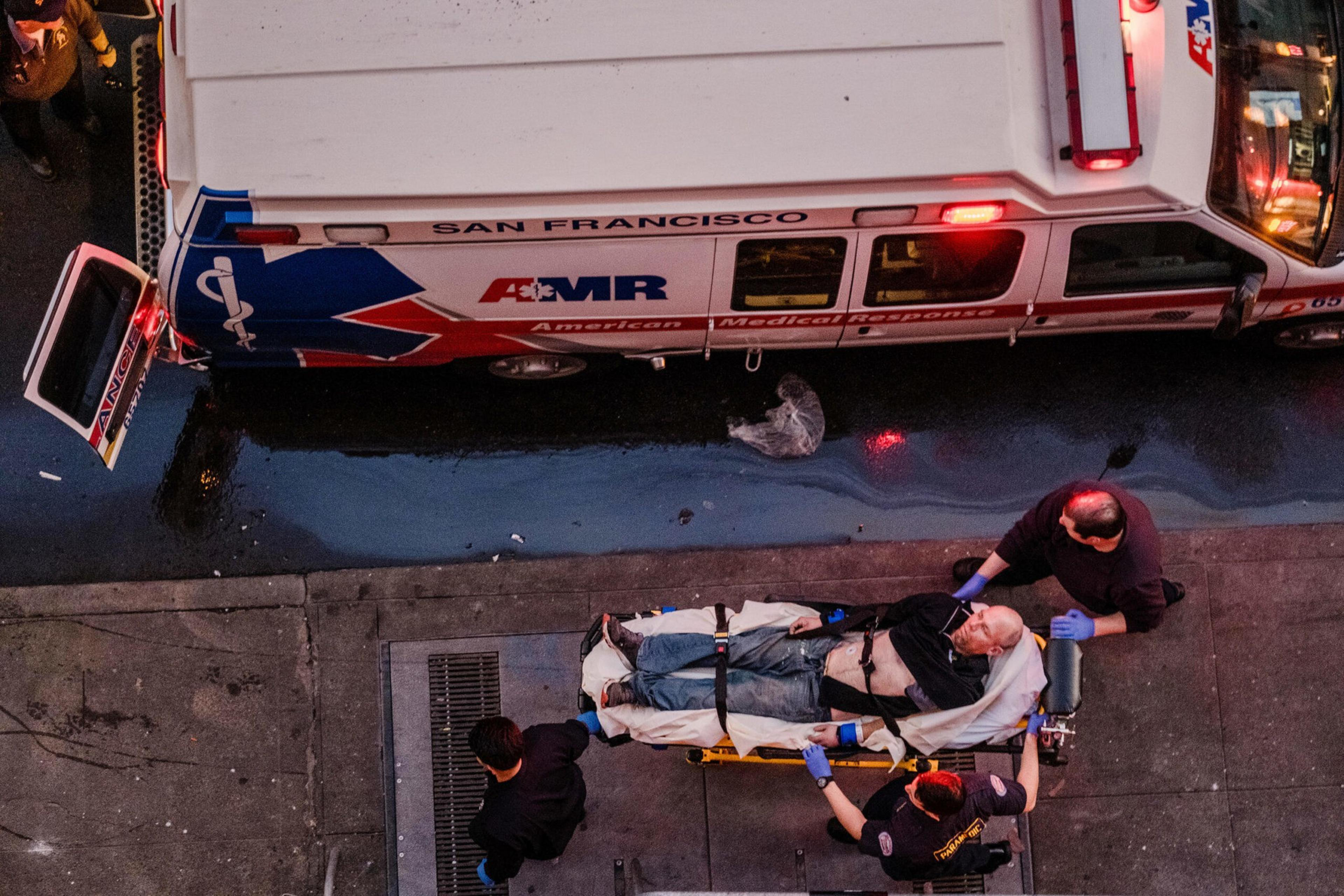 A person who overdosed is wheeled away on a stretcher toward an ambulance by EMTs in the Tenderloin. | Source: Nick Otto for The Standard
The annual overdose death rate has declined 23% from its peak in 2023. But last year, more people died from fentanyl than the year before, according to preliminary data. By the end of 2025, 10 years after the drug’s emergence in the city, fentanyl had killed more than 3,000 people in San Francisco.
Some say the drug — unprecedented in its narcotic effects and deadly risks — was an unstoppable force. Others say this didn’t need to happen in a city known for its progressive approach to substance use.
In the early days of the epidemic, reactions from officials and advocates were subdued as efforts to raise public awareness conflicted with a deep culture of drug tolerance. And still, a decade into the disaster, city hall is torn between celebrating a slight decline in the number of deaths and keeping the fentanyl problem from making additional headlines.
Last month, Public Health Department leaders stood before reporters to announce 2025’s overdose death toll: 621 people, enough to hold hands around the perimeter of City Hall.
Representatives of three media organizations attended the press conference, a noticeable decrease from when SF’s fentanyl addiction dominated national headlines.
The faces responding to the crisis have changed as well. Public Health Director Dan Tsai was appointed to the role last year following his work as federal Medicaid chief, with the hope that he could transform San Francisco’s healthcare system to better serve those suffering on the streets.
At the press conference, Tsai said the 2025 numbers made him hopeful. But he struggled to explain what they indicate and where the city goes from here.
“There’s not one single factor, and the numbers, I expect, will continue to go up and down,” Tsai said. “I will always emphasize that every single death from an overdose is unacceptable. But I am pleased with the direction we have been trending.”
Everyone is ready for this to be over.
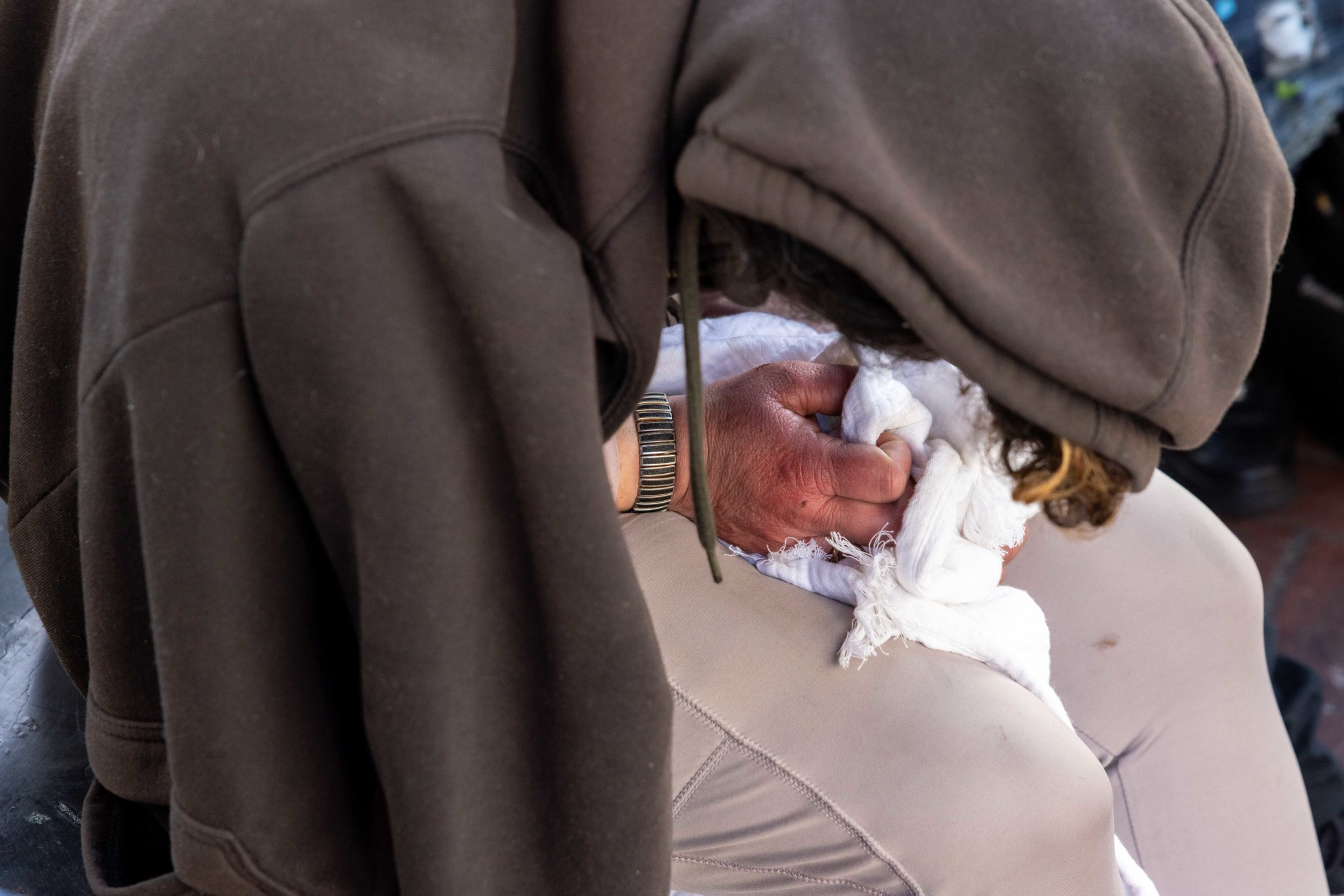 A person who appears to have Puffy Hand Syndrome, common among IV drug users. | Source: Amanda Andrade-Rhoades/The Standard
But in fact, the city’s decline in overdose deaths mirrors a nationwide pattern, indicating that it is not due to any strategy unique to San Francisco. No one knows if the downward trend is going to last. And aspects of the current strategy under Mayor Daniel Lurie, such as widespread arrests for drug possession and a ban on public distribution of clean smoking supplies, contradicts advice from many local health experts — so much so that it is driving some exhausted longtime advocates away from the city.
A decade after fentanyl made San Francisco the West Coast capital of opioid overdose, the city is still at a loss over how to meaningfully treat the plague.
The first hit
Ten years ago, San Francisco was on the rise. But so was a threat to its existence.
For the first time, Mexican drug cartels were mass-producing fentanyl, a synthetic opioid invented in 1959, for recreational use. The drug, made largely with chemicals sourced from China, was cheaper and easier to manufacture and ship than other opioids. East Coast cities felt its wrath first. In 2015, more than 9,500 people died from the drug nationwide.
San Francisco thought it might be protected from the crisis. The city was long a hub for heroin; the needles littering downtown sidewalks were proof. But heroin was consumed mostly in the form of black tar, which is more difficult to mix with contaminants than the white, powdered opioids prevalent on the East Coast.
Whatever was coming, the city’s health apparatus appeared to be prepared. San Francisco was a model for harm reduction, a philosophy based on treating drug users with compassion and reducing stigma by centering autonomy in healthcare. This approach has been credited for curbing the spread of HIV and reducing overdoses during a spike of heroin abuse in the ’90s.
Experts and local leaders were bullish.
“I was jaded or a little resistant to the alarms going off,” admitted Dr. Daniel Ciccarone, one of the city’s leading drug researchers. “I’m not proud of that.”
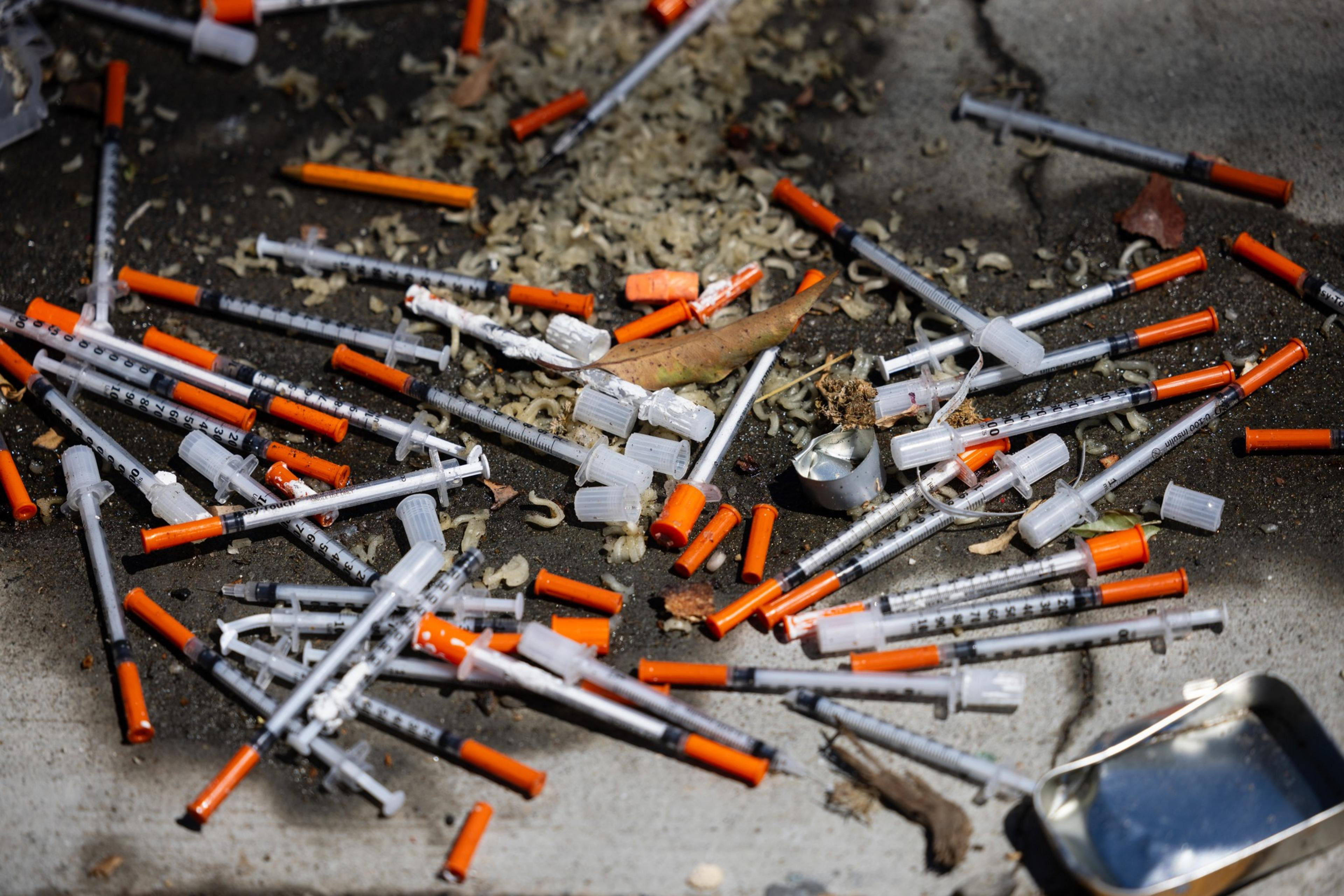 Syringes on Ingalls Street and Underwood Avenue in the Bayview. | Source: Isaac Ceja/The Standard
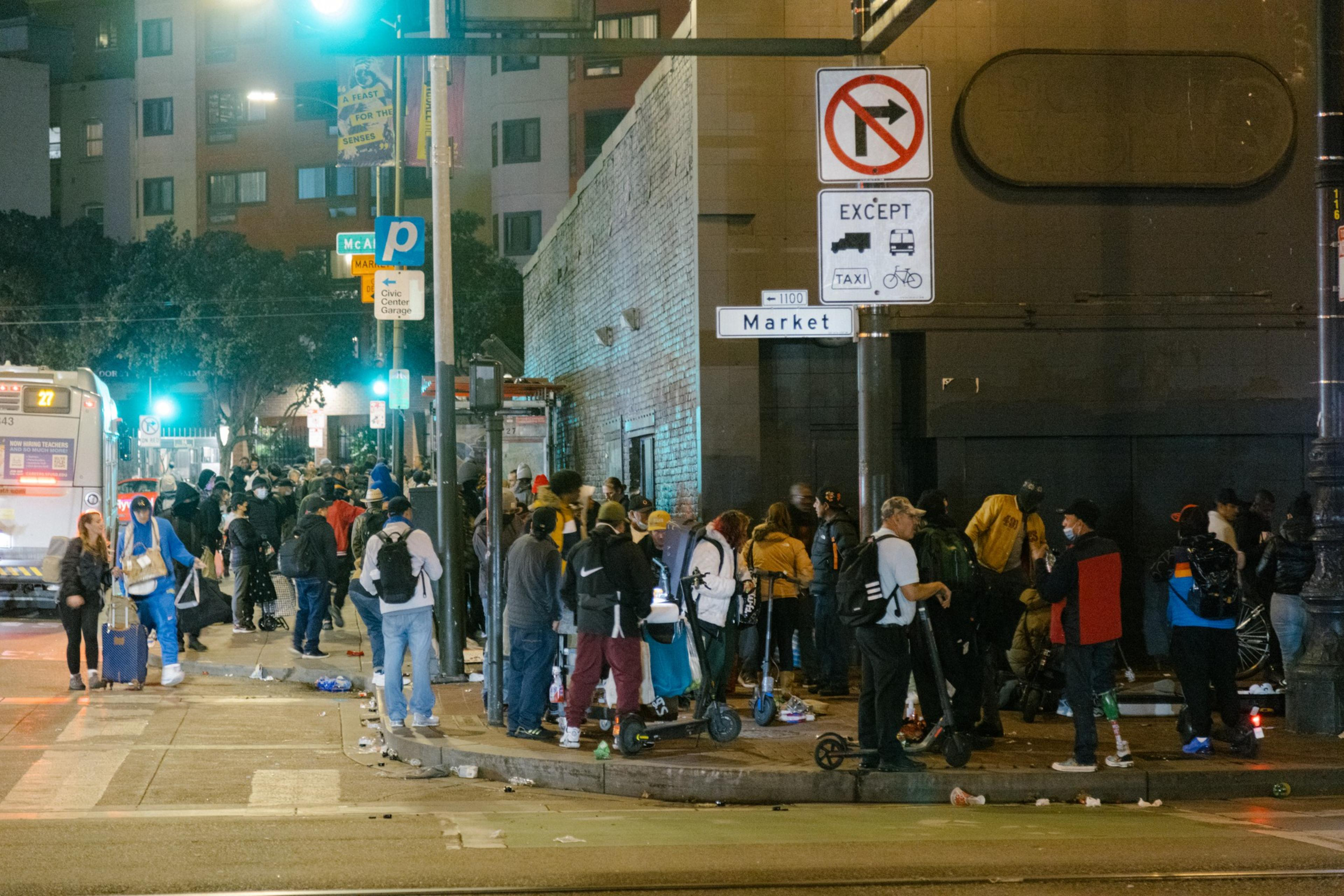 People congregate on the corner of Market Street and Charles J Brenham Place. | Source: Jason Henry for The Standard
In July 2015, service providers conducted 75 overdose reversals linked to a new powdered heroin cut with fentanyl. Providers reported that most users tried to avoid it — they knew it could kill them. The following month, the Department of Public Health issued its first advisory.
Many front-line workers saw a haunting inevitability. Some had calls with officials and advocates working on the problem on the East Coast, hoping to glean information on how to prepare. Even so, advocates were hesitant to raise the alarm — scared of bolstering anti-drug narratives they thought would be used to justify criminalizing drug users.
“We were trying not to be hysterical,” recalled Paul Harkin, who was an outreach worker for the nonprofit Glide at the time. “Some of the programs dialed back the messaging because they didn’t want to act like every bag of crack had fentanyl in it.”
In October 2015, the city saw its first fentanyl deaths: Three fatal overdoses were linked to the synthetic opioid. Two of the victims had consumed counterfeit Xanax pills; the other had used heroin.
The first died the morning of Oct. 15. Her boyfriend had also taken the Xanax pills but recovered. She was found in bed, without a pulse. Her mother is still too traumatized to speak of her 34-year-old daughter’s death.
The Department of Public Health issued another health advisory, and news outlets picked up the story. But by 2016, a market for fentanyl was forming, and dealers were selling it as a product, according to the city’s annual substance-use trends report.
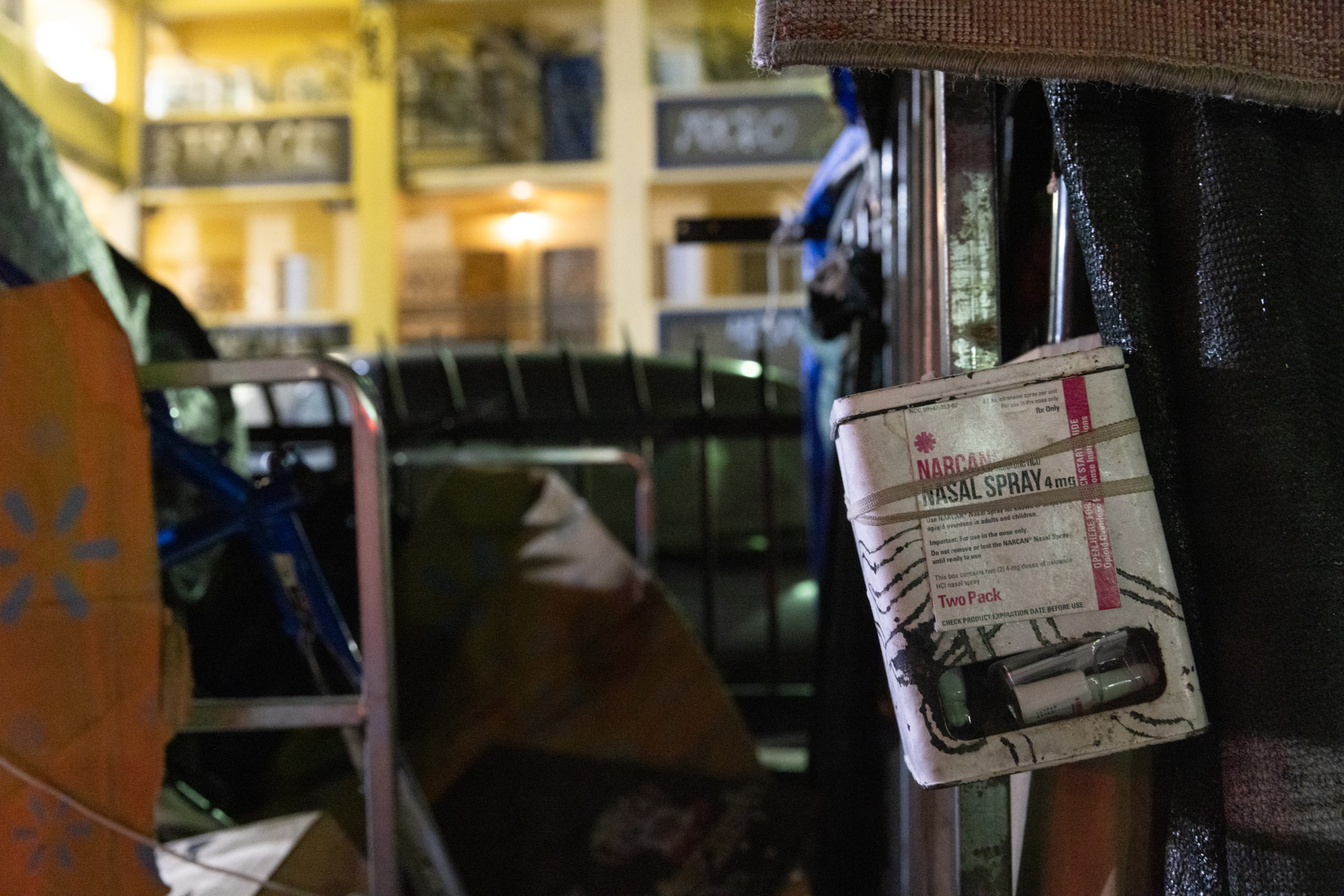 Narcan nasal spray is strapped to a shelter along Ellis Street near the Civic Center Inn in the Tenderloin. | Source: Benjamin Fanjoy for The Standard
Harm-reduction providers widely pushed for more drug testing and training on how to use the overdose-reversal drug Narcan. They advocated to open safe consumption sites, where people with Narcan and training would be on hand to save lives. Local leaders shared widespread support for these facilities, with soon-to-be Mayor London Breed stepping up as one of the most vocal supporters.
By the end of 2016, 21 people had died of fentanyl overdoses. By 2017, it was drug dealers themselves who began warning outreach workers that fentanyl was coming, Harkin said. It was just the beginning.
The addiction
Tom Wolf first heard of fentanyl during the six months he spent addicted to drugs and living on San Francisco streets in 2018. The year before, 26 people had died of a fentanyl overdose. It remained a quiet problem, isolated in public health literature and anxious meetings among officials and advocates.
Wolf’s preference was heroin. But everything was about to change.
As he remembers it, fentanyl’s scourge accelerated thanks to a middle-aged man who claimed to be a doctor from Oakland. Every week, the man would bring a supply of fentanyl to the Tenderloin and bestow it upon a few drug users he trusted to sell his product.
“At first people were curious about it and wanted to try it,” Wolf said. “Then, when people started dying, there became an awareness campaign on the streets.”
 Source: Jeremy Chen/The Standard
In the shelters, staffers were noticing a change in their clients. Users were often not alert enough to receive assistance. Lydia Bransten, who was managing the food hall at St. Anthony’s church, remembered people falling asleep while they ate.
“They were using more often, and when they used, they were obliterated,” Bransten said. “They use, they pass out, they wake up, they use again, they pass out. So their ability to connect to services was declining.”
Workers were responding to more overdoses. But, at the time, a dose of Narcan cost $125, Bransten recalled. Back then, the medication was difficult to use because it was administered as an injection into the muscle rather than a nasal spray, as it is commonly found today. It also had a negative stigma. Bransten remembers receiving a citation at work for teaching clients how to use Narcan.
“There was a feeling of helplessness,” Bransten said. “So many people were dying, and we didn’t have the tools to assist them, nor did we have the language or the capacity.”
On the streets, the used needles were disappearing, but that wasn’t good news. They were replaced by scorched tin foil and other smoking utensils — a hallmark change between heroin and fentanyl. The social nature of smoking led users to gather in larger groups, according to Ciccarone, who has published studies on the trend.
“Injecting is a private behavior,” Ciccarone said. “People started finding out they could smoke fentanyl just as well as they could inject it. And it was social.”
Through 2019, heroin use on the streets dried up. Many users didn’t want fentanyl, but the addicted suddenly had no other choice.
“Nobody wanted it,” Harkin said. “The market directed them to it.”
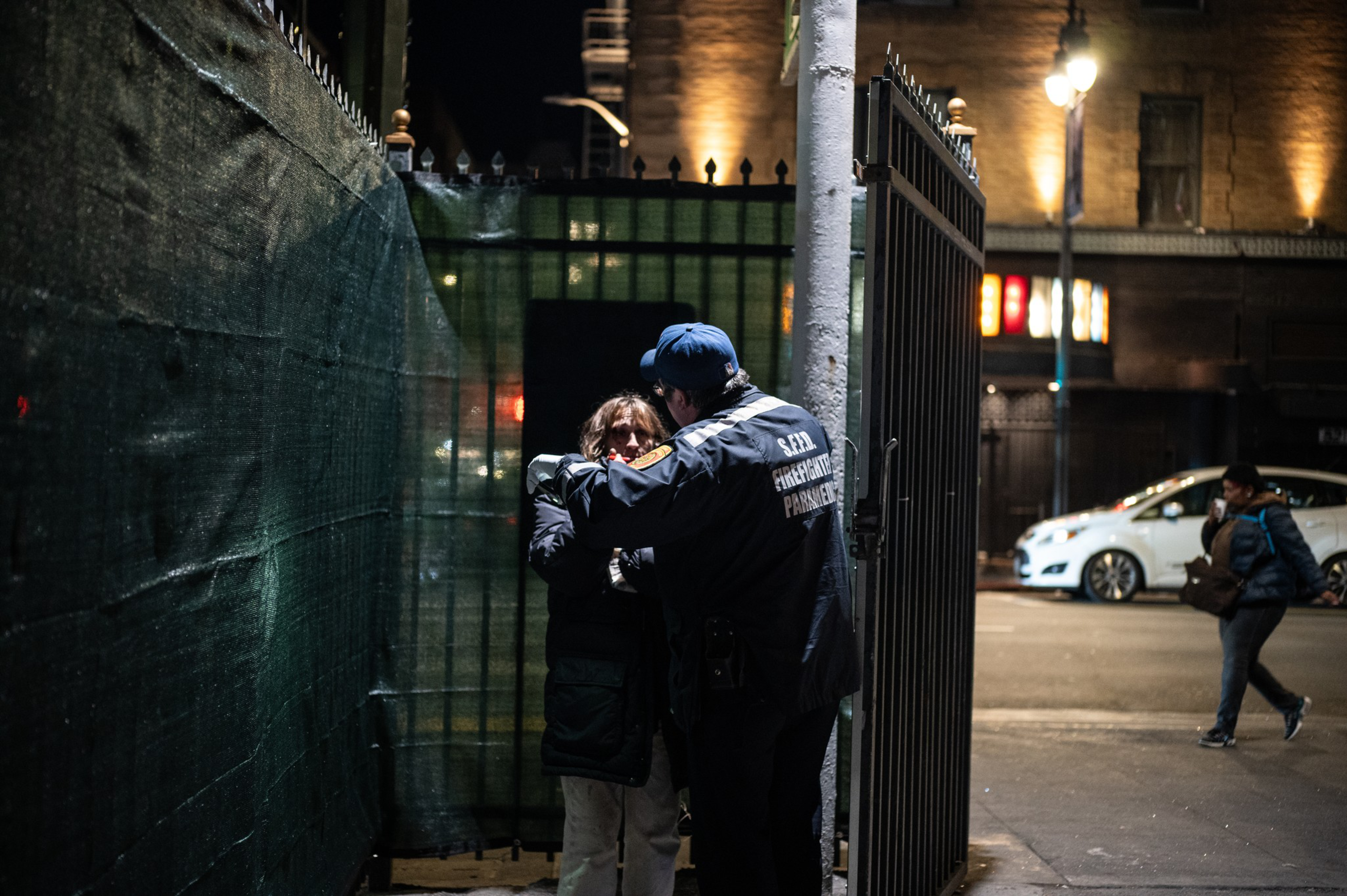 Source: Pablo Unzueta for The Standard
The goalposts started to shift. Health workers say they became less focused on directing clients to treatment and more concerned with simply keeping them alive. Advocates intensified calls for supervised consumption sites, but the shift from injecting to smoking meant drug use could no longer take place indoors.
By the time the Covid pandemic hit, fentanyl was everywhere.
In 2020, 726 people died of overdoses. At makeshift shelters in hotels, they died in isolation. On the streets, they died as bystanders watched.
When San Franciscans emerged from their homes in 2021, wearied by the pandemic and social unrest, they found not only a city hollowed out by Covid shutdowns but a community battling a different deadly epidemic.
The harm-reduction advocates on the frontlines of the emergency were blamed by a shocked public for letting things get so bad. It was the beginning of the end of their period of power, as a city desperate for solutions leaned away from compassion and toward punishment.
“They started saying harm reduction is killing people, when it was actually the complete opposite,” Harkin said. “Everyone is entitled to their opinion, but Joe the Plumber’s shouldn’t be given the same weight as a professor of addiction medicine.”
Wolf became a prominent critic of harm-reduction strategies, and of local politicians.
“London Breed kept going back to the same solutions, the same organizations, the same harm-reduction model,” Wolf said. “It wasn’t solving it. It wasn’t getting better.”
Breed’s hometown, hurting and hopeless, turned on her. Under local and national pressure, she oscillated on her drug policy stance, first promising a crackdown, then opening a safe consumption site, only to close it less than a year later in response to complaints from Tenderloin residents.
The public begged city leaders to further empower police, and Breed obliged. In 2023, hundreds of drug users were arrested for possession, and more died by overdose than ever before.
The withdrawal
San Francisco’s fortunes changed seemingly overnight. In 2024, fatal overdoses declined meaningfully — 21% — for the first time since fentanyl hit the market.
Both sides of the city’s debate rushed to take credit. One faction argued that the crackdown was finally having an impact. Others countered that the decline could be more readily attributed to the increased distribution of Narcan.
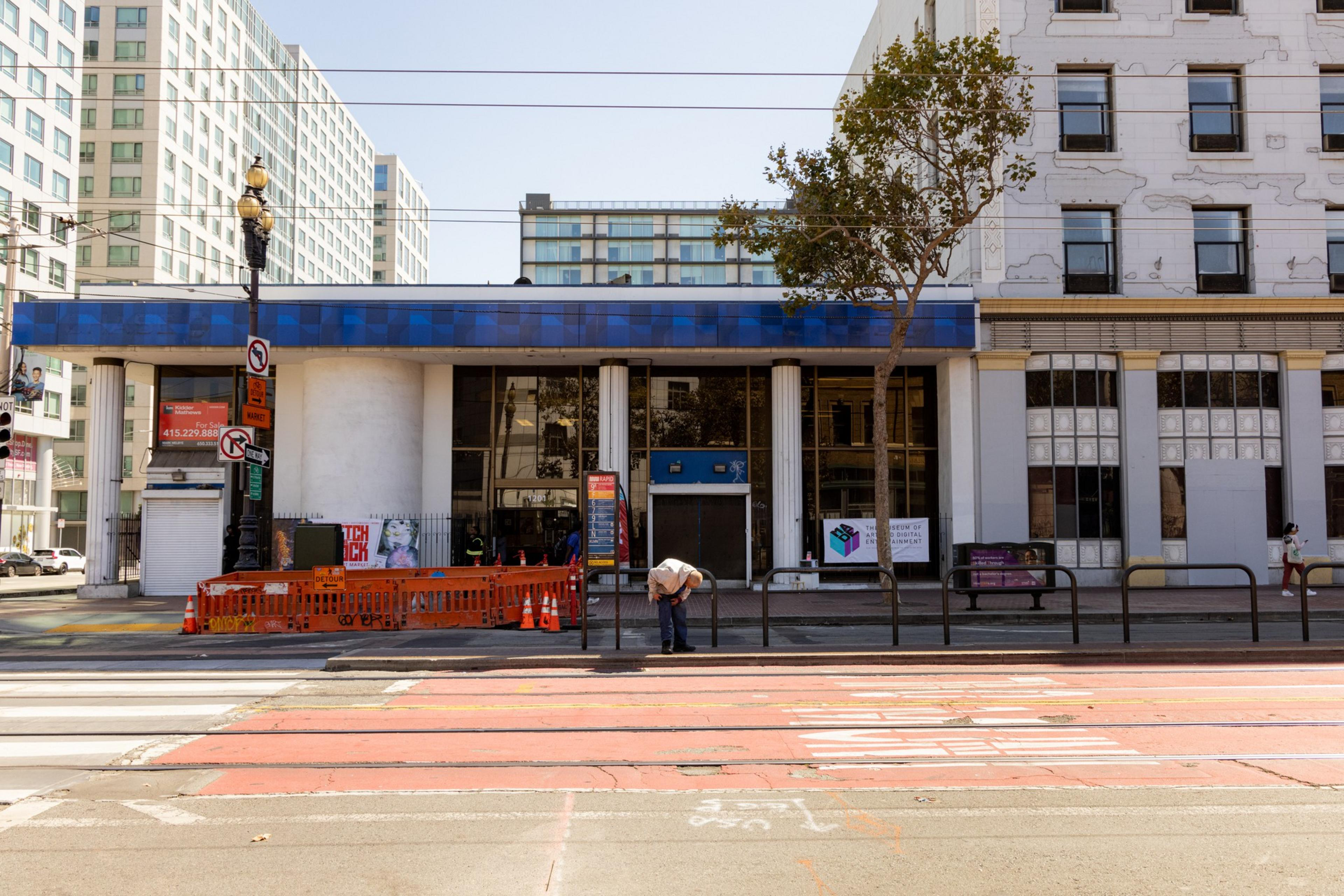
To close observers, however, it appeared something else was happening. San Francisco wasn’t alone: Cities across the U.S. were experiencing roughly the same rate of decline in fentanyl overdoses. Nothing any one city had done was working much better than any other.
 Source: Jason Henry for The Standard
Some questioned whether the population of drug users was just disappearing. Between 2020 and 2023, more than a quarter million people died from fentanyl in the U.S. It was possible, experts offered morbidly, that there were only so many opioid users left.
Others noted that the sudden and coordinated decline in overdoses resembled “supply shock,” in which a disruption in the drug market led to a sudden drop in potency — and thus, a drop in deaths.
On San Francisco streets, drug users reported that the fentanyl just wasn’t as strong as before. Some nicknamed it “soap,” because it was mixed with hygiene products. Drug Enforcement Administration data supported these reports, showing potency dropped 6% between 2023 and 2024.
In late 2023, reports emerged (opens in new tab) that the Sinaloa cartel was backing out of the fentanyl trade. In Culiacán, Mexico, the cartel’s base, where most fentanyl was produced, banners hung above roadways warning, “Business dealing with fentanyl is strictly prohibited.” Dead bodies were displayed next to mounds of baby-blue fentanyl pills in grim public demonstrations. Fentanyl cooks reportedly took their labs into the mountains, and the drug money dried up (opens in new tab).
Around the same time, President Joe Biden reportedly made progress on talks with China to curb its production of fentanyl ingredients, known as precursors. In January, a study linked the decline in overdoses to China’s crackdown on precursors.
The drop in potency had a near-instant impact. Some users took it as a sign to get their lives together, inspiring a rush of patients at San Francisco treatment centers. Others became more desperate, spending most of the day scrounging for the money needed to get a fix — only for the less powerful drugs to leave them in painful withdrawal, and broke.
“It’s not fun anymore,” Carmen Sierra, a drug user in the Tenderloin, told The Standard in September 2024. “The drugs we’re doing have gone so far away from what we were originally trying to do.”
The recovery
San Francisco wants to believe it’s in recovery. Public outrage over the epidemic, and the city’s handling of it, has seemingly faded. The national headlines, the impassioned City Hall diatribes, the legislation, and press conferences have slowed.
But the facts are more complex. For six consecutive years, an average of roughly two people have died by overdose every day in San Francisco.
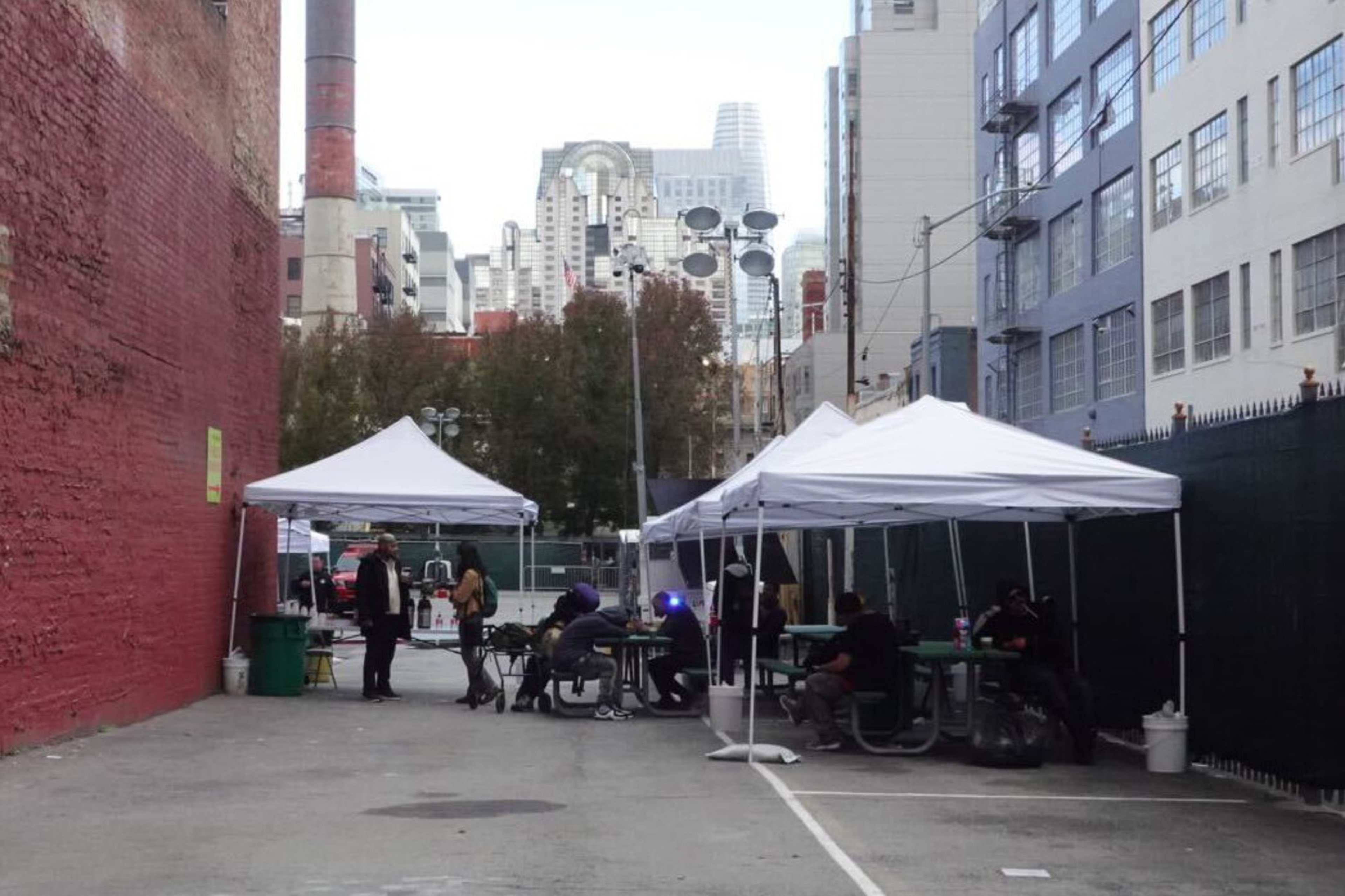 An SFPD triage center for quickly transporting arrested drug users and dealers to jail. | Source: David Sjostedt/The Standard
 A person smoking drugs at a night market near UN Plaza. | Source: Jason Henry for The Standard
In October and December 2025, the city logged its lowest monthly overdose death tolls since 2019. City leaders appear eager to take credit.
The Public Health Department has increased the availability of drug treatment, as well as access to overdose reversal medications. And the law-and-order approach to opioid addiction remains. Widespread enforcement of drug use and dealing has continued, with officers confiscating more than 340 pounds of fentanyl from the streets between May 2023 and November 2025.
Since the early days of his campaign, Lurie has railed against safe consumption sites. In April, he instituted a ban on providing clean paraphernalia in public. In May, the Board of Supervisors passed an ordinance that made “recovery-first” the city’s official drug policy.
Demoralized and stripped of the influence they once had, some health advocates have left the city as local leaders have backtracked on policies they say are best practices for minimizing drug-related deaths.
But deaths by fentanyl have remained largely flat, even rising in 2025, though still down from their 2023 peak. And compared to the U.S. overall, which saw a 26% decrease (opens in new tab) in overdose deaths between 2023 and 2024, the city’s 23% decline remains slightly behind the curve.
Despite research suggesting a correlation between fentanyl potency and overdose rates, the Public Health Department remains unable to collect and compile data on the strength of the city’s fentanyl supply from its test sites. Some experts say this is a strategic blind spot.
Between November 2023 and August 2024, the city operated a program to test wastewater for novel drugs but quietly ended the initiative after it was deemed ineffective. At January’s press conference, Tsai said the Public Health Department is keeping tabs on the drug supply through word of mouth.
“How people are feeling about the potency, our team hears about that pretty much instantaneously,” Tsai said. “Regardless of what is happening with that piece, if we don’t have a system of care that can quickly get people plugged into we will have no shot at helping.”
On the streets, users say stronger fentanyl shows up from time to time. It’s unclear whether this indicates a change in supply or a fluctuation in drug users’ tolerance.
The data that does reach the city is delayed. Every month, experts, advocates, and concerned members of the public wait for the medical examiner to release the latest report, hoping that we aren’t on the verge of a relapse.
A decade since the epidemic began quietly, San Francisco is still addicted to fentanyl. The city remains at the whim of a bad batch.