
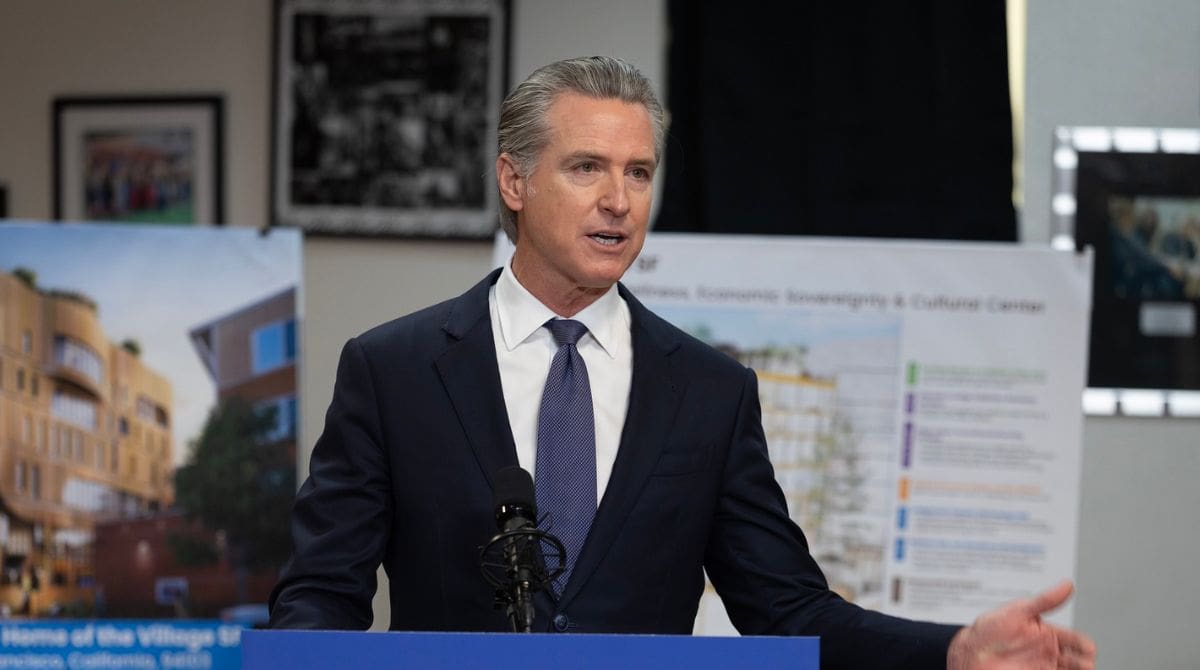
Governor Gavin Newsom celebrated a major legal victory Wednesday after the U.S. Supreme Court declined to hear a Republican-backed challenge to California’s newly adopted congressional district maps.
The court’s decision clears the way for California to move forward with revised district boundaries under Proposition 50, with the new maps set to take effect beginning with the 2026 congressional elections.
The legal challenge was brought by California Republicans and supported by President Donald Trump’s administration.
Republicans argued in court filings that Proposition 50 improperly replaced California’s voter-approved independent redistricting system with maps drawn by the state legislature, calling the move overtly partisan.
Newsom framed the ruling as a direct rebuke of partisan redistricting efforts led by Republicans nationwide.
“Donald Trump said he was ‘entitled’ to five more Congressional seats in Texas. He started this redistricting war. He lost, and he’ll lose again in November,” Newsom said in a joint statement with Attorney General Rob Bonta.
Donald Trump said he was ‘entitled’ to five more Congressional seats in Texas. He started this redistricting war. He lost, and he’ll lose again in November.
— Governor Gavin Newsom (@CAgovernor) February 4, 2026
Bonta also praised the decision, calling it a win for California’s democratic process.
“Governor Gavin Newsom and our Legislature advanced Proposition 50, presented it to the voters, and Californians overwhelmingly supported it,” Bonta said.
Republican opposition to California’s new congressional maps intensified last year following a broader national redistricting battle, including reports that President Donald Trump had urged Texas Republicans to redraw districts to favor the GOP, the Associated Press reported.
At the time, Republicans held a narrow majority in the U.S. House of Representatives, with 218 seats compared to 214 held by Democrats.
In August, Texas lawmakers approved a revised congressional map despite a walkout by Democratic legislators.
Meanwhile, Newsom advanced Proposition 50, a California ballot initiative designed to counter the Texas map and potentially increase Democratic representation by five seats, elevating redistricting into a national fight over control of Congress.
Proposition 50 replaces California’s existing congressional maps with new ones drawn by the state legislature. While the total number of districts remains unchanged, the maps must comply with federal law but are not required to follow California’s stricter redistricting rules, according to the Legislative Analyst’s Office.
The legislatively drawn maps will be used starting with the 2026 elections and remain in place until new districts are drawn following the 2030 U.S. Census. The measure also calls on Congress to require independent redistricting commissions nationwide.
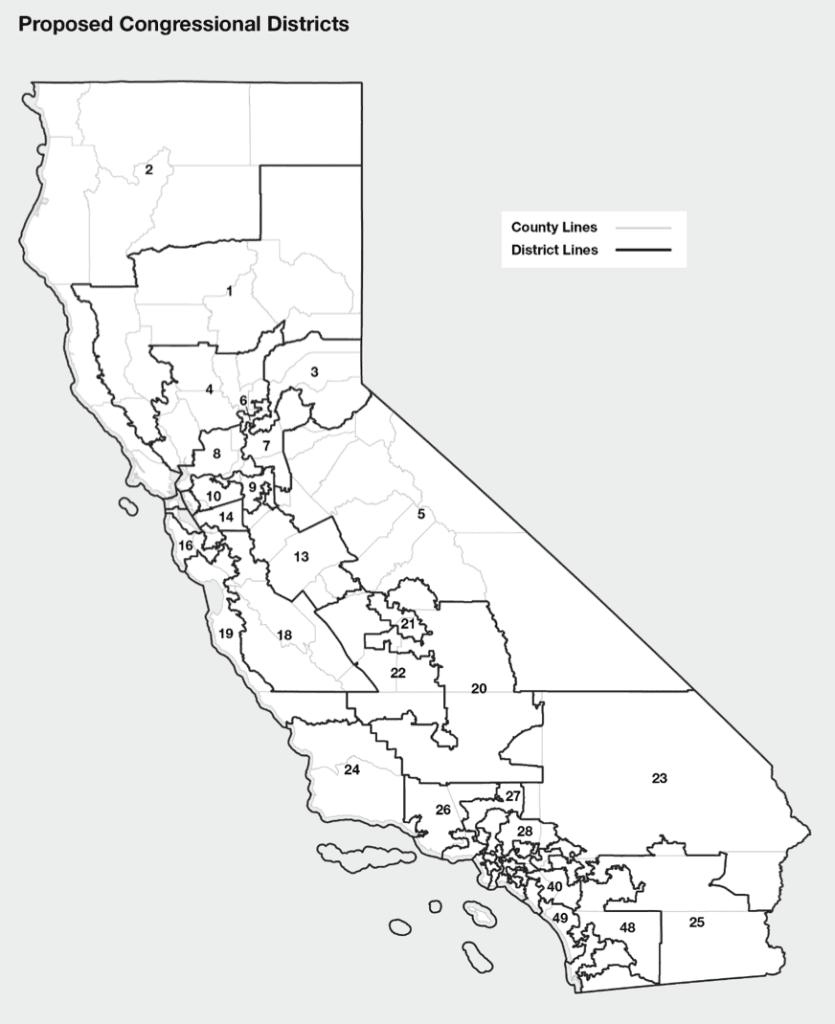 Proposed Congressional District. Image Source: Legislative Analyst’s Office
Congressional redistricting is tied to the structure of the U.S. House of Representatives, which has 435 members elected every two years. Each state’s number of House seats is based on population figures from the U.S. Census, conducted every 10 years.
California currently has 52 congressional districts, which are redrawn after each census to reflect population shifts.
With the Supreme Court declining to intervene, California will move ahead with the new congressional maps, setting the stage for the 2026 elections.