
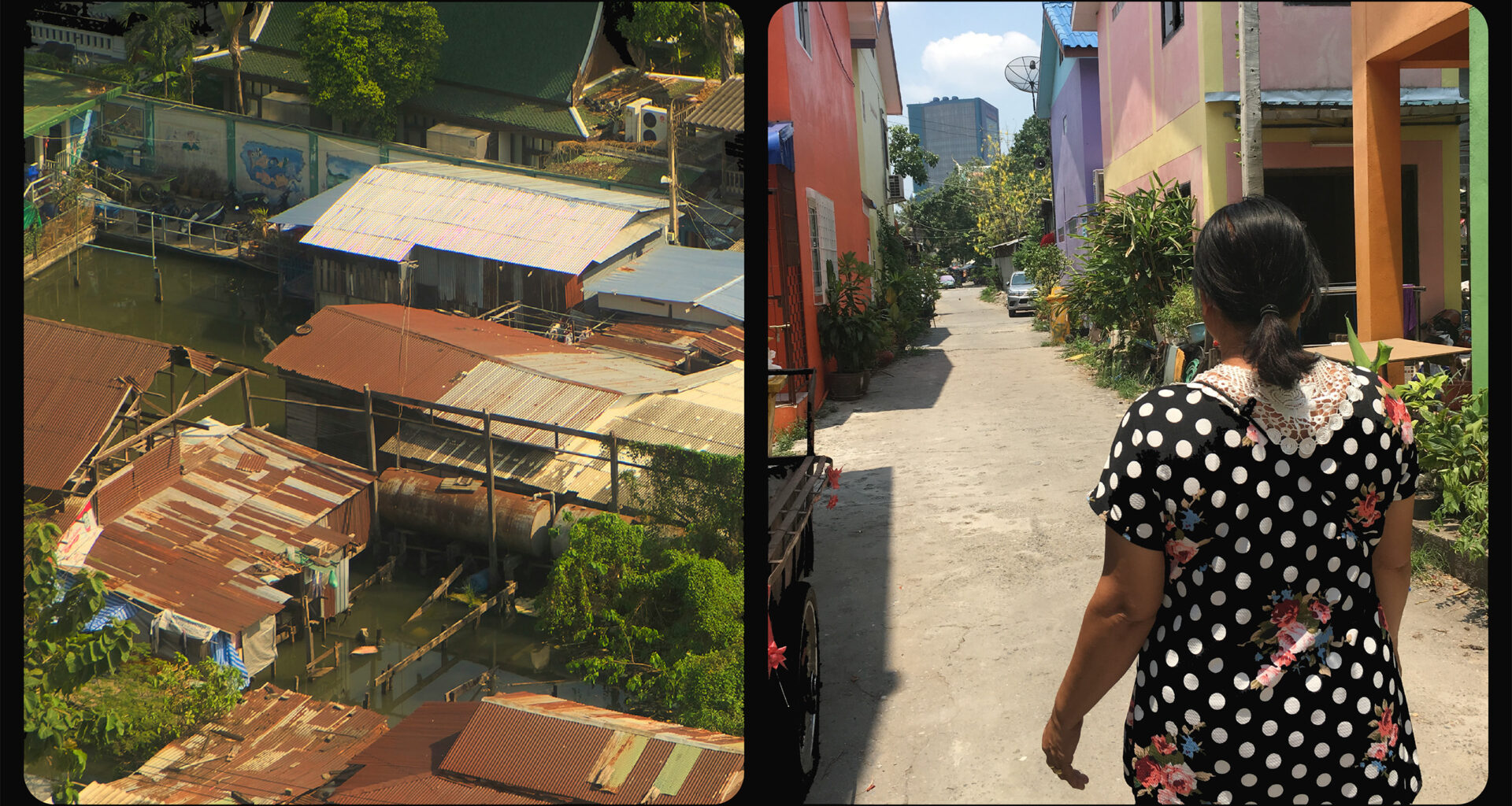
Anne Brice (narration): The housing crisis in the U.S. can feel like an unsolvable puzzle of political infighting, zoning restrictions and rising interest rates. We talk of housing as something we navigate alone — a commodity that we rent or buy, subject to the whims of a volatile market.
(Music: “Aloe Joe” by Blue Dot Sessions)
But halfway around the globe in Thailand, there is a world-renowned program that treats housing as a collective right, a model that proves our individualist approach to housing isn’t the only way.
Housing and community development expert Hayden Shelby first studied this policy as a Ph.D. student in UC Berkeley’s Department of City and Regional Planning in 2014.
Hayden Shelby: Baan Mankong is “secure housing program.” That’s the name of the policy. It works through communities. They get money for housing and also rights to their land, and so in order to do that, they don’t give grants to individuals. People have to form these very discrete communities, they have to form cooperatives.
Anne Brice (narration): Launched in 2003, it’s a type of cooperative housing where a group of people — sometimes as many as a few hundreds households — not only share land, but also manage their own budget and take on collective debt to pay back low-interest loans.
(Music fades out)
This model turns the threat of eviction into an opportunity for ownership. By pooling their resources, residents can negotiate for land rights as a single legal entity, creating a mutual safety net that prevents foreclosure and displacement even during economic downturns.
Hayden Shelby: They take out money together as a community, and so they have collective debt, which is a huge source of stress. It requires a huge amount of trust among the people, and sometimes you’re talking like 300 households together who all have this collective debt, and they have to administer it themselves. So it’s this really onerous, complicated process that requires building a concrete community, a legal community where people are bound to each other through law and debt.
Anne Brice (narration): Hayden says it’s similar to community land trusts or cooperatives that you might find in the U.S. But in Thailand, they’ve managed to scale it up in a way that most places in the world haven’t.
As a graduate student, Hayden wondered if a model like this, where people share responsibility and make decisions together, could help alleviate the U.S. housing crisis.
(Music: “Beignet Interlude” by Blue Dot Sessions)
To understand the ins and outs of how the program worked, Hayden knew she had to be in Thailand, where she could learn from housing experts on the ground. She’d already had some training in the Thai language during the Peace Corps years before, but to do this particular field research required a much higher level of fluency.
Hayden Shelby: I needed to really be able to immerse myself, and I didn’t want to rely on translators, and I wanted to do this through building relationships, just as I had in the Peace Corps. And so that required me to have a very specialized level of Thai that was both academic and policy-oriented, and so I could read policy documents and engage with the academic literature, because there was more written in Thai than there was in English on this particular policy and these issues.
Anne Brice (narration): So she enrolled in advanced Thai classes in the Department of Southeast Asian studies. To accommodate specialized instruction in advanced Thai, Berkeley partnered with the University of Wisconsin-Madison to offer a joint virtual curriculum.
Hayden Shelby: We were able to tailor our lessons and our projects that we did in class to what we were planning to do our research on.
(Music ends)
When you’re doing these less-spoken languages, you really get to know your instructors very well because it’s a small group of you. So there are those personal relationships that kind of help move your research forward as well.
Anne Brice (narration): In the summers of 2014 through 2016, Hayden went to Bangkok to study the secure housing program. This research was especially important because the program at the time was being scaled up to include canal-side communities, which were going through a period of upheaval. Following the historic 2011 floods, the government had launched an aggressive campaign to clean up the waterways — an initiative that often meant needing to relocate the informal homes that lined the canals.
Hayden says being able to understand and speak the technical Thai used to describe the program’s complex financial and social structures proved invaluable — not only so she could make sense of the material, but also so she could connect with community members.
Hayden Shelby: There’s something really magical that happens the first time you have a conversation with someone in a different language. People open up when they know that you’ve made this really deep and difficult investment in learning their language.
There’s something that let’s people, for one thing just on a logistical level to be able to talk directly to you and not have to go through a translator, I think that As a researcher now, that is incredibly important for me because it establishes a rapport that you really can’t through a translator, I think that, as a researcher now, that is incredibly important for me because it it establishes a rapport that you really can’t through a translator.
We gain more from having people who are deeply knowledgable about other places and other people.
(Music: “Bergamot” by Blue Dot Sessions)
Anne Brice (narration): Berkeley is one of America’s top institutions when it comes to the breadth and depth of its world languages program. It offers courses in over 60 different languages, including ones that are less-commonly taught like Thai, Urdu, Ukrainian and Swahili, among dozens of others. For more than 150 years, the program has prepared Berkeley students for a range of careers in fields like diplomacy, translation, education and international development.
Penny Edwards is a professor of Southeast Asian studies at Berkeley. She speaks Mandarin Chinese, Cambodian and Burmese, and worked in international finance, peacekeeping and publishing before joining the Berkeley faculty in 2007.
(Music fades out)
Anne Brice: Did you find when you were learning these different languages that you understood the culture and the society more deeply, too? Do you see those as connected?
Penny Edwards: Absolutely. In so many ways, through different … not only the nuance of language, but expressions of humor. And of course the broader field of body language and the sort of dos and don’ts that you can really only learn, which are so crucial in communications and international relations, especially when conducted at the interpersonal level, one-on-one and other interactions.
Anne Brice (narration): By taking her Berkeley training out of the classroom and into the communities of Bangkok, Hayden was able to turn academic study into a lived experience, allowing her to move from being an outside observer to being a trusted collaborator.
During her field research in Bangkok, Hayden attended hourslong policy meetings, interviewed housing experts and went on community visits. To help decipher all that she was learning, she worked with a local tutor.
Hayden Shelby: We sat down and did formal lessons. A lot of those lessons were based on things that I had encountered in the previous week of doing my preliminary field work. Things that I was picking up in the process of talking to people that I was like, “I don’t get this word.”
“Here’s this particular sentence construction that only happens when I’m reading official government documents,” because Thai has a lot of different registers of formality, so you almost have to learn different levels of language to be able to read a policy document.
Anne Brice (narration): To support this intensive study, Hayden was awarded two Foreign Language and Area Studies fellowships, known as FLAS fellowships. Funded by the now-discontinued federal Title VI program, the fellowship allowed Hayden to take the time she needed to move beyond basic conversation and reach professional fluency.
Hayden Shelby: Sitting down and talking to people takes time. It’s not terribly expensive, but I need that time to do really good research.
Anne Brice (narration): Penny says the fellowship helped her bring top students, like Hayden, to the campus.
Penny Edwards: It has been incredibly important in diversifying the campus intellectually, linguistically and in terms of perspective diversity.
(Music: “Pastor” by Blue Dot Sessions)
One thing deep language learning gives you is really good problem solving skills. It really sharpens cognitive skills and the ability to translate, not in the literal sense, necessarily, across two languages, but translate across different contexts and situations and, you know, to think outside the box in any given situation.
(Music fades out)
Anne Brice (narration): For Hayden, who is now an assistant professor at the University of Cincinnati, being adaptive and receptive to how other people live has been essential in her housing and community development work.
Hayden Shelby: My primary goal is to go in, even for community members on the ground, I say, “Baan Mankong, this program is pretty famous, and I’m trying to understand how it works on the ground.” That breaks down the expert/non-expert barrier. It makes me not able to sort of parachute in and try to give advice, because I’m able to see all of the nuances in it.
And I really am able to go in and say, “OK, what can we learn from this?” That’s always my attitude is that I’m, you know, everybody has something to teach me, and when I speak their language, they’re able to.
Anne Brice (narration): After more than a decade of research on the secure housing policy in Thailand, Hayden is now widely considered an expert on the program in the U.S. Today, it has transformed thousands of informal Thai settlements into legal neighborhoods, giving residents a permanent claim to the land that many of them have lived on for generations.
People often ask Hayden if the secure housing program could work in the U.S., where the culture is highly individualistic, as opposed to Thailand’s more collectivist mindset.
Hayden Shelby: I think this type of program is a very good option for some people all around the world. There is a certain type of person in a certain type of situation where doing this sort of collective housing meets their needs. So I think that these programs should exist and we should have them more widely available in lots of parts of the world.
Anne Brice (narration): But, she says, it’s not the one answer that’ll fix the housing crisis, but rather a piece of the housing solution.
Hayden Shelby: This is not the, sort of, advocate’s dream that we’re all going to live in collective housing and have these beautiful, non-commodified housing options and live in community. I can pretty safely say that it does work really well for some people, and it’s not the best option for a lot of people. And so there needs to be other housing policies.
(Music: “Weathervane” by Blue Dot Sessions)
But that being said, if I could find a bunch of people to build a community land trust with, I would totally do it. I’ve seen the people who live in those communities in Thailand, and I think to myself, “I would love to live in one of those. That’s for me.” And I wish we had that option in the U.S. that it was more widespread.
Anne Brice (narration): Hayden says it can be easy to think about community development as one-sided, getting stuck asking ourselves: What are we doing for them, instead of asking: What can we learn from them?
Hayden Shelby: There is a big conversation happening in the U.S. right now about loneliness and the need for community. You know, community is hard. Community involves disputes — that’s one of the things that I’ve learned from this program. It doesn’t always work, it can fall apart, and somebody is always unhappy with somebody else. But I’ve also seen people really become something closer to what we would call family through this program when it does work.
I think that in the U.S. right now, we’re at a moment where there are people across the political spectrum who are willing to have a conversation about: How do we build community in our society?
And thinking about how we rearrange our built space and our notions of ownership and how we live together can be a bigger piece of that conversation. And I think that we could learn from this program to that extent.
Anne Brice (narration): I’m Anne Brice, and this is Berkeley Voices, a UC Berkeley News podcast from the Office of Communications and Public Affairs. Music by Blue Dot Sessions.
You can find Berkeley Voices wherever you listen to podcasts, including YouTube @BerkeleyNews.
This is the fourth episode of our new season of Berkeley Voices. In six episodes, we hear from UC Berkeley scholars working on life-changing research and the people whose lives are changed by it. New episodes come out on the first Thursday of every month, from November through April.
We also have another show, Berkeley Talks, that features lectures and conversations at Berkeley.
You can find all of our podcast episodes, with transcripts and photos, on UC Berkeley News at news.berkeley.edu/podcasts.
(Music comes up, then fades out)