
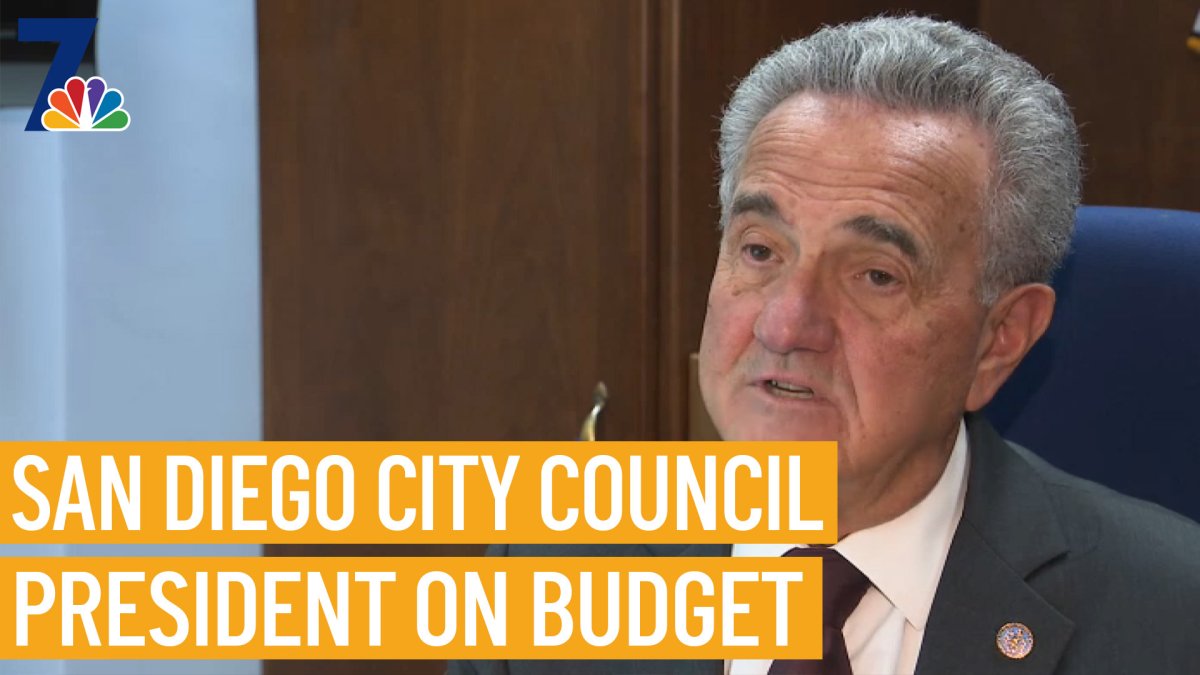
Even after the San Diego City Council passed its budget last year, the contentious conversations about the city’s financial woes never subsided, in large part because of the implementation of paid parking at Balboa Park and the trash collection fee.
Now, halfway through the budget year, the city’s outlook is even bleaker than expected, with city hall staring down another $110 million shortfall next year. We hear from elected officials that the time has come to make “difficult decisions,” so I asked the council president what those tough calls look like.
NBC 7’s Joey Safchik: First of all, tell me where things stand with this year’s budget as we’re a little bit past the midway point and then looking ahead at next year’s budget.
San Diego City Council president Joe LaCava: This is an interesting confluence. This time of year, where you’re worried about: Is this year’s budget actually going to balance? And you’re already starting to think about next year’s budget. So, just recently, the mayor’s office and department of finance released what we call the mid-year. We’ve gone through two quarters of the Fiscal Year 2026 budget. And we take that snapshot. And this is a great opportunity to make any mid-year adjustments. And we’ve learned that we’re about $17 million short. Some of it is revenue that we expected isn’t coming in as we had projected. Some of it is expenses coming in a little bit higher. And because the budget was so delicately balanced last June, we are especially vulnerable, I would say, this year, for that kind of conversation. And so we’re about $17 million, which, you know — $2 billion [in the overall budget] — doesn’t sound that dramatic, but it is significant because we’re obligated to deliver a balanced budget by the end of June.
Safchik: Was it a mistake to balance the budget on revenue that was not guaranteed?
LaCava: Well, you know, I’ve done a lot of self-examination. I’ll let the mayor and the councilmembers decide for themselves, b ut as I reflect on what we did in June, we did a lot of last-minute adjustments. Some of the revenue that the mayor was putting on the table was based on best-available information but was really kind of aspirational. And the council came in and actually kind of doubled down, said, “Mayor, we need to do more. We need to do it faster.” And again, not with all the information you’d like to have to actually, as you framed it, actually really reliable data that we can project this. It was speculative. We knew, parking meters, raising the rates around the ballpark, of course, is a big part of this conversation, that when you bring in different prices or higher prices or first-time prices, you’re going to change people’s behavior. And that could put those projections at risk. And, certainly, I think we’re seeing that play out in these very real numbers today, going forward.
Safchik: Who’s to blame for that revenue coming in under what was expected?
LaCava: I don’t think anybody, any one person. I think we all take responsibility as elected officials. We’re the ones that voted for this last June. Certainly, the mayor put out their budget. The council made some last-minute adjustments. I can tell you I’m going to be very leery about making these last-minute judgments in June.
Safchik: It sounds like there are some things you would have done differently.
LaCava: Absolutely. You know, we, you know, we as a council, we have that authority, that budgetary authority. The mayor puts out a preliminary and takes additional input, does that revision in May, and then it’s in the council’s hands. So I think the things that I think twice about are those last-minute kind of adjustments. And sitting as council president, having perhaps a different bird’s eye view of what the dynamics that happened are, the recommendations that came from several of us were literally dropped into the hands of the independent budget analyst as the meeting was unfolding. So the independent budget had zero opportunity to weigh and, that I’m going to fight with the options that I have at my disposal to try to prevent that from happening this June. I’ve already told some of my colleagues I’m going to be less supportive of these last-minute adjustments, especially on ideas, whether it is revenue ideas or whether it’s cuts that are more speculative, so that we get these right, because that also prevents the public from having an opportunity to weigh in on that: “Well, if I knew you were thinking about that, I may have tailored my comments a little bit different.” So I’m going to take a little bit different approach. We’ll see what my colleagues and the mayor does in this upcoming budget, because folks are now aware we’re looking at $110 million, which, again, is, what? Roughly 5% of our total budget. But when you look at the deeper cuts we did last year, when you look at the revenue ideas that were put on the table that the public were not excited about, it really creates a much narrower space for us to figure out: How do we meet that $110 million shortfall?
Safchik: When we spoke about the budget during the last cycle, you constantly reiterated that it was a living, breathing document, that it was fluid and could be changed. So some of these items that you’re having doubts about now, can you make these changes halfway through the budget cycle?
LaCava: Well, I mean, that’s a great question. I mean, there’s a couple of elements. One of the things that I said, being the council president, is that I’m prepared to get adjustments as soon as we can identify them. And it’s easy to say that it’s a little harder to do that, because you don’t want — some of the information that we get lags behind. So, whether it’s sales tax or the transient occupancy tax, it takes a while for that information to actually get to us. That causes you to make a decision. And so, while I was ready, it’s very difficult. And then when you’re talking about cuts, [they] are often talking about people’s jobs. And so you don’t want to pull that string until you really know that it’s absolutely necessary. And as we know now the mid-year for this year’s budget, we’re looking at how we’re going to create, you know, modify that shortfall. But we’re really going to have that harder conversation in the months ahead of us for next year’s budget.
Safchik: Are any emergency cuts to services imminent?
LaCava: We’re trying to identify those. One of the things that the mayor tried to do, and I believe the council was supportive last year, was: don’t wait. The sooner that we can say we’re going to make this cut, it’s going to be in the budget. Let’s start today. Because that will create savings that we can … that will cover any shortfalls or anything unpredictable. And we didn’t really see as much of that happened. There were some changes that were made in spring of last year that helped us. But we need to do more of that. And frankly, from a morale point of view, you know, employees need to know: Is my job at risk? What kind of reorganization might you be talking about? And the sooner we can get in, as opposed to having that just lingering like a dark cloud over their jobs, I think that’s really better for everyone going forward. And then, even when you make those hard decisions, we made some hard decisions when we adopted it in June. It took two or three months for them to actually be implemented. So that savings that we were predicting in those three months didn’t manifest itself. Now, the generally smaller numbers. But at times like this, every dollar can make the difference about how many hours our libraries are open or rec centers, or whether our parks are being maintained. So every bit. And that’s what I always try to talk to my constituents about. Yeah. In the bigger scheme, it seems like a small dollar amount, but those are the dollars that actually make a difference in preserving as much of city services as possible. And I really want to emphasize this, really minimizing the impacts of cuts to services in our under-resourced … you know, a pothole’s a pothole no matter where you’re at, but a library can make a big difference in some communities, much more so than in other communities, going forward. So we want to be as strategic as possible and minimize the impact on the general public.
Safchik: We hear a lot about tough cuts, about difficult decisions. What do those actually look like?
LaCava: Well, that’s what we’re just starting to get into the conversation. Going forward, I know the mayor is doing what is called the executive budget review [in each department]. And, I’ve had the opportunity to sit through some of those, and those are difficult conversations, because, the cuts were so dramatic last year that a lot of those departments who do a lot of the work that the public never sees but are critical to a well-functioning city, have already been cut to the bone and already are having difficulty keeping up with the workload. We are way below the standards of best practices, which is why we see delays in some of the things that the public or even council members complain about, because of those cuts of the past. And so the question is, Where are you going to cut? And when you started, try to be a little, minimize cuts to police, fire and lifeguards, which we all see, and I know the public agrees with, the pot of money that you can actually play with, gets smaller and smaller, and then you add in federal mandates and state mandates, mandates that we have to comply with. You look at litigation settlements that we’ve agreed to over the years that we’re obligated to comply with, the pot gets smaller and smaller that you get to work with. And that’s where the challenges really, really hit home.
Safchik: We know that during the recession, for example, there were salary reductions made. Are you considering that, looking at this next cycle?
LaCava: Well, everything is on the table. So salary reductions are certainly on the table; furloughs, which are equally unpopular as salary cuts. I think we’re going to work very hard to avoid the salary cuts, as we saw, back in the day, because that has such an impact not only on the individual, but it really has a dramatic impact on retention. And so we really, as a city, really suffered over a number of years that, not only did we do cuts, but we didn’t do pay increases to compensate for that for quite a few years. And now, we’re trying to catch up, because we want the best and the brightest to be working for the city, to deliver city services and make sure we’re really a high-functioning city. We have amazing employees. We need to hang on to them, whether it’s their experience or expertise or their long term knowledge of the city operations. And so that’s where that difficult balance comes in.
Safchik: Are you satisfied with how the mayor’s administration has enacted the will of the council, looking at this past budget?
LaCava: Generally, yes. There were some difficult conversations where the mayor didn’t make some of the changes that the council adopted. There is some debate about whether he’s obligated. I’m trying to get the conversation pivoting away from individual positions and talk about programs. What programs does the council no longer support that we supported back in the day? And then that will manifest itself to whatever employees are working on that program without making it personal. I don’t think that really helps any of us. So I’m trying to do my part to change that conversation to more program or programmatic ideas. And again, there aren’t that many when you … that are really optional for us. There are, you know, not too many that are in the nice-to-have bucket, if you will. Again, when you start looking at the things that are mandated to do, there’s not much left. And if we really want to be a high-functioning city, it starts to get thinner and thinner are the places you can really look at. That’s what will make this next round so difficult.
Safchik: I know the city has extracted as much revenue as it can. I have heard some rumblings about seeking more one-time revenue opportunities. That might surprise people because that’s really how the city ended up in this position in the first place. How do you justify that?
LaCava: Well, that’s – I haven’t heard any of those proposals, but, you know, I know the public can sometimes get confused because we talked about a deficit, and then we talked about a structural deficit. And to the degree that we can explain to the public the structural deficit is when we rely on one-time funding that, maybe, is available today and maybe can be used wisely, but it’s not going to be there next year. So your problem is just going to roll over to the next year. And last year, we probably came pretty close to actually significantly reducing that structural deficit. We did do some one-time funds to do that. But that’s where it gets very difficult. And that’s where the hardest thing for an elected official is to hear some good news. Oh, this insurance settlement came through. We have new money. And to say, “No, no, let’s not use that for, you know, our ongoing issues. That’s great funding to use for a repair to a library or a city building.” Because that is a one-time expenditure, one-time revenue, one-time expenditure that works very well, but don’t use that to fill the budget gap for these ongoing expenses. So, I’m going to take a very hard look at that. Certainly, reserves are there for those rainy-day funds. And one could argue this is another rainy day, so to speak, from a budgetary point of view. And so we have to look at that and again, trying to balance what services are you going to cut? How are you going to impact, especially, our most vulnerable communities? And how are you going to balance? There has been a lot of talk. When we did our five-year outlook that this FY, Fiscal Year 2027 and Fiscal Year 2028 are going to be very rough conversations. It starts to get a little bit easier once you get out there. But again, a lot of us will be out of office. But, you know, I remain committed to kind of setting the stage so that the next generation of councilmembers have a little bit easier conversations, neighborhoods and communities are not so worried about what services might be cut.
Safchik: Why should people trust that the outlook is going to improve in a few years?
LaCava: One: There are certain things that are in place – the way the pension obligations start to trigger. There is a hope that tourism will start to come back into our city. That was one of the main — another factor that came into play, shortfall that we weren’t predicting. And so we’re hoping that that will start to bounce back. San Diego was clearly a desired destination, but there’s a lot of noise out there that may be affecting people’s decisions about whether to travel at all. So, irrespective of whether San Diego’s desirable or not, but we’re still seeing a lot of enthusiasm about San Diego, who we are as a city, who we are as a tourist destination, who we are as a job center. Conventions, once they start bouncing back more than they already have. Clearly, San Diego is a desirable place. We have a lot to offer, but other outside factors get in the way. The state of the economy, the uncertainty that comes out of Washington, all plays in and affects us directly. Sometimes we can predict that we can base our budget on that. Sometimes, things have a greater impact and cause shortfalls that we’re experiencing today.
Safchik: Mr. President, thank you so much. I appreciate how comprehensive this discussion was.
LaCava: Well, thank you very much. I appreciate you taking the time as well.
So what happens next? The looming question now is whether emergency cuts are imminent, especially if any of the paid parking policies are rolled back. And then the council awaits the mayor’s initial budget proposal for next year.