
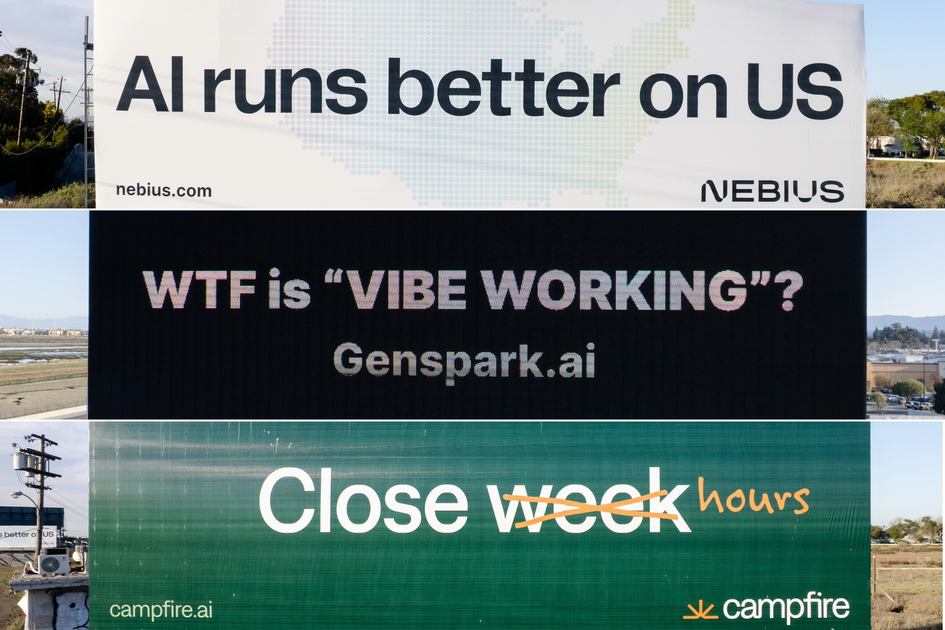
If you’ve flown in for the Super Bowl and are driving down Highway 101 toward Levi’s Stadium in Santa Clara, you are about to be very confused.
The stretch of highway from San Francisco International Airport to San Jose is lined with billboards advertising the tech industry’s latest darlings: artificial intelligence companies.
To most, the ads are inscrutable. To some, insufferably so.
Unlike previous tech billboards, which featured pictures of the products for sale or well-known slogans, today’s AI ads are a different breed. They are written in jargon for those already fluent in startup.
Don’t get the joke? It’s not meant for you anyway.
Premesh Purayil, chief technology officer at outdoor advertising company Outfront, said the past 18 months have seen a surge of AI companies spending on billboards, particularly in downtown San Francisco and near tech campuses.
All told, there are 170 billboards along Highway 101 in San Francisco, San Mateo, and Santa Clara counties, according to Caltrans Outdoor Advertising. Around 20 of these are digital, displaying multiple ads (and allowing for dynamic pricing, which changes according to demand). One digital billboard near SFO was listed for $7,000 a week starting Feb. 16; purchasers get an eight-second spot every 64 seconds, on a loop.
The ads bring in revenue for municipalities. In 2024, the city of San Carlos made $500,000 to $600,000 from five (opens in new tab) digital billboards.
We don’t want you to feel unwelcome in our city, visitors! So we drove down to Santa Clara and back, documenting and translating some of the most head-scratching billboards.
Here’s our SF Standard AI billboard cheat sheet.
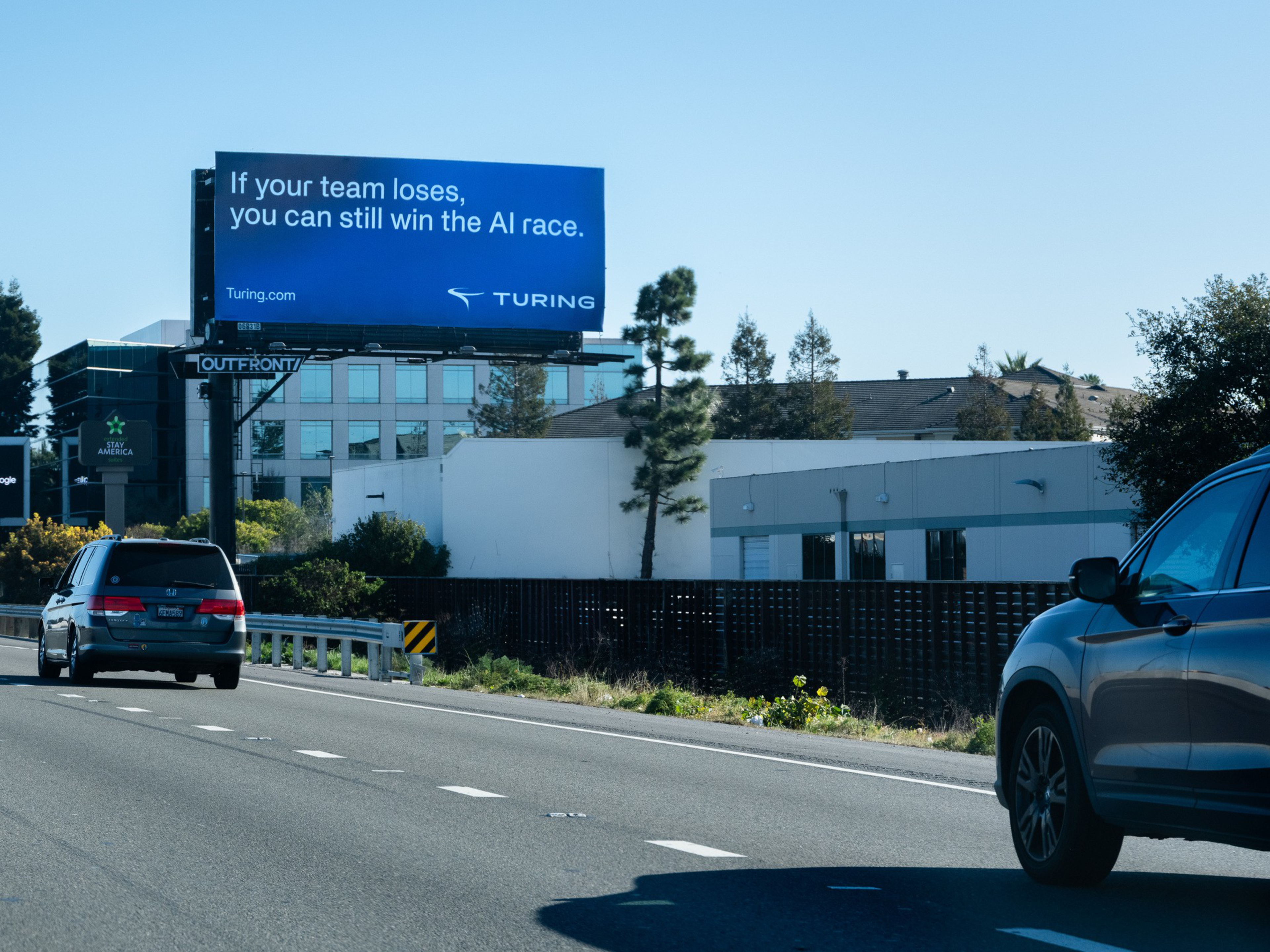 If your team loses, you can still win the AI race (Turing)
Translation: Turing implies that the bigger game right now is not the Super Bowl but the AI arms race, and there’s still time for companies to catch up.
Subtext: The ad taps into the growing concern that companies will become obsolete if they don’t stay ahead of the AI curve.
About the company: Palo Alto-based Turing, valued at $2.2 billion, was founded in 2018 by two Stanford-trained engineers. It provides human experts to train and improve large language models. Clients include OpenAI, Anthropic, Google, and Meta.
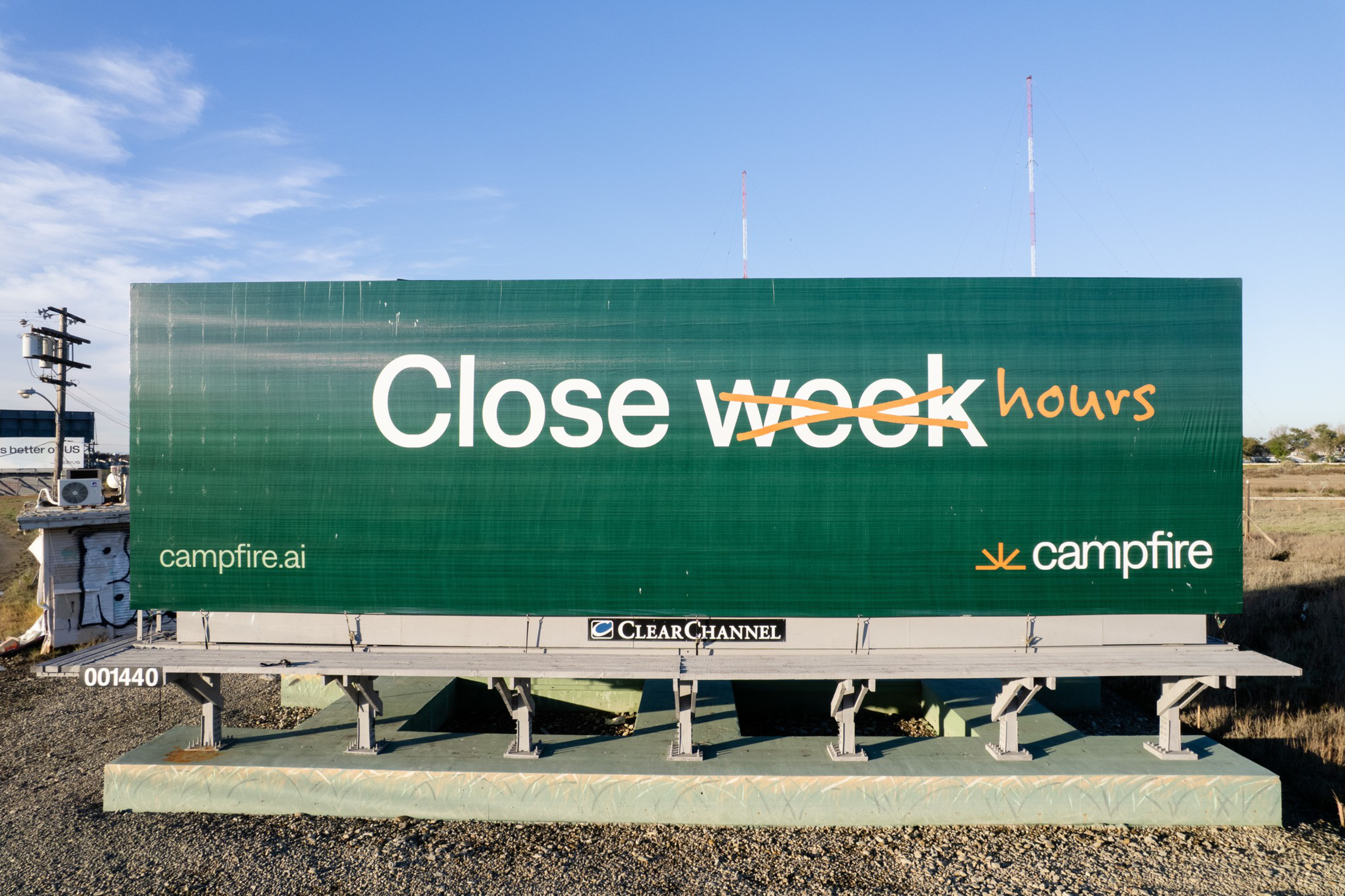 An advertisement for Campfire sits on a billboard in Belmont on Monday, Feb. 2, 2026. | Source: Jungho Kim for The StandardClose week hours (Campfire.AI)
Translation: The ad claims that Campfire’s AI tool will streamline a company’s accounting process. “Close” is accountant slang for closing the books.
Subtext: Campfire is targeting CFOs. The cryptic copy intentionally excludes anyone irrelevant to the service, making it feel more insidery.
About the company: San Francisco-based Campfire emerged from Y Combinator in 2023. It uses AI agents to handle repetitive accounting tasks and has a $375 million valuation. Clients include Replit, PostHog, and Decagon.
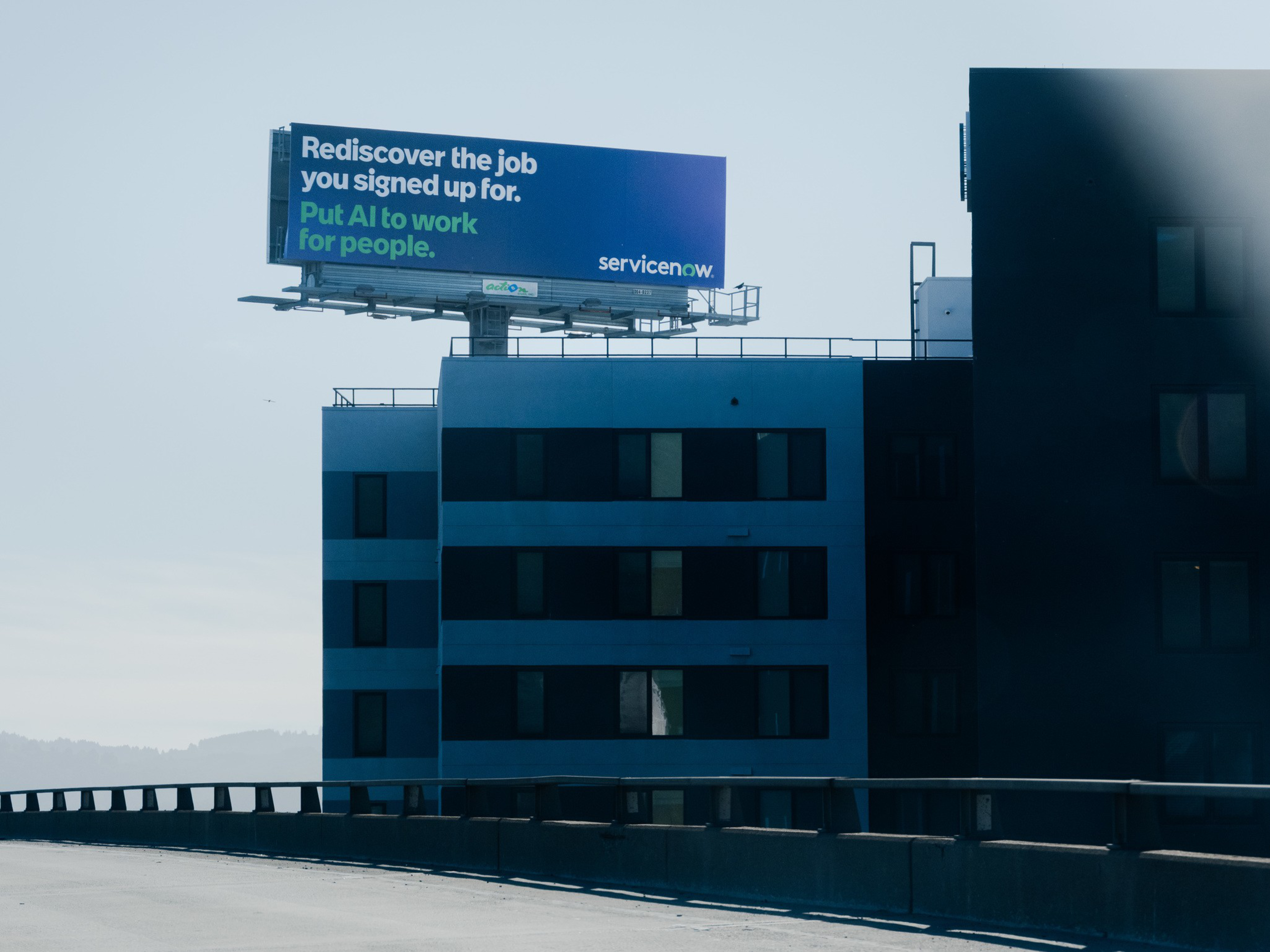 Rediscover the job you signed up for. Put AI to work for people (ServiceNow)
Translation: ServiceNow’s AI can handle your busywork while you do the fun parts of your job.
Subtext: The slogan is meant to convey that ServiceNow provides helpful AI, rather than AI that eliminates jobs. “We’ve seen an influx of billboards focused on replacing people with AI. We fundamentally disagree with that narrative, so what better place to say it?” said a ServiceNow spokesperson, noting that “AI should work for people, not instead of them.”
About the company: ServiceNow is a $122 billion Santa Clara-based public company that automates workflows like HR requests, onboarding, and IT tickets and provides a suite of generative AI tools. Founded in 2003, it employs more than 26,000 people (opens in new tab). Clients include Adobe and Lenovo.
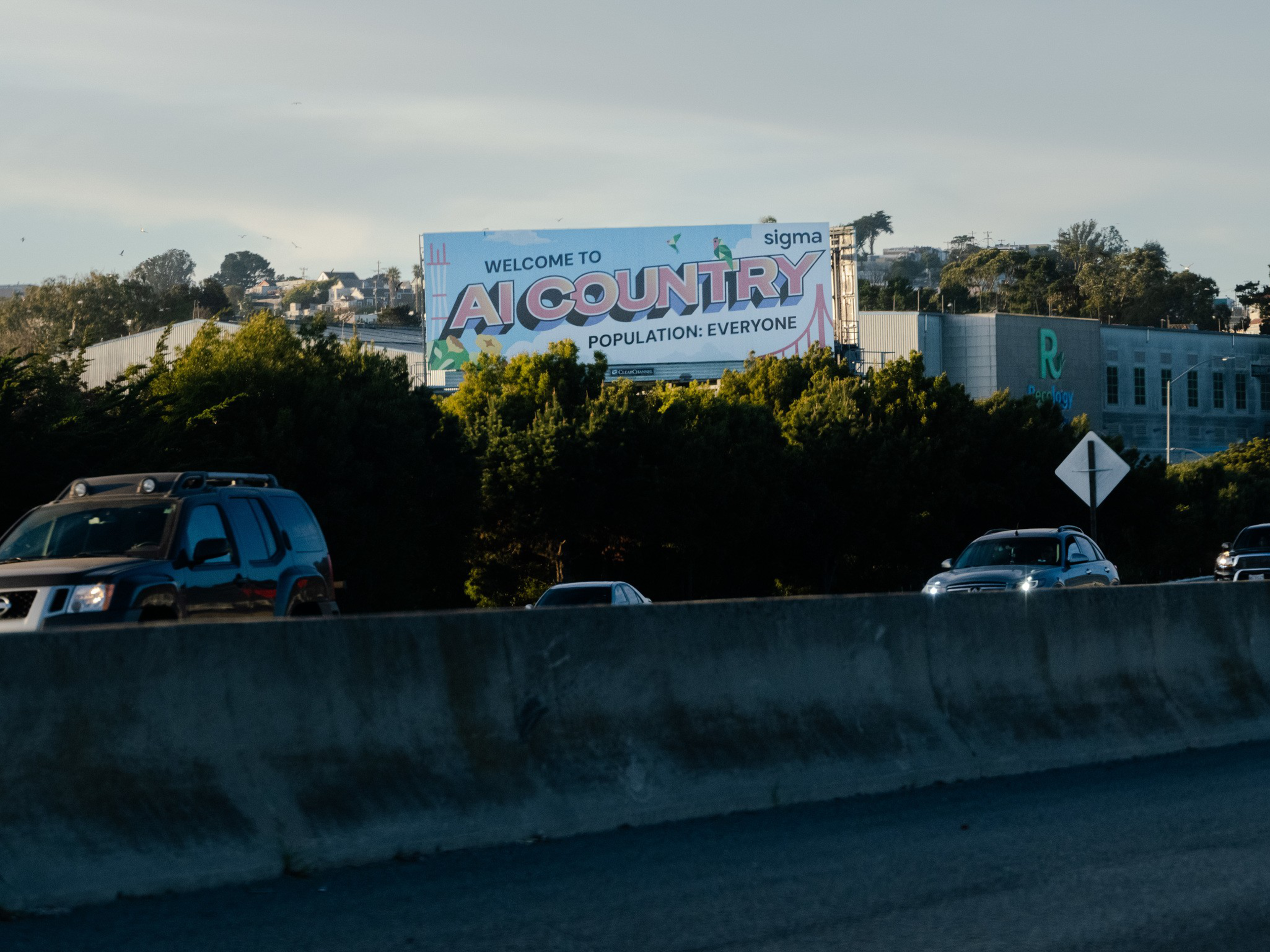 Welcome to AI Country: population everyone (Sigma)
Translation: Yeah, all the ads around here are about AI, and that’s because you’re living in an AI world now.
Subtext: “This was our way of saying: We’re here, we’re credible, and we’re a bigger part of this story than many of the loudest voices,” said Sigma CMO Fred Studer. It’s the rare AI ad that speaks to outsiders, acknowledging what Studer calls “AI fatigue.” “You’re literally surrounded by hundreds of billboards all claiming some version of ‘We’re the AI company.’”
About the company: Founded in 2014, Sigma is a San Francisco-based analytics platform, valued at around $1.5 billion (opens in new tab), that lets nontechnical users analyze cloud data from Snowflake and Databricks, and build AI-powered apps without coding. Their clients include DoorDash and Workday.
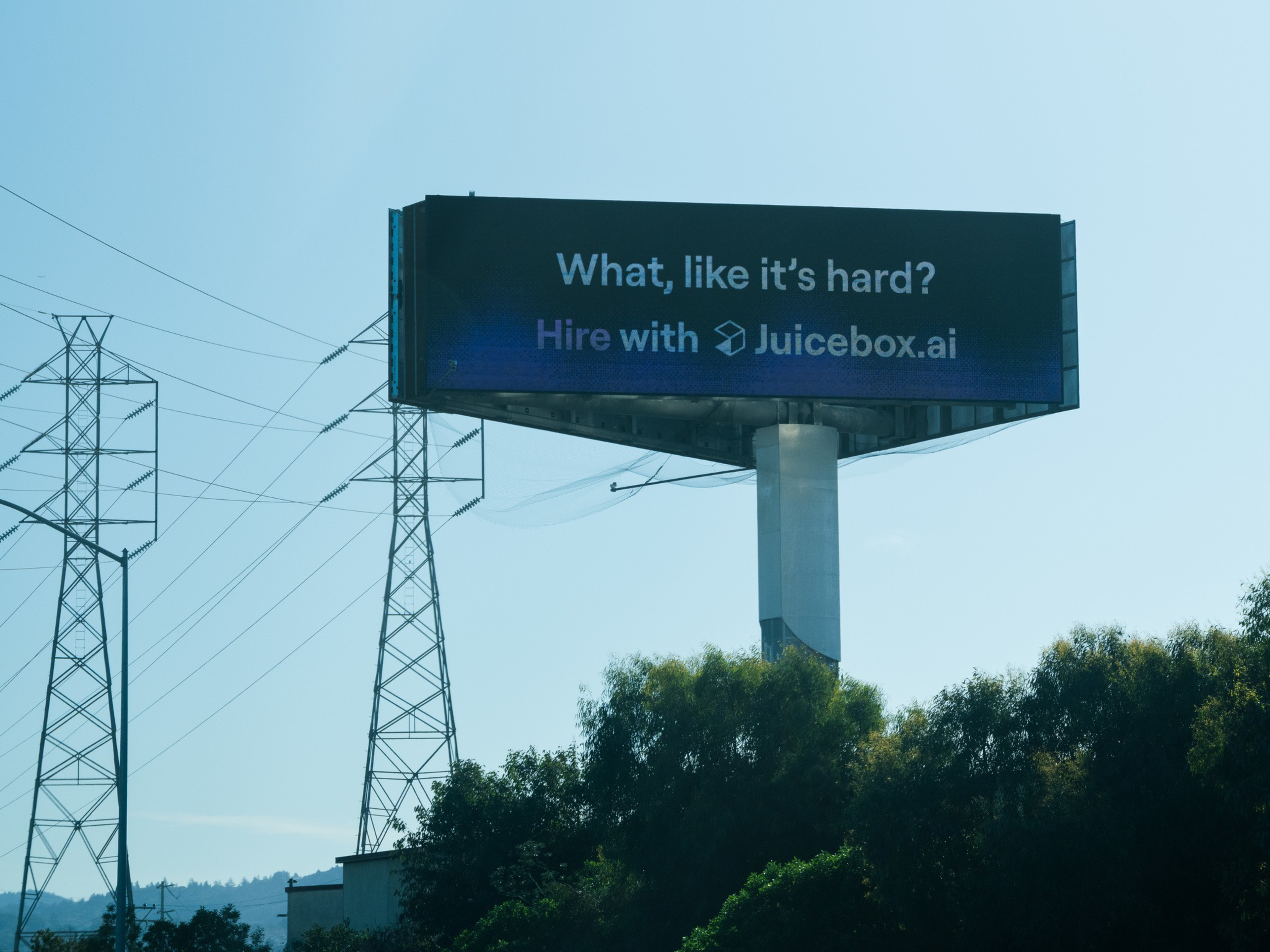 What, like it’s hard? Hire with Juicebox AI (Juicebox)
Subtext: The hiring process has become a slop smackdown, with AI-generated résumés up against AI screening tools. Juicebox suggests that it has the solution. “Recruiting is at an inflection point [because of] the influx of fake, AI-generated inbound applications,” said CEO David Paffenholz.
About the company: San Francisco-based Juicebox’s recruiting platform analyzes, screens, and scores candidate résumés, then hands them off to its AI agent for outreach and onboarding. Founded in 2022, the company has raised $36 million with a $180 million valuation (opens in new tab). Clients include Ramp, Quora, and Perplexity.
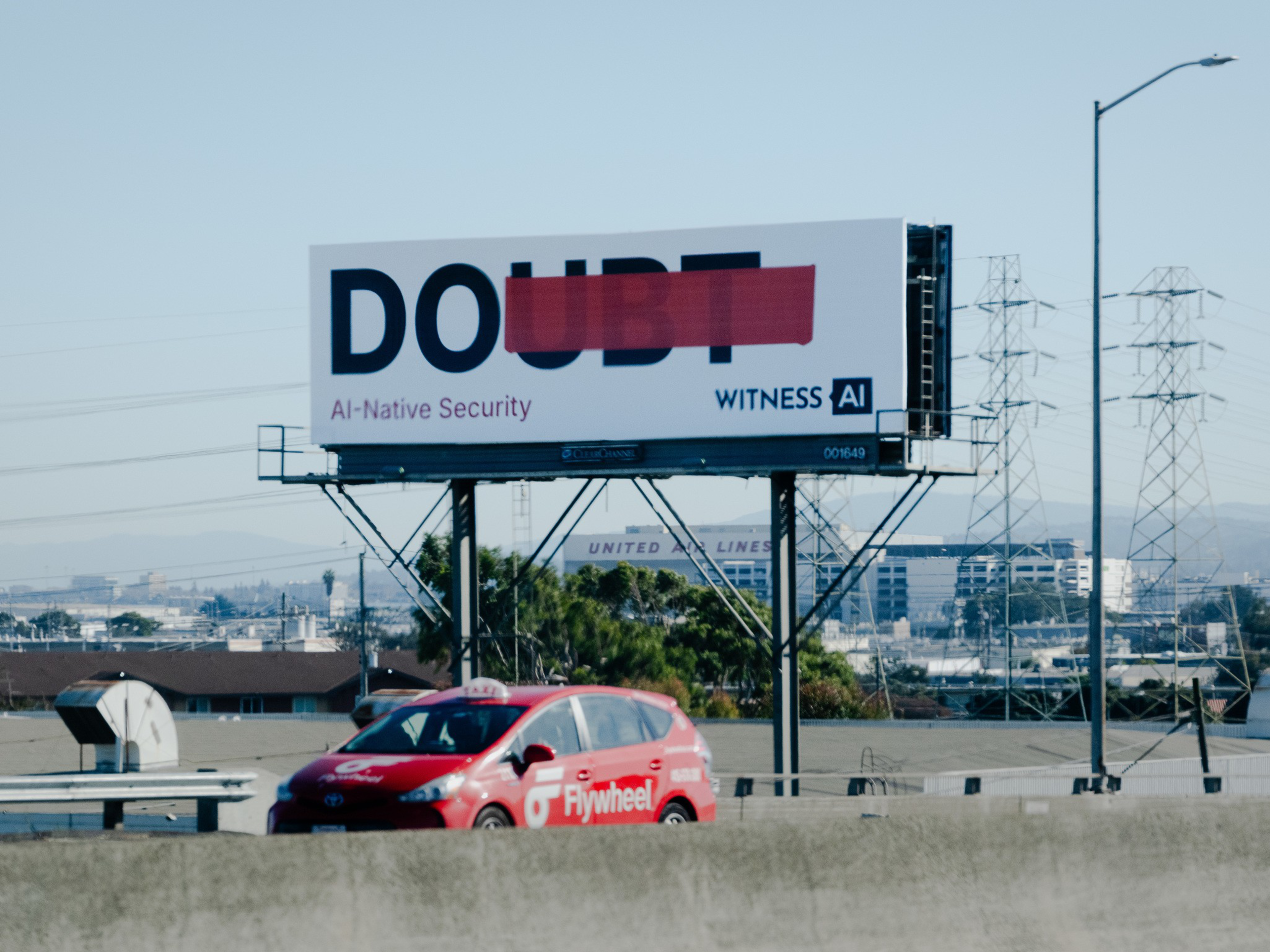 DOUBT, AI-native security (Witness AI)
Translation: AI use has security risks that WitnessAI can solve.
Subtext: Companies ramping up AI use might assume their security measures are adequate, but they’re not.
About the company: Witness AI, a Mountain View-based security company with $90 million raised since 2023, says it helps businesses by monitoring AI agents and employee AI use and blocking threats in real time. “The billboards allow us to show up boldly in one of the few shared spaces where the tech and business worlds intersect,” said VP of marketing Stephanie Gilliam, noting that the ad will remain up until after the RSAC Conference on information security in March.
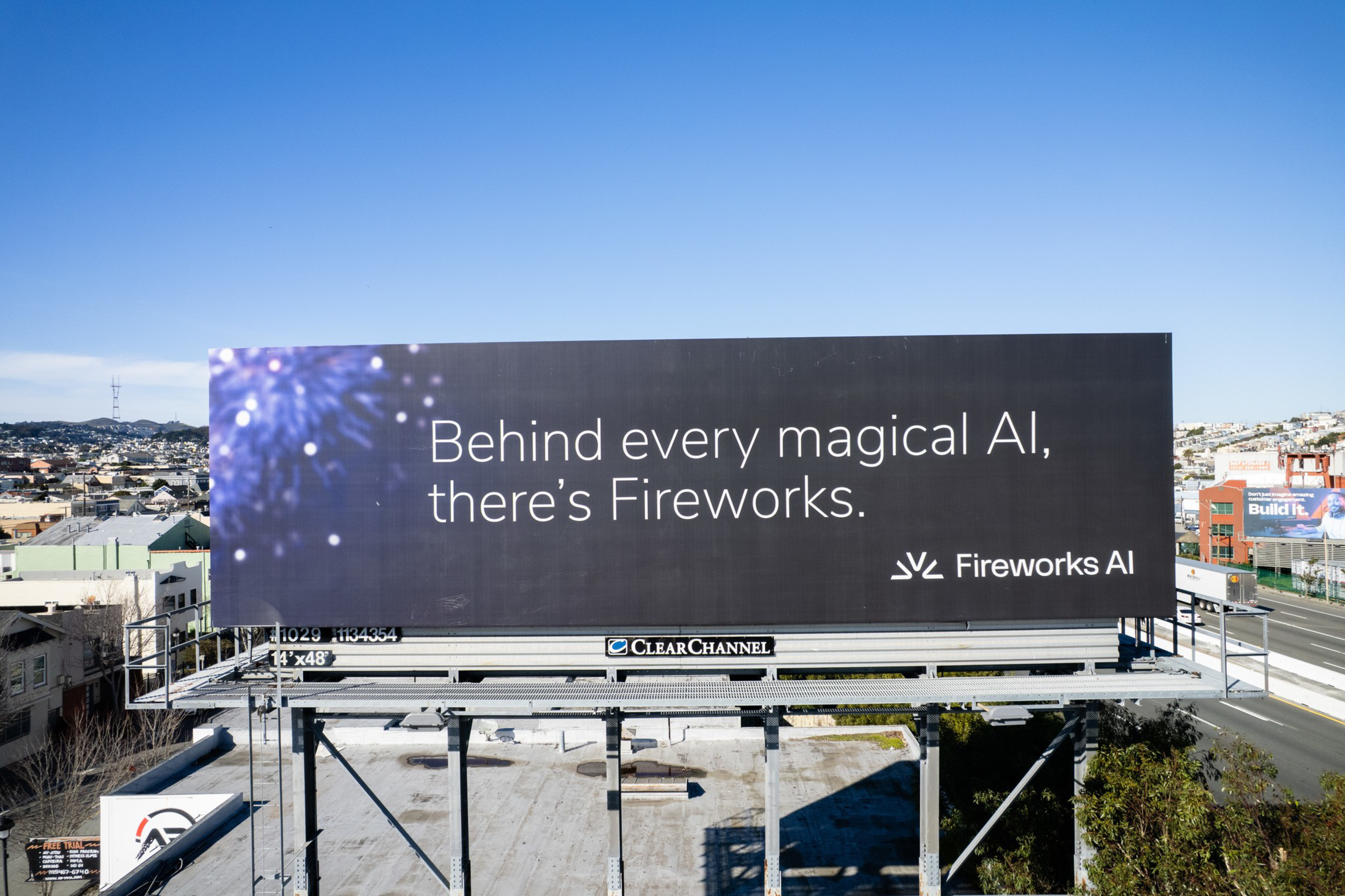 Behind every magical AI, there’s Fireworks (Fireworks AI)
Translation: That cool-looking AI app uses Fireworks.
Subtext: Everyone is trying to make an AI app. Fireworks AI wants their business.
About the company: Fireworks AI, based in Redwood City, sells inference infrastructure, a back-end system that makes AI apps run smoothly at scale. It was founded in 2022 by Meta and Google engineers and is valued at $4 billion (opens in new tab). Clients include Cursor, Uber, and DoorDash
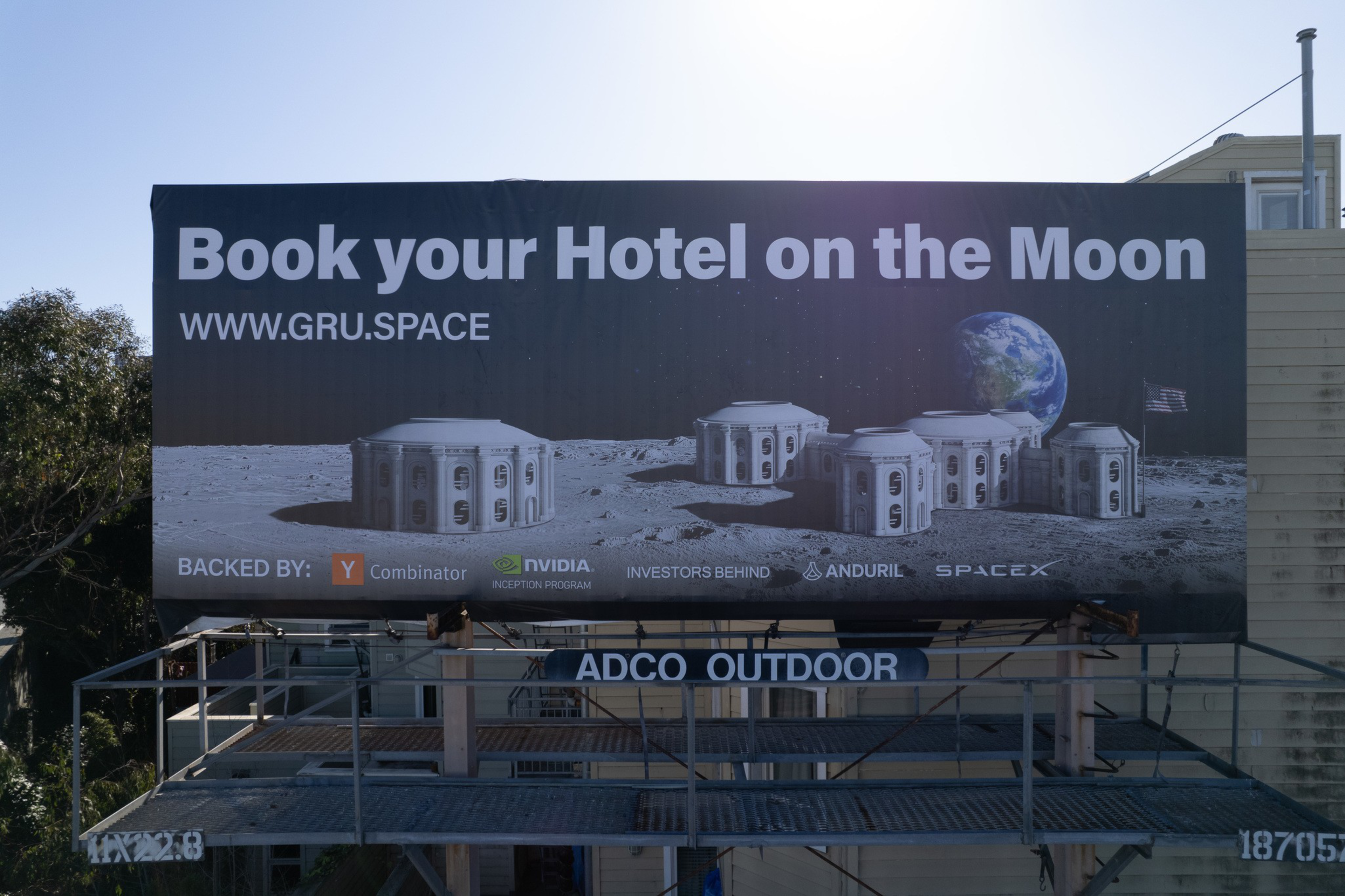 Book your Hotel on the Moon (GRU.Space)
“Translation: This is literal. Galactic Resource Utilization Space is taking deposits for a hotel it hopes to build on the moon, ETA 2032.
Subtext: This is a publicity-seeking presale for a literal moonshot. GRU Space is accepting (refundable) deposits of $250,000 to $1 million for a room, plus a $1,000 nonrefundable registration fee. It’s guaranteed buzz with no guarantee.
About the company: GRU Space, founded last year in San Francisco by 22-year-old Skyler Chan, is part of Y Combinator’s winter 2026 batch. The moon hotel is pitched as Phase 1 of a plan to use robots and lunar soil to build habitats in space. The level of funding is unknown, though one report suggests it tops $150 million. (opens in new tab)