
In December, the San Diego Association of Governments (SANDAG) voted 16-1 to approve the 2025 Regional Plan, which sets out the infrastructure projects planned for the next 25 years across San Diego County. In the initial 10 years of the $125 billion plan, there is heavy emphasis on two classes of projects: highway expansions and new Rapid bus lines, a high-frequency, limited-stop bus service. Missing from the initial 10 years is any work on the long-planned rail system, the Purple Line. Thus, as a vision of our transportation system in 2050, this plan is flawed due to placing too much emphasis on freeway expansion and insufficient resources on public transit.
A large majority of commutes in our county are with cars and light-duty trucks, so it is understandable that highway projects get significant funding in the plan. Ninety-three miles of new highway lanes are planned for our freeways, with the goal of alleviating congestion. SANDAG’s own analysis showed that these projects will cause much more driving and pollution, and are expensive: $2.7 billion by 2035. Highway widening is well documented to cause induced demand, i.e., more traffic, and ultimately, the relief from congestion is only temporary. Additionally, more driving results in more greenhouse gas emissions, and while most adults in the U.S. own cars, there is a growing trend, particularly among millennials and Gen Zers, to forgo car ownership, mostly because of the expense (more than $12,000 per year in California). Thus, the number of highway expansion projects in the plan should be reduced.
The addition of 35 new Rapid bus lines in the plan is very positive, as bus transit is a critical transportation component, and it is much cheaper to implement than rail. SANDAG is obligated to pass a plan that meets state requirements for reducing greenhouse gas emissions, so it is important that these bus lines are efficient and gain significant ridership.
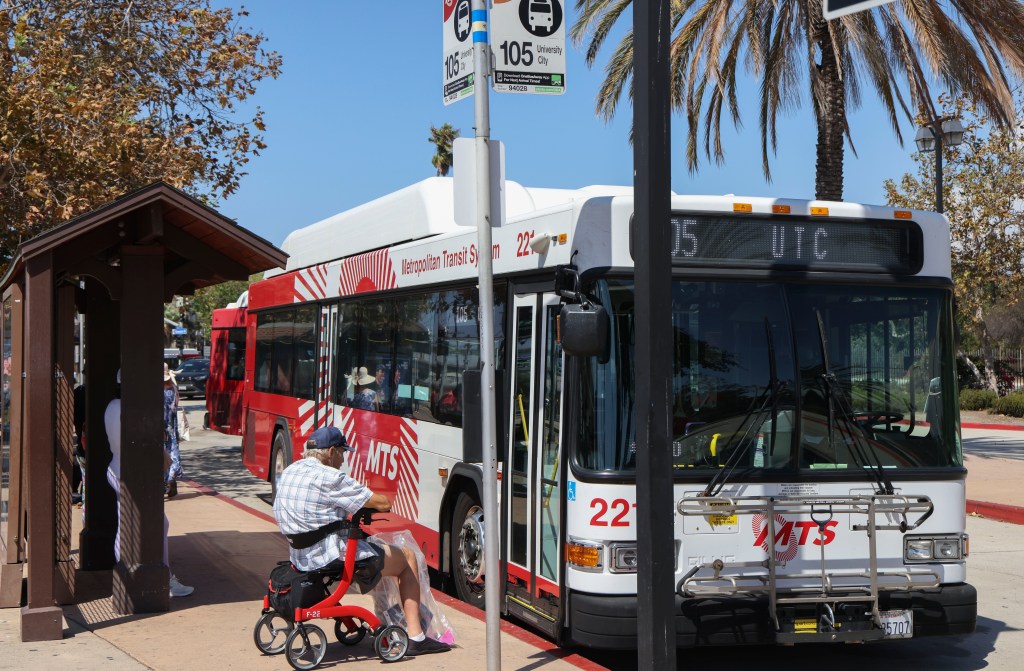
However, our region has a poor record of implementing truly Rapid bus lines. An important example is the Rapid 215, created in 2014, which is slower than the line it replaced. For these new bus lines to be successful, the city of San Diego and MTS must implement key policies and technologies, including bus-only lanes and Transit Signal Priority (i.e., smart stop lights that give priority to approaching buses). These are low-cost solutions and should be implemented in all jurisdictions across the county.
The Purple Line, which was originally planned to deliver commuters from San Ysidro through Southeast County to Mission Valley and Sorrento Mesa, will be a lifeblood for the South County transportation system when it is completed. The new 25-year plan has essentially no funding for this project in the initial 10 years, shifts from heavy rail to slower and cheaper light rail, and is limited to reaching Mission Valley by 2050.
In its place, the Rapid 688 bus is added, which will run on a new lane on I-805. The 688 is likely to suffer from slow commute times due to the issues described above, as well as service disruption caused by frequent freeway crashes (35 crashes a day in our county in 2022). The failure to invest either in the initial phases of the Purple Line, or to build separate infrastructure for the 688, is a blow to transit equity for commuters who will continue to have slow commutes to San Diego’s largest job centers in Kearny Mesa, UTC and Sorrento Valley.
To approve the plan, the SANDAG board used an unweighted “tally” vote for approval, and not the population-based weighted vote, which was enabled by passage of a state law in 2017. This decision takes voting power away from populated cities like San Diego, where the vast majority of transit riders live. When the weighted vote is used, San Diego’s clout increases from less than 10% (two of 21 votes) to more than 40% (the city of San Diego has 1.4 million of the 3.3 million county residents).
In 2029, when the next Regional Plan will be considered, SANDAG should use the weighted vote, and should fight harder to meet the needs of all county residents, especially those who depend on transit.
Roberts is a volunteer with SanDiego350. KC Gupta is a volunteer with Youth4Climate. They live in San Diego.