
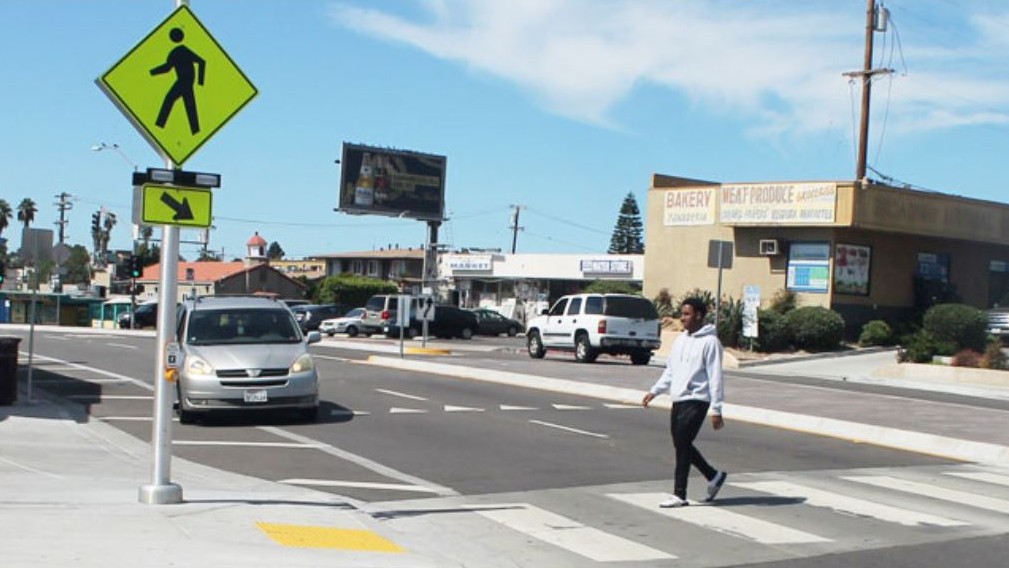
 A crosswalk in San Diego. (File photo courtesy of the city)
On Jan. 17, 6-year old Hudson O’Loughlin was fatally struck by a driver while riding his bike with his family in Pacific Beach. According to reports, the driver then sped off, running him over again in the process.
We saw the same pattern in October, when 11-year-old Andrew Olsen was tragically killed while crossing Jackson Drive with his two sisters on their way to Pershing Middle School. Just days later, 6-year-old Lucas Louis was killed in City Heights by a hit-and-run driver.

Andrew’s neighbors had requested safety measures at the Jackson Drive intersection, yet no action was taken. Within weeks after Andrew’s death, the city installed stop signs. Too little, too late.
My heart breaks with each of these tragic losses. In 2017, my husband Bill was fatally injured by a careless driver while we were cycling in our quiet Talmadge neighborhood. My life and our family unit were forever changed.
I had attended our community planning meetings previously to advocate for safe cycling lanes in our area — particularly along El Cajon Boulevard. The resistance from drivers was strong. Had that infrastructure been implemented, my husband would be alive today, watching his grandchildren grow up, enjoying a retirement after many years of hard work — a time that was stolen from him and from me.
Based on preliminary data from SANDAG, 96 pedestrians and 12 cyclists were killed on San Diego County streets in 2025. After each death, we see the same responses: community outrage, promises from elected officials, and ultimately no change in the safety of our streets.
Enough is enough.
Families for Safe Streets San Diego is a chapter of a nationwide organization composed of victims and those who have lost loved ones to the epidemic of traffic violence. We honor our lost loved ones by advocating with local officials for safe infrastructure and policy, often by sharing our stories with the media, City Council members and Mayor Todd Gloria’s office.
Safety advocates don’t use the word “accident.” We say “crash.” The word “accident” implies that these deaths are an inevitability waiting to happen, an unavoidable side effect of vehicular use. This isn’t true. When a neighbor, friend, or family member is struck and killed in our city, it is always due to a series of choices and actions.
We chose to build a city centered around cars. We chose to prioritize extra traffic lanes, parking and driver convenience over safe streets. The evidence, and unfortunately the consequence, is visible all around us. We just saw another heartbreaking example with Hudson’s death. It’s not just physical infrastructure — speed limits, signage, enforcement, education and post-crash care are all policy decisions that determine how many of our neighbors die on our roads each year.
Take stop signs for example. Each stop sign you see, and more importantly each sign you don’t see, is a choice. The intersection where Andrew was killed in October was deemed by the city as not dangerous enough for a stop sign. In 2024, this intersection was among the 488 across the city identified as having an “elevated risk of fatal crashes.”
Still, nothing was done. Upholding a policy that that declines life-saving stop signs in the name of traffic flow is a choice. Not dedicating funding to fix intersections with elevated risk of death a choice. It’s time that our elected officials choose safety.
Last year, in the midst of another alarming year of road tragedies, safety advocates, including Families for Safe Streets San Diego, organized around key safety priorities of fixing the Fatal 15 — the 15 deadliest intersections in the city — and reducing speed limits near schools. Each Fatal 15 intersection saw over three pedestrians and cyclists die in the past ten years, and car crashes are one of the leading causes of deaths for school children. Still, the Mayor and the City Council chose not to fund these safety improvements.
While the city of San Diego has faced ongoing budget challenges, transportation funding has remained a bright spot. Transportation dollars actually increased last year over the prior budget year. Budget constraints are not a reason for our unsafe streets. Again, this is an active choice by our elected officials.
No more children should die on our streets. This year, safety advocates are calling on the Mayor to fully fund the Fatal 15 intersections and to reduce speeds near our city’s schools. Proactive safety measures can save lives. Please help our children grow up safely by contacting your city councilmember and Gloria’s office to call for safe traffic areas around schools and intersections. Your voice can save lives.
Mary Elliott is a member of Families for Safe Streets San Diego. She was assisted in preparing this column by member Jill Green and Laura Keenan, chair of the organization.
READ NEXT