
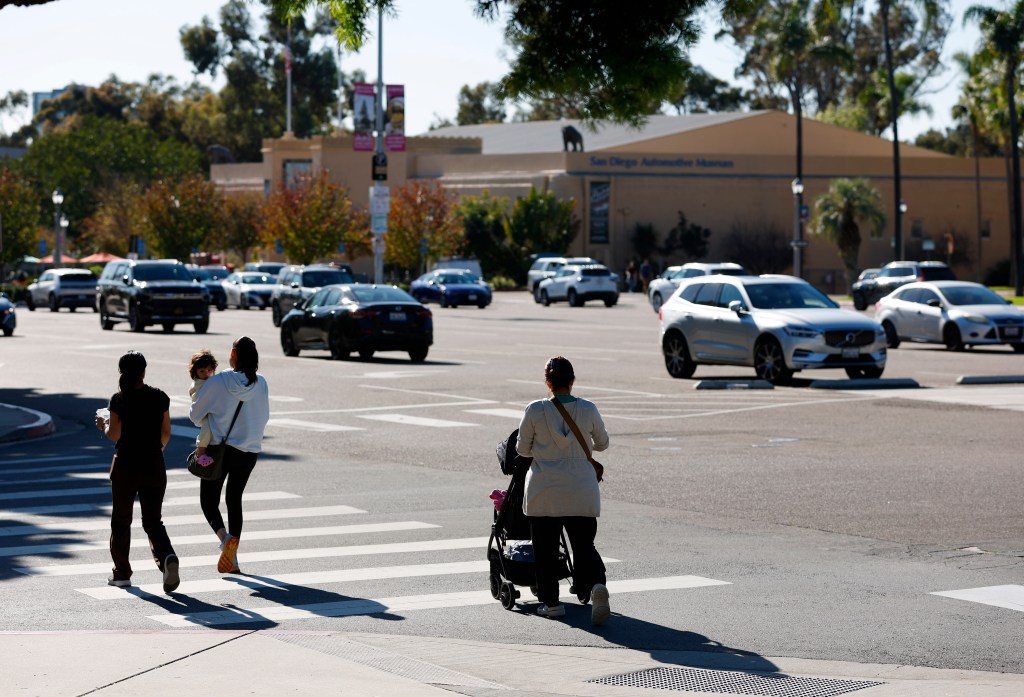
A deal reached Friday at San Diego City Hall will make parking free for city residents in six large Balboa Park lots and end parking enforcement at 6 p.m. instead of 8 p.m.
The city’s retreat from its controversial rollout of paid parking in the park was praised as a good compromise by City Council members who lobbied for the change. But those who have called for a full repeal called it only a good first step.
The agreement between Mayor Todd Gloria and Councilmembers Joe LaCava, Kent Lee and Sean Elo-Rivera allows the city to cancel a Monday public hearing to consider making parking free for residents throughout the park.
Under the new deal, city residents still must pay to park in five lots closest to Balboa Park’s most popular attractions. They will be charged $8 for a full day or $5 for four hours — half of what non-residents must pay.
The deal also doesn’t include any changes to the complex process of residency verification.
City residents must apply for their half-price discounts online, pay $5 to have their residency verified, then wait two days for that verification and choose the day they will visit in advance.
The new rules, which will take effect March 2, make no changes to the parking fees non-residents must pay.
LaCava, Lee and Elo-Rivera demanded changes and scheduled the Monday hearing 10 days ago as backlash against paid parking grew.
A poll sponsored by The San Diego Union-Tribune and 10News found that 80% of city residents wanted the new parking fees, which took effect Jan. 5, either eliminated or reduced.
Leaders of some Balboa Park museums and other organizations said two weeks ago that visits were sharply down and that their overall annual revenue could fall by more than $20 million.
The deal will reduce the amount of revenue the city expects to bring in from Balboa Park parking fees, but city officials did not estimate by how much. Gloria said the council members have agreed to find cuts they can make to city services to close any budget gaps.
On Friday, LaCava, who serves as council president, said the deal is the kind of compromise he was seeking.
“This is what collaborative dialogue can achieve: protecting affordability, access and Balboa Park,” he said in a news release.
But he also acknowledged that the compromise is unlikely to quiet critics of paid parking in Balboa Park.
“I recognize that with today’s announcements this conversation may not yet be over,” he said. “My colleagues and I recognize the impacts paid parking has had on residents, Balboa Park institutions and the many clubs.”
He said the city is treating residents differently than non-residents because the taxes they pay help maintain the park.
“San Diego residents should continue to uniquely benefit from their investment,” LaCava said.
The Balboa Park Cultural Partnership, a group representing dozens of museums and other institutions, gave the deal measured praise.
“This is a start of movement in the right direction,” said Peter Comiskey, the partnership’s executive director. “Our board supports this as a first step and believes there is more that must be done to restore free parking for everyone.”
Comiskey said his group will observe and react.
“We will closely monitor the effects of this change to see whether, and how much, it reverses the dramatic decline in visitors,” he said.
But Comiskey praised city leaders for not ignoring the complaints.
“It’s clear the city is hearing the concerns of institutions, visitors and supporters,” he said.
LaCava said the partnership’s endorsement of the changes is important to him.
The Natural History Museum issued a statement that was less positive.
“We contend this is a half-measure and not a real solution,” the statement said. “Free parking for city residents still marginalizes hundreds of thousands of county residents who’ve supported Balboa Park for generations. And it tells our community that access to our cultural institutions depends on which side of a municipal boundary you live on.”
Ending enforcement at 6 p.m. instead of 8 p.m. is expected to have a particularly big impact on the park’s restaurants, include The Prado, and the Old Globe Theatre.
In a news release, the mayor characterized the deal as his reaction to public complaints.
“Good governing also means listening,” he said. “I’ve heard from residents and from members of the City Council about how this program is affecting San Diegans who love Balboa Park as much as I do. That feedback matters.”
Elo-Rivera said the deal moves the city closer to his goals.
“From the beginning, my priority has been keeping Balboa Park free and accessible for San Diegans, while asking visitors to pay their fair share to help maintain and improve the park we all treasure,” he said. “I appreciate Mayor Gloria listening to community concerns and acting to protect resident access, while also ensuring the city continues to exercise financial discipline.”
Gloria focused on the budget impacts of the deal.
“This change will reduce revenue, and I have received a commitment from the City Council president as well as other council members to identify other service-level reductions in order to keep the budget balanced,” he said. “I appreciate the willingness of council members to roll up their sleeves and work alongside my administration as we embark on a difficult budget process for the coming fiscal year.”
The city has collected nearly $700,000 so far in parking fees.
The lots where residents still must pay are the Space Theater, Casa de Balboa, Alcazar, Organ Pavilion and South Carousel lots.
The lots that will remain free to city residents are the Pepper Grove, Federal, Upper Inspiration Point, Lower Inspiration Point, Marston Point, Palisades and Bea Evenson lots.
Even before the deal, all park visitors have been able to park in Lower Inspiration Point for free for three hours.
The new rules won’t take effect until March 2. Details can be found on the city’s website.