
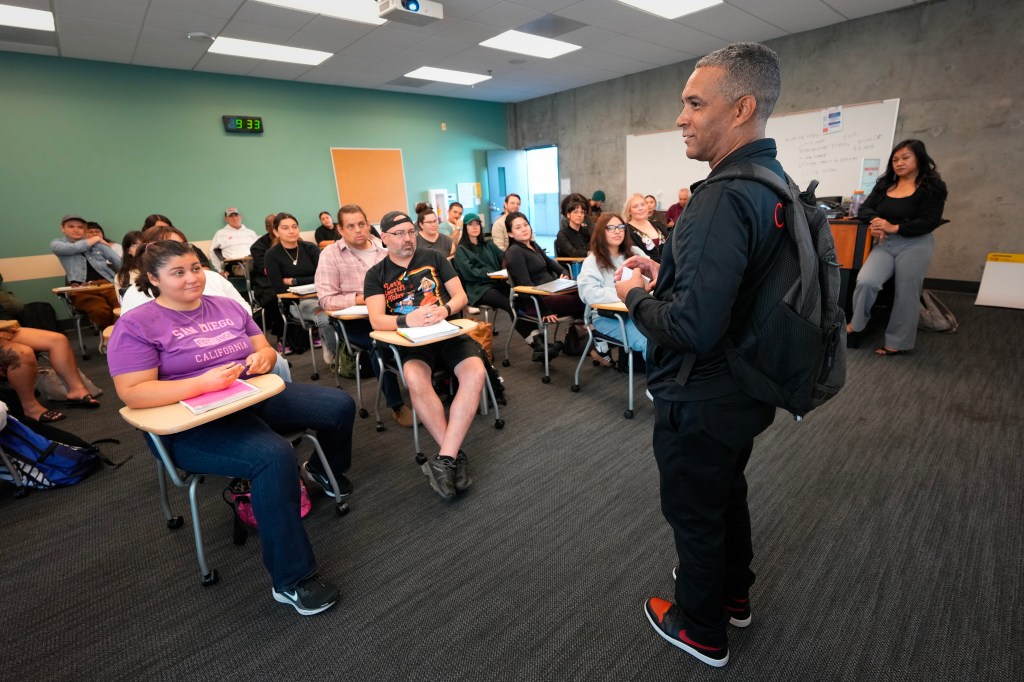
San Diego City College President Ricky Shabazz was in a defiant mood last May when he kicked off commencement before a packed audience in Balboa Park.
The Trump administration had told colleges and universities that receive federal money not to emphasize race and culture during graduations, calling it a form of segregation.
Shabazz, a self-described social justice warrior, wasn’t having it. He played loud salsa music over speakers, bringing people to their feet to dance.
“We’re one of the most racially and ethnically diverse colleges in the country,” he recently told the Union-Tribune. “I wanted to show students they can be their authentic self and still be a scholar. We are the United Nations of colleges.”
San Diego filmmaker and City College alumnus Michael Taylor saw this as a defining moment for Shabazz, saying, “Some people stand up for what they believe in. Some do not. Ricky does.”
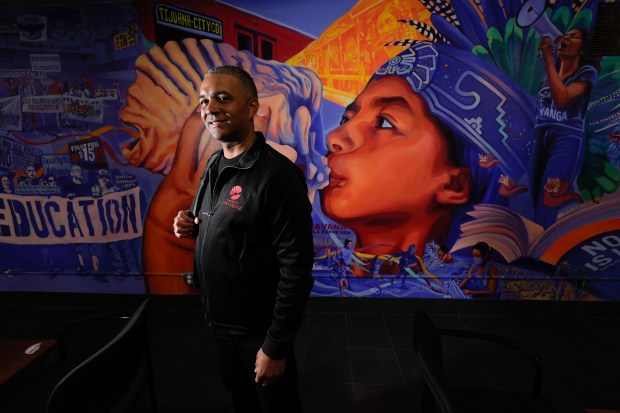 Ricky Shabazz, president of San Diego City College, in front of a campus mural on Tuesday. (Nelvin C. Cepeda / The San Diego Union-Tribune)
He isn’t alone in praising Shabazz, a gregarious figure who often forgoes the 40-plus suits hanging in his closet for polo shirts and Air Jordan sneakers to better relate to the student body.
His wallet is filled with $20 food vouchers for the college’s many low-income students. And he often gives students copies of the book, “The Greatest Salesman in the World,” because of its lessons about positivity and persistence.
Many students, faculty and staff say they like how Shabazz uses social justice to unify and lift a 112-year-old public community college that is burdened by enrollment, money, image and public safety problems.
As the spring semester gets underway, they see lots to celebrate.
In October, City College broke ground on its first residential tower — an anomaly at community colleges statewide. The $280 million building will house about 800 students, some at below-market rates in a pricey corner of downtown San Diego. The school is part of a four-college district where nearly 60% of students systemwide say they cannot afford to pay rent or have to move frequently, according to a 2024 survey.
City Village will focus on full-time students from many backgrounds, including those who are low-income, military veterans, former foster youth, people with disabilities, and some who were formerly incarcerated.
In December, the state designated the college as a Black-Serving Institution, a new title bestowed on colleges that excel at helping these students. City’s selection was influenced by the fact that Shabazz opened a barber shop that offers free haircuts to students enrolled in at least one class and who had filed for financial aid.
The program is primarily meant to be a social center for Black and Latino men who are offered academic, financial and personal guidance while they’re there.
 Students get free haircuts while learning about the school resources available to them to help towards graduating. Students Chasan Haynes, Elvis To and Mike Patke are pictured from left to right in the front row. From left in back row, barber Larry Jackson. Synod Mitchell and Stephen Williams. (Nelvin C. Cepeda / The San Diego Union-Tribune)
“I can’t really afford haircuts,” said Chasan Haynes, a communications major. “And this is a very warm, welcoming environment.”
About 10% of City’s students are Black, almost twice the percentage of Black people who live in San Diego.
“I didn’t see a lot of faces that looked like mine when I was attending UC Davis,” said the 50-year-old Shabazz, who is Black. “That’s what this is about.”
Shabazz has started to get large scholarship and basic needs donations from Jim Sinegal, the co-founder of Costco.
“I got a good, practical education at City College in the 1950s,” said Sinegal, a Seattle-area resident who prefers not to reveal the size of his gifts.
Much of the money will support students who want to get manufacturing jobs at companies like Solar Turbines, electrician slots at San Diego Gas & Electric and the Metropolitan Transit System, and cosmetology positions countywide. This focus was strongly shaped by Shabazz, who watched his father, Sam, train as a mechanic at a community college in Los Angeles after he left the Marines.
“That’s why I love to fix things,” said Shabazz, who lives in La Mesa. “I just fixed our hot water heater.”
The college also is looking forward to spring graduation, when it will confer bachelor’s degrees for the first time. They will go to about 40 students studying cybersecurity. And the school has greatly expanded the number of free college-level courses it offers at area high schools.
Hurdles ahead
The joy is offset by daunting problems, including one that is shared by most of the state’s 116 community colleges: the difficulty in attracting and keeping students in a changing marketplace.
Enrollment soared in the 1960s and ’70s due to the Baby Boom. The colleges were mostly funded by local property taxes until 1978, when that responsibility began to shift to the state, introducing volatility.
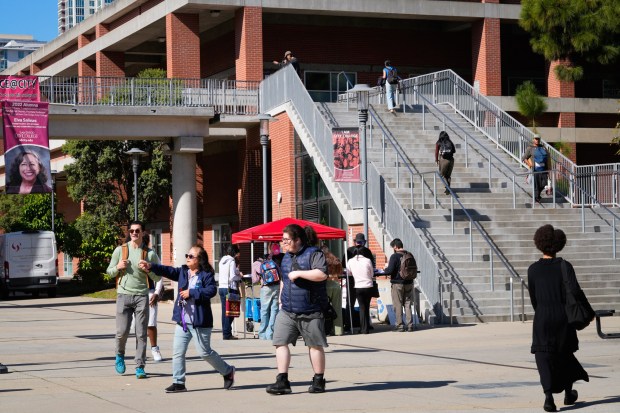 Students on campus at San Diego City College on Tuesday. (Nelvin C. Cepeda / The San Diego Union-Tribune)
Generally speaking, the state gives the colleges budget increases when the economy does well and the opposite when it does not. There’s a quirk in the formula. When the economy is bad, people surge into the colleges for training, but the schools don’t always get enough money to cope.
For a while, City College fared reasonably well. Enrollment peaked at 18,794 in 2010. But it began to slip the following year and slid quickly when the pandemic hit. It has since slowly risen to 14,236.
Shabazz does not see a huge boom ahead, telling the Union-Tribune, “I think our enrollment number (10 years from now) is between 15,000 and 16,000 students.”
That contradicts what the college has been telling the public for decades.
In 2005, the school’s trustees approved a plan meant to enable City College, which then had nearly 16,000 students, to serve 25,000 students within 20 years. The same estimate was used in 2014 when the college celebrated its 100th birthday. A 2022 campus report pointed to the same number.
Shabazz, a perpetually upbeat person with deep expertise in enrollment matters, believed a big jump was possible when he became president in 2017.
“I was very naive given my enrollment background…” said Shabazz, who is paid a $365,000 salary. “I came into this position really believing that we could get to 25,000 students.”
There are many roadblocks to prosperity for community colleges.
The number of high school graduates is dropping because American women are having fewer children. More and more students who do graduate focus on getting into the prestigious California State University and University of California systems.
And California is tied with Louisiana for the nation’s highest poverty rate, which makes it hard for many to afford school, even community colleges, which have modest tuition rates.
City College also is something of a secret in its own hometown. It has a tiny, easy-to-miss campus that’s set amid busy city streets next to Interstate 5. It has some new buildings that have added a dash of color. But much of the infrastructure is a bland gray. So far, there is no iconic building to serve as a landmark.
And City — as many call it — doesn’t strongly and broadly emphasize that its alumni include such people as astronaut Katya Echazarreta, filmmaker Cameron Crowe, whose mom taught at City, and Pearl Jam frontman Eddie Vedder.
The MTS trolley stop that serves campus can also be a high-crime area, including being the site of a stabbing that occurred in late December. Students and faculty say they find that scary. It’s been a factor in the college’s decision to offer comparatively few night classes to a student body mostly made up of working adults.
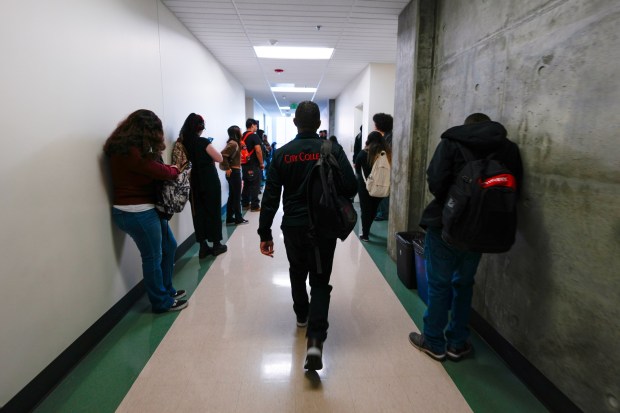 Ricky Shabazz, president of San Diego City College, walks down one of the crowded hallways on campus Tuesday. (Nelvin C. Cepeda / The San Diego Union-Tribune)
The pandemic also delivered a blow.
Before COVID, fewer than 20% of the school’s students took one or more classes online. Today, more than 50% attend online, or through a combination of online and in-person classes.
That reflects the growing influence of online learning and could diminish the college experience by reducing foot traffic on a campus that faculty and staff say looks like a ghost town at times.
Shabazz is deeply aware of this and never passes up an opportunity to retain the students he has and engage those he might recruit. On Tuesday, a man began looking at campus literature at an outdoor greeting table Shabazz was helping run. The man said, “I can’t do this, I’m 48.”
The salesman in Shabazz burst forth. “No, the average age here is older,” he said. “You’re perfect! You’re not alone!”
The guy moved on.
A short time later, Shabazz ducked into a social work class that had 37 students — 10 of whom are over age 30 and one who is 69.
“You cannot compare (what we do) at a community to the UC or CSU,” said Shabazz. “This is where formerly incarcerated people, parents who raise their children, come back to school to invest in themselves.
“I see myself in these students,” he later added.
Upward bound
Shabazz came from modest means. His mother gave birth to him in Oceanside when she was only 14. His father also was young. The couple never married, and Shabazz says that both of them, for a period, had drug problems.
“I wouldn’t say I had a rough life because my grandparents helped raise me,” said Shabazz, who went on to graduate from Pasadena High School.
This Pasadena connection might surprise some people. Shabazz has a strong, lyrical Texas accent that he attributes to family members with ties to the state. He pronounces the word hill as “heal.”
His mother envisioned him playing baseball for the Los Angeles Dodgers, which was fruitless. He was obsessed with bass fishing and chose to attend UC Davis because the major fishing tournaments were within an hour’s drive.
He earned a bachelor’s degree in Native American studies while evolving into a nationally known fisherman who says he earned large sums of money in tournaments. It’s an obsession that hasn’t faded; Shabazz is forever checking the Navionics app on his phone to get the latest data on local fishing spots.
After he graduated, Shabazz got a job helping UC Davis recruit students in Southern California, where he prospered. He went on to become dean of student services at Compton College near Los Angeles. Problems immediately arose.
He said two of the school’s executives were bothered that he didn’t come from community college culture and wanted to get rid of him. Shabazz told them that if he didn’t raise enrollment within six months, he would resign.
He got off to a quick start and, with considerable help, raised enrollment from 3,000 to 15,000 in seven years.
That success largely led to his appointment as president of City College, where he manages a $120 million budget. Despite being more than a century old, the school did not have a fundraising foundation or an alumni database. Enrollment also was dropping.
Shabazz learned a hard lesson fast, saying, “The vast majority of our students are part-time, and I did come in very naive, and maybe even arrogant to a degree, that I could convert them into full-time students …
“To ask students who are taking one class a semester toward their degree to take three to four, knowing that the average rent (in San Diego) is $3,000, is unreasonable.”
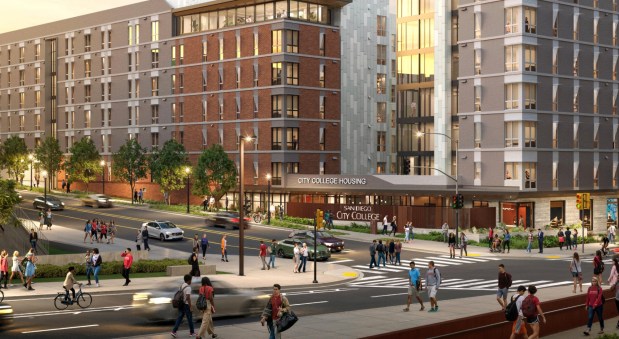 San Diego City College has started building an 800-bed residential hall that will open in 2028. (Rendering courtesy of San Diego City College)
But he did click with students, partly by giving the school a three-word motto: You Belong Here.
He recognized that many potential students — most of them non-White and from low-income families — were apprehensive about entering college and wondered whether it was safe to go to school in a neighborhood where crime is a concern and homelessness is common.
Shabazz spoke to their fears in different ways, including placing a large social justice message on an outdoor wall that says, in part, that City is committed “to closing the opportunity gaps perpetuated by structural injustice in higher education.”
The words “You Belong Here” especially resonate with Nicolei Perez, who is studying to become a nurse.
“It made me feel like I’m home already, that they were welcoming me with open arms,” she said.
It’s made Shabazz, who drives a 13-year-old, tuna-can-sized Honda Fit, popular with students. Many affectionately call him Little Ricky because he’s 5-foot-5-inches tall.
For many, the optimism is tempered by a fear that City, which has lots of undocumented students, will be raided by Immigration and Customs Enforcement. The college has a plan that’s meant to alert students and faculty if that happens.
Professor Kirin Macapugay, who teaches social work, said, “Some teachers are wondering whether we should buy crow bars to bar the doors and keep ICE out.”
Shabazz acknowledges the threat but does not regret defying the Trump administration during last year’s graduation.
He is supported by Greg Smith, chancellor of the San Diego Community College District.
“It may invite some heightened scrutiny,” he said. “It may invite some unwanted interference. But I’m willing to take that risk because these are our values.”