
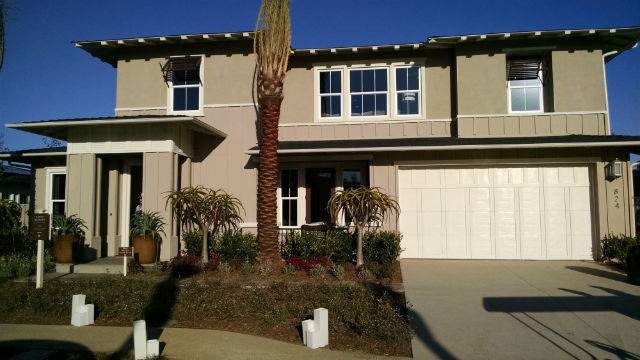
 A model home in North County. Homeowners have a number of options to find energy savings in their residences. A new county program offering DIY toolkits aims to help. (File photo by Chris Jennewein/Times of San Diego)
Monitoring daily water and energy use may seem like a daunting task for some homeowners, but a pilot program from the San Diego County aims to make it easier.
The “Do-It-Yourself Sustainability Toolkit” program provides residents of unincorporated communities with a range of supplies to assess water and energy usage in their homes. Each kit can be borrowed for two weeks at a time and includes infrared, refrigerator and water thermometers; a Kill-A-Watt meter; water pressure and drip gauges; pliers and a step-by-step user manual.
There’s also giveaway items, such as a low-flow showerhead, LED lightbulbs, weatherstripping and more, which can be kept by borrowers after they return the whole kit. Meghan Kelly, the county’s program manager of sustainable planning, said that these items were chosen as initial steps that homeowners can take to become more water and energy efficient.
But it’s not just about sustainability. Using the kits can help residents with their utility bills as well.
For example, Kelly said that LED lightbulbs can save around four times as many kilowatts per hour of electricity compared to incandescent lightbulbs. “[Changes] are relatively small, but over time, you know, it can add up in real savings. If that’s just one lightbulb in your house, look at how you can maximize that across as many different outlets that you have.”
She added that one of the most helpful aspects of the toolkits comes in the user manual, which details how to “open up your utility bills and really understand all of the information that is included there.”
Once homeowners have a better grasp of their energy usage, they can find ways to maximize efficiency, such as by identifying “energy vampires” — appliances that use energy even when turned off — or what times of day electricity use is most cost effective.
“The purpose is to help folks reduce their energy and water use, but it’s also really about education,” Kelly said. “Like understanding when you’re using energy and how much energy you could be saving if you shift things to off-peak hours, for example. A lot of folks don’t know that, and just increasing awareness from that perspective really helps.”
The U.S. Department of Energy said that “do-it-yourself” home energy assessments can help homeowners “pinpoint some of the easier areas to address,” such as by detecting air leaks. That alone can reduce energy bills by 10 to 20%.
The DoE also noted that households can save approximately $225 per year by switching to LED lighting.
There are currently 31 toolkits available to borrow, with enough giveaway items for 200 checkouts. They can be picked up from the County Operations Center on Wednesdays – residents must reserve them online – or during scheduled pick-up event dates.
Kelly said that the kits are designed to be checked-out once per household, and that “hopefully, once folks kind of read through the manual and go through the process, it’s something they can take forward on their own.”
Pick-up and return events are typically announced one month in advance, with upcoming dates at 10 a.m. Saturday at Spring Valley County Park, and also at 3 p.m. Feb. 12 and 19.
In March the site will be the Ramona Branch Library. Kelly said that these dates are often scheduled in conjunction with other events or programs, such as the county’s Equity-Driven Tree Planting initiative, with the aim of leveraging high foot traffic at the locations.
She added that there have been 30 total checkouts since the program started last October, and that these pick-up and return events have provided program operators with the opportunity to receive live feedback from borrowers.
According to user testimonials, the infrared and refrigerator thermometers were deemed the “most useful for identifying where heat was being gained or lost.” The most cited “lesson learned” from users was “identifying which appliances were using more energy when plugged in, but turned off or on stand-by.”
Feedback also showed that all toolkit users said they were “likely” or “very likely” to recommend them to friends and family.
Provision of the kits was supported with $220,000 in funding from the Local Government Partnership Program. Distribution was initially slated to begin in March 2020, however Kelly said that lockdowns and distancing regulations during the COVID-19 pandemic made hosting in-person events nearly impossible.
It wasn’t until October that the department was able to reinstate the program as part of the county’s Climate Action Plan (CAP), which includes 70 items aimed toward reducing greenhouse gas emissions.
Introducing sustainability toolkits aligns with two CAP measures for unincorporated areas – to develop policies and programs “to increase energy efficiency and electrification,” in hopes of reaching 30% electrification in residential developments by 2030, and “to increase indoor and outdoor water conservation (including water efficiency, retention, recycling and reuse) in new and existing development(s).”
“This is one program that we’re doing under our climate action plan, and we have more that we are working on,” Kelly said. “So, I think things that we’ve learned through this process will also be brought into additional future programming as well.”
READ NEXT