
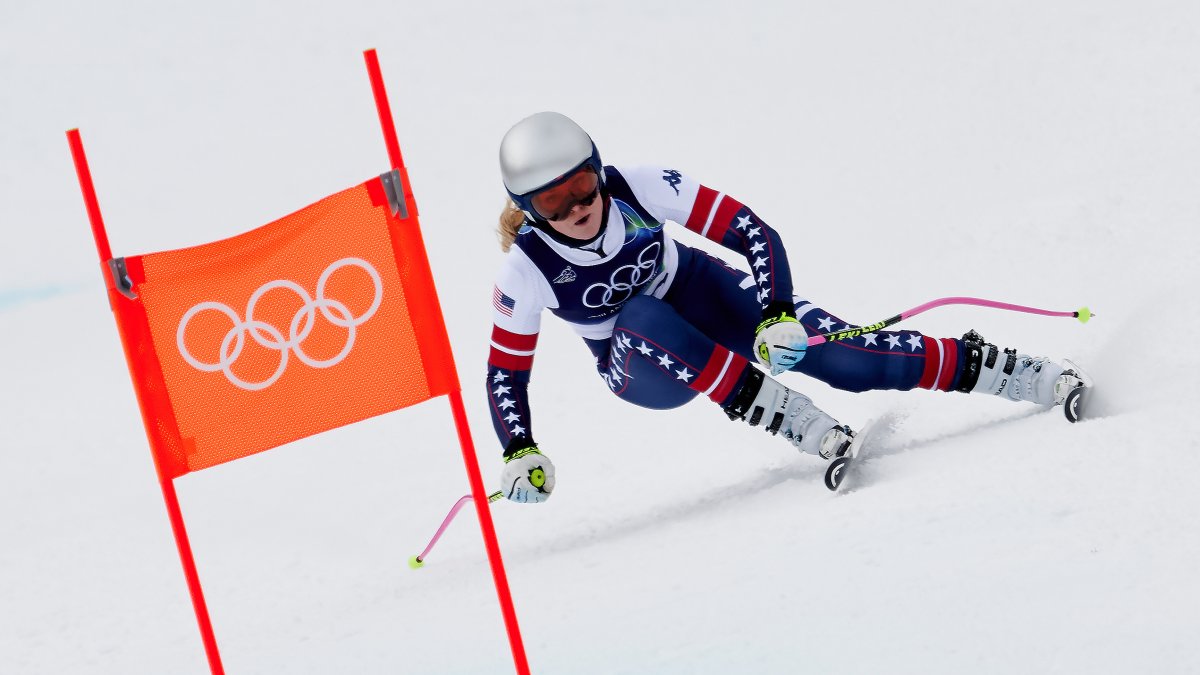
Lindsey Vonn is back.
After a six-year absence from competitive skiing, and less than two years removed from a partial right knee replacement, a 41-year-old Vonn won a World Cup race in December of 2025. She won again in January of 2026, sparking real belief she could become the oldest Olympic women’s ski champion in history.
Then, a week before the 2026 Winter Games in Cortina, Vonn crashed, suffering a tear of her left anterior cruciate ligament (ACL), the piece that basically holds the knee together when an elite skier is trying to get down a mountain at speeds pushing 70 mph.
“There are those cutting and twisting maneuvers, and then the torque with upward force applied against the tibia. She’s fighting gravity and then also the force of the mountain. So, it is a lot of energy directed against the lower extremities,” says Dr. Mark Schultzel, an orthopedic surgeon with Sharp Memorial Hospital.
For context, just how much force are we talking about here?
“It’s almost as if she’s on a roller coaster being dragged by her legs,” says Schultzel, who has performed ACL repair surgeries and, in 2024, was a member of Team USA’s medical contingent at the Paris Olympics.
With that in mind, it was more than a little surprising to see Vonn on a mountain in Italy on Friday, taking a training run just two days before she plans on competing in the women’s downhill competition.
Just one week after tearing her ACL, Lindsey Vonn has completed her Olympic training run in Cortina.
The women’s downhill competition takes place this Sunday. pic.twitter.com/FgEG8xkWTI
— NBC Olympics & Paralympics (@NBCOlympics) February 6, 2026
She plans on wearing a brace in competition, which will help a bit. But, Vonn’s biggest asset to supporting a compromised knee might come from work she’s already put in.
“I have to imagine that she has very strong quadricep muscles, which can be another counterbalance to help keep the knee stable,” says Schultzel.
That is absolutely correct. Vonn is a workout wonder who’s squatted more than 450 pounds. Keeping the knee mechanically sound is just half the battle. Vonn also has bone and meniscus damage, and that is going to be extremely painful. The International Olympic Committee is extremely strict on what athletes can put in their bodies to avoid performance enhancement but Vonn might be able to take something to numb the discomfort.
“In a lot of cases they do allow for steroid injections. And in other pain reliever injections like Toridol and things like that,” says Schultzel.
The most powerful drug of all just might be the competition itself.
“At the Olympics, one thing I’ve learned in working with these athletes is that the endorphins are real,” says Schultzel. “So, even if they’re having aches and pains and things like that in the moment, I think the energy is so powerful for them that it helps them overcome any pain they have at the time.”
Vonn is opening herself up to the potential for even more devastating injury. Schultzel says as a doctor, he would not advise her to sit this one out.
“No. You know, at the end of the day, this is really core to her being. And so I think, really, it’s not for us to decide. If this is really what she wants to do we should be there to support her. We can pick up the pieces if she gets injured or has problems afterwards. But, you know, she’s trained your entire life for this moment. She should get out there and do her very best and bring home some gold for team USA.”
Vonn will ski the downhill competition on Sunday, then decide her status for the Super-G and team events.