
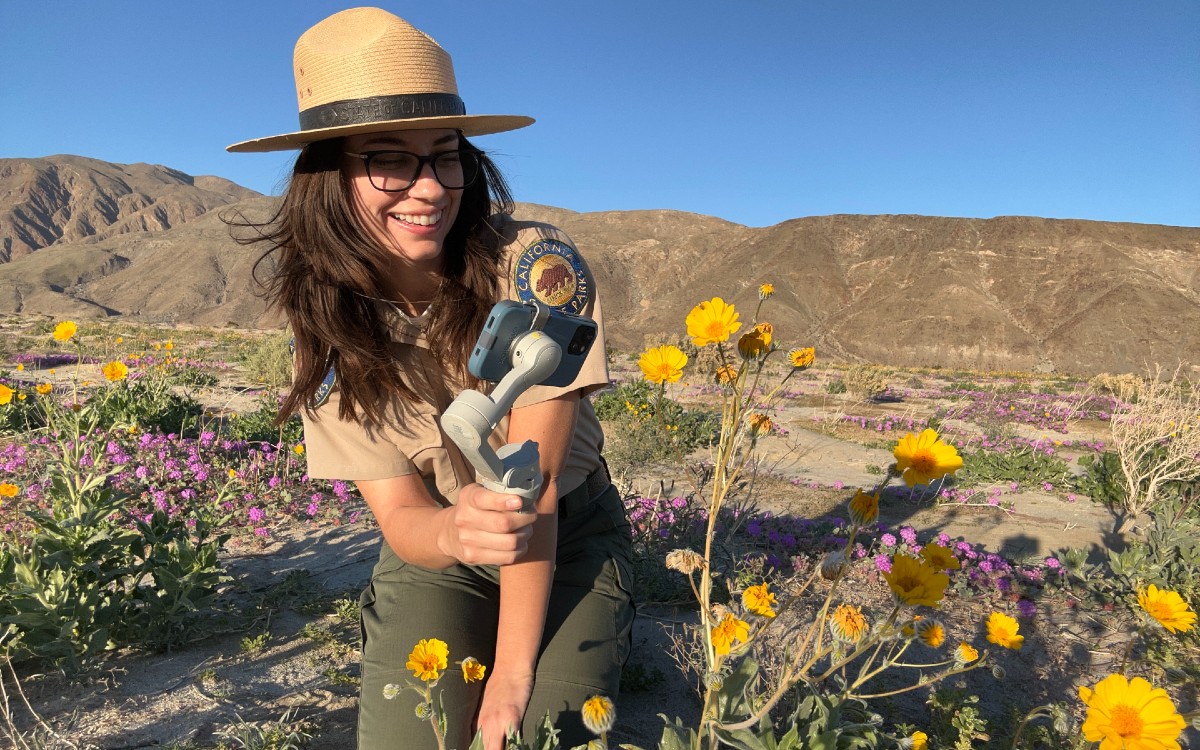
 Brianna Pinto examines wildflowers closely in Anza-Borrego Desert State Park. (Photo courtesy of Brianna Pinto)
After wetter-than-usual weather and early bursts of color across Anza-Borrego Desert State Park, a familiar question is blooming right alongside the wildflowers: Is San Diego County headed for a full-blown superbloom?
The answer, according to local experts, is a cautious maybe and a reminder that desert wildflowers operate on nature’s timetable, not ours.
“What we call a superbloom is really the result of a very specific combination of environmental signals,” said Wolfgang Busch, PhD, a professor at La Jolla’s Salk Institute for Biological Studies who studies how plants sense and respond to their surroundings. “In the case of the superbloom, what has been shown to be relevant is actually moisture and temperature.”
Desert wildflowers don’t sprout on a whim, Busch explained. Their seeds can lie dormant in the soil for decades, waiting for the right moment. When enough rain falls and temperatures align, some seeds “decide,” in a biological sense, that it’s worth the risk to grow.
“It’s really a life-or-death decision for each seed,” Busch said. “If seeds respond to the wrong rainfall, at the wrong time of year, that’s probably pretty bad for them.”
That uncertainty is why even a rainy season doesn’t guarantee a dramatic carpet of flowers. The amount of viable seed in the soil, the timing of rainfall and the temperature patterns all matter. Different species also respond to different thresholds, which is why blooms often arrive in waves rather than all at once.
 Visitors perusing the flowers at Anza-Borrego Desert State Park this year. (Photo courtesy of Brianna Pinto)
From a visitor’s perspective, that variability is already playing out across Anza-Borrego, said Brianna Pinto, an interpreter at the state park and a San Diego native.
“A lot of us in the park system shy away from the word ‘superbloom’ because it sets expectations,” Pinto said. “Having winter annual blooms at all — they don’t happen every year — but when they do, it is really spectacular.”
Pinto said 2019 remains the benchmark year, when widespread, simultaneous blooms drew massive crowds from around the world. This year looks different. Flowers began appearing earlier than usual, and while some areas are putting on a strong show, others are quieter.
“This year we had some of our historically good bloom areas start a little bit earlier than we typically see,” she said. “It’s been amazing to already have wildflowers that have been there for a couple of months.”
Among the most recognizable blooms are the white evening primrose, purple sand verbena and yellow desert sunflower — the trio often seen in iconic Anza-Borrego photos. But some of this year’s early risers are already nearing the end of their life cycle, particularly in areas that haven’t seen rain since December.
“Rain might activate some seeds that are still lying dormant in the seed bank,” Pinto said, “but temperature also plays a really big role.”
Busch said that kind of biological patience offers lessons far beyond the desert. Understanding how plants “compute” environmental information could help scientists develop crops better suited for a warming, drier climate.
“There have been plants discovered that can be productive and even grow in Death Valley,” Busch said.
Learning from genetic “recipes” that desert plants have evolved to survive extreme heat and drought, he added, could inform the breeding of future crops to withstand climate change.
For now, both experts encourage visitors to slow down and experience what’s already happening on the desert floor.
Pinto suggests checking ABF.org for real-time wildflower information thanks to volunteer “flower scouts” who track and report blooms throughout the park. She also invites visitors to explore beyond Henderson Canyon Road to quieter spots such as Coyote Canyon, noting weekdays are generally less crowded than weekends.
“The deeper you go and the slower you go, you’ll find there’s a lot more than just those three species,” Pinto said, pointing to free apps such as Seek to help visitors identify plants along the way.
Busch echoed that sentiment, urging visitors to look closely, but tread lightly.
“Be amazed and be respectful of these living beings,” he said. “Bring a magnifying glass, look at the really sophisticated and beautiful flower structures, but be mindful. These flowers want to produce seeds for the next generation.”
 Evening primrose along Henderson Canyon Road in Anza-Borrego State Park. (Photo courtesy of Brianna Pinto)
Whether or not 2026 delivers a textbook superbloom, Pinto said the desert is already offering something special.
“We don’t really know when the peak is until after it’s passed,” she said. “But we know there are flowers here now, and it’s beautiful.”
And in nature, being present is the point.
READ NEXT