
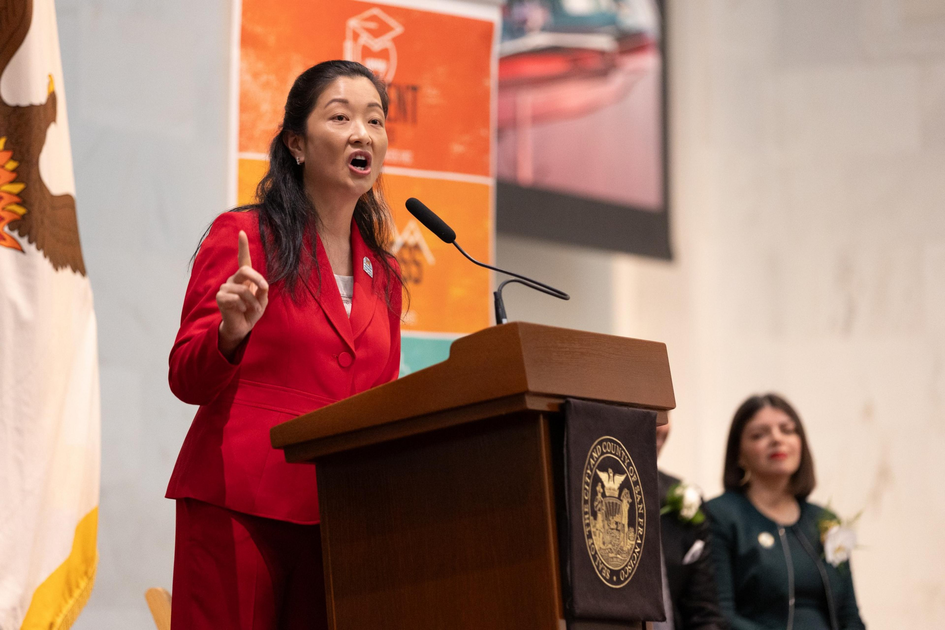
While walking into a 2 p.m. Saturday negotiation session at the Veterans Building on Van Ness Ave. with members of her leadership team, Superintendent Maria Su was noncommittal as to whether the district was prepared to concede anything to the United Educators of San Francisco.
“I’m just excited to get the conversation going,” Su told The Standard, declining to address any changes to the district’s proposal. “I look forward to getting to an agreement that supports our students.”
The union told the Standard around 4 p.m. that there was no scheduled end time for negotiations on Saturday afternoon, and suggested that all parties could work late into the night, and possibly into Sunday.
Whether the strike takes place or not, all SFUSD schools and district offices will remain closed on Monday Feb. 9, according to an email that went out on Saturday from Su’s office.
In addition to Su, Deputy Superintendent Chris Mount-Benites and Amy Baer, the Associate Superintendent of Human Resources, are part of the SFUSD negotiating team. President Cassondra Curiel and Executive Vice President Frank Lara, among others, comprise the UESF side.
The two entities are looking for a middle ground around pay and healthcare benefits, along with other issues including special education staffing and artificial intelligence. If successful, a new deal would end a year’s worth of bargaining over a new contract for teachers.
SFUSD has offered a 6% wage increase over the next three years for both certificated and classified employees. But the union is seeking a 9% increase over two years for certificated employees and a 14% increase over that same period for classified employees, which include custodians and paraprofessionals.
On Saturday, while negotiations were ongoing the UESF put out messages on Facebook (opens in new tab), suggesting that a strike was likely.
“This isn’t just about us, it’s about every student who needs consistent special ed support, every family facing housing insecurity, every educator who can’t afford to live in the city they serve,” the union wrote on Saturday morning.
“SFUSD needs to prioritize today’s dollars on today’s students and settle a fair contract. Until then, we’re ready to strike on Monday, Feb. 9.”
While the district claimed last week it had offered the district fully-funded healthcare, the proposal presented at Thursday’s negotiations had offered two different options: 75% of family healthcare or an annual health benefits allowance of $24,000 for each educator, using Proposition A parcel tax funds to pay for the cost in a separate memorandum of understanding, or MOU.
The union is also seeking a commitment to implement a workload model, instead of a caseload model. A workload model corresponds to paying teachers based on time and effort with students, rather than a number of assigned students. The district has proposed implementing a pilot at five schools, while the union seeks a commitment to implement this model at all locations.
On Friday, after administrators announced they would be striking in solidarity with teachers — further complicating the potential of opening schools.
The district released a list of free lunch and breakfast sites (opens in new tab) and childcare programs (opens in new tab) around the city. The district said parents should not expect that there will be enough availability, and advised families to contact each childcare provider.
On Feb. 3, the school board gave the superintendent authorization to enact measures which extend beyond the dictates of typical district policy, including the ability to close school sites and change staffing assignments.
By Saturday, the district sent out “Independent Study” packets (opens in new tab) for students, which would supplement instruction during time away from the classroom. Administrators also asked parents to sign an Independent Study contract, which said that assignments would be submitted through online platforms.
Also on Saturday, at least some teachers sent out an email to parents, including those at Sloat Elementary, encouraging parents not to sign this contract lest the district continue to receive attendance money from the state and use it to keep schools open during a strike.
“Please do what is right for your family,” the message concluded, which was obtained by The Standard.
In a pair of emails sent Friday — and also obtained by The Standard — the district’s human resources department informed teachers they’d be redeployed to alternate school sites.
However, it remains unclear what tasks they’d be asked to perform, but the district suggested that “current work hours are in effect.”
“Checking in with HR at your assigned Staff Center will be necessary to ensure accurate pay,” SFUSD’s HR Chief Amy Baer wrote in one of the two emails.
John Logan, chair of labor and employment studies at San Francisco State University, said this move seems like an effort to put “maximum pressure” on teachers to call off the strike, or to lure some teachers across the picket lines.
But, he said, “this kind of aggressive messaging can backfire, result in more entrenched positions, and destroy relationships long into the future.”
“If they really believed that a settlement was imminent,” Logan added, “it’s difficult to understand why they would think this was a good idea.”