
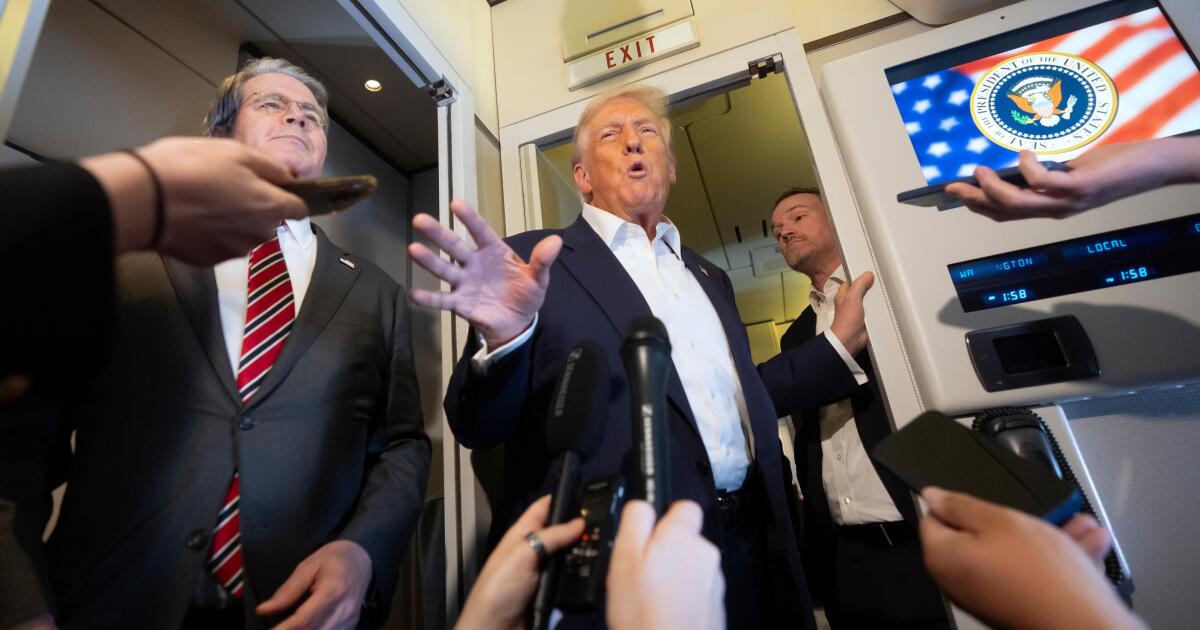
Unlike Kaitlan Collins of CNN, Catherine Lucey of Bloomberg, Mary Bruce of ABC, Nancy Cordes of CBS or Rachel Scott of ABC, I have never been yelled at or insulted by a president.
OK, once, next to an Iowa cornfield, then-presidential candidate Barack Obama made fun of me for shivering in the cold. But I deserved it; the weather was a balmy 50 degrees.
The sheer number of journalists who find themselves the targets of Trump’s childish outbursts demonstrates that he flaunts the kind of personality flaws that most chief executives try to hide. He has a short fuse, has no use for decorum and can’t stand being challenged — especially by women.
The journalists, you have probably noticed, almost never take the bait. Nobody chucks a shoe at the president the way Iraqi journalist Muntazer al-Zaidi did in 2008. (“This is a farewell kiss from the Iraqi people, you dog!” al-Zaidi yelled before throwing both of his shoes at President George W. Bush during a Baghdad news conference. Bush ducked. Twice.)
In any case, American journalists generally don’t take Trump’s attacks personally because they are not in the room for personal reasons. They are professionals who represent their readers, listeners and viewers. They are there to elicit information, not pick fights or get the last word.
Collins is the most recent journalist to find herself in the crosshairs of Trump, who bristled Wednesday at her question about redactions in the Epstein files: “What would you say to the survivors who feel like they haven’t gotten justice, Mr. President?”
After a brief I-really-don’t-care-do-you shrug of his shoulders, the president went off on Collins. “I think it’s really time for the country to get on to something else,” said Trump, whose name appears more than 38,000 times in the most recently released batch of Epstein files.
“You are the worst reporter,” Trump said. “CNN has no ratings because of people like you. … I don’t think I’ve ever seen you smile. I’ve known you for 10 years and I don’t think I’ve ever seen a smile on your face.”
Collins, still not smiling, tried to redirect Trump to her question. Twice. But he was on a roll: “You know why you’re not smiling? Because you know you’re not telling the truth. You’re a very dishonest organization.”
Later that day, I read a few social media posts questioning why other members of the media didn’t step in to defend Collins in the moment.
“I don’t understand why colleagues stay silent when this happens,” writer Roxane Gay posted on Bluesky.
To that, another Bluesky user replied, “I want at least one reporter, ONE, to be like ‘Hey, that’s rude, don’t talk to another person like that. Be an adult.’ That’s all it needs to be!”
I hate to disappoint them, but that would be pointless.
Take, for example, the experience of former CNN White House correspondent Jim Acosta. During Trump’s first term, Acosta often challenged the president for denigrating the media as “fake news.” Shortly after taking office the first time, Trump pouted at a news conference that the media hated him.
“And just for the record, we don’t hate you,” said Acosta, mistakenly thinking he needed to defend himself. “I don’t hate you.”
But Trump is never actually talking to the reporters he insults or whines about. He is talking to his base, building an alternative narrative to shift attention away from an unpleasant subject like Epstein, or to undermine reporting he considers unfavorable. His is a tried and true rhetorical strategy that has little to do with individual journalists.
Back in Trump’s first term, before his lack of restraint was entirely normalized, his exchanges with reporters still had the power to shock. In November 2018, Acosta asked Trump why he mischaracterized migrant caravans from Central America as an “invasion.” Trump called him a “rude, terrible person.” Trump became furious; Acosta continued to press him.
Finally Trump said, “OK, that’s enough,” and a White House intern tried to take the microphone away from Acosta to give it to another reporter. Acosta held fast. The White House later accused him of putting his hands on the young woman, which video clearly shows did not happen. Nevertheless, the White House punished Acosta by revoking his credential. CNN sued, a federal judge ordered Acosta’s access restored and the White House complied. (Those were the good old days when the White House complied with federal courts.)
Last week, many journalists stepped up to defend Collins on social media. Our tone-deaf vice president, JD Vance, on the other hand, defended Trump’s remarks as “so perceptive” and seemed energized by the whole affair.
“Just have some fun,” Vance told Megyn Kelly. “You can’t always take yourself too seriously.” (Do we really need to explain why telling a woman to smile is sexist? Collins’ question, remember, was about girls who had been sex trafficked by Jeffrey Epstein. Fun!)
Anyway, we do have a record of what happens when a journalist steps up in the moment to defend a colleague against Trump. It’s pointless to argue.
In 2018, after the president insulted Acosta, he called on NBC’s Peter Alexander. “In Jim’s defense,” Alexander said, “he’s a diligent reporter who busts his butt.”
“Well,” Trump replied, “I’m not a big fan of yours, either.”
See what I mean?
Bluesky: @rabcarian
Threads: @rabcarian