
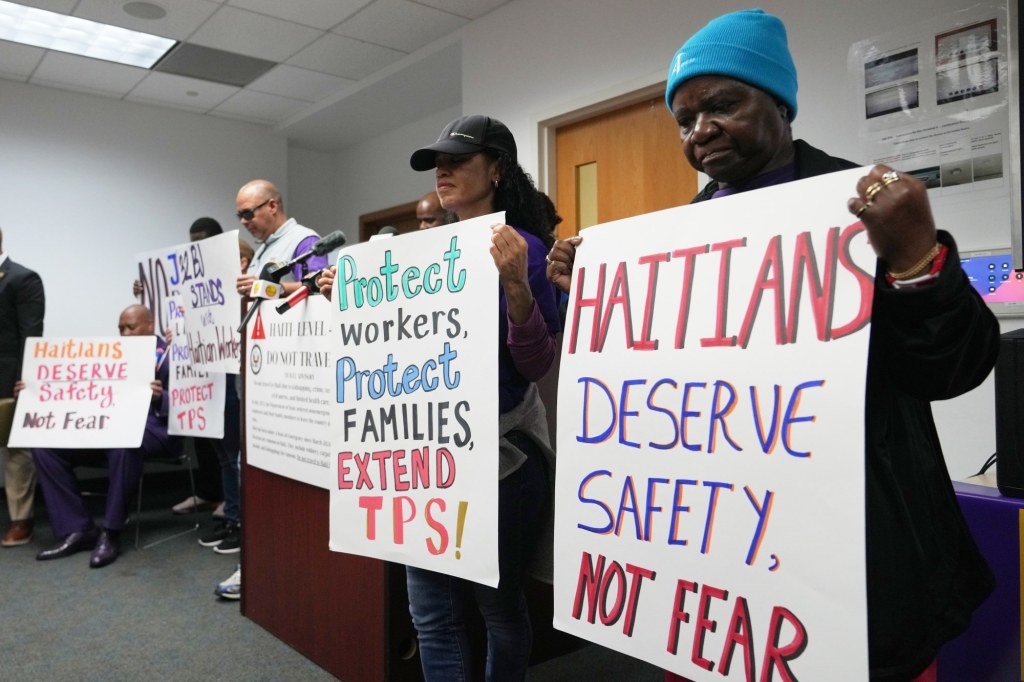
With the late-night court ruling last week blocking the Trump administration from ending protections for Haitian immigrants, there’s been a sigh of relief from advocates and people in the Haitian community. It’s a small sigh of relief, as the fight for those protections continues.
“We know that the fight is not over, so I have not found any strength to celebrate because I have to really pay attention to the response from the government, while at the same time trying to find other ways to protect the community. So that’s where we are right now,” Guerline Jozef, executive director of the Haitian Bridge Alliance, said during a call while in Springfield, Ohio last week.
The Haitian Bridge Alliance, headquartered in San Diego, is a community organization advocating for immigration policy and addressing issues specific to Black migrant communities, providing services and resources, as well as partnering with other organizations in service of similar work. For Jozef, the daughter of Haitian parents who were activists in their community and who brought their family to the United States when she was a child, the organization started with a phone call in 2014. There were a few Haitians stranded at the U.S.-Mexico border at the time, and someone called her to see whether she could help them. She figured it would be a one-time thing, but an increase in Haitian immigrants, and other Black immigrants, were arriving at the border in 2016 and she says their needs weren’t being met.
“That’s when we started receiving a lot of people in San Diego, and the lack of cultural understanding, structure, in any organization to really address the realities and understanding and the care of Black folks. That’s how we decided to create and put in place a foundation, a home to welcome those people who normally would not be able to get the support that they need,” she said. “We want people to understand that we have a large community in San Diego that continues to live in fear, and we are asking for support. We are asking for people to come alongside the Haitian and Somali communities, and others in San Diego. We welcome them to please join the Haitian Bridge Alliance in the fight for dignity, protection for immigrants right now, with a lens on human rights and racial justice.”
Today, Jozef’s concern is pointed toward ongoing litigation, immigration reform, and supporting the San Diego Haitian community—estimating an unofficial count of between 8,000 and 10,000—in the midst of what she says have been recent ICE detainments during the past few weeks that occurred while doing laundry, driving for rideshare services, and heading to school. She took some time to talk about the reaction to last week’s court ruling and the plans that are currently in place during this reprieve.
Q: Temporary Protection Status for Haitian immigrants was set to expire Feb. 3, (a temporary benefit for foreign nationals from countries designated for this status by the secretary of Homeland Security, granting individuals from those countries with the ability to obtain employment documentation, travel authorization, and preventing them from detainment based on immigration status; this status has also been revoked for Venezuela, Honduras, South Sudan, Ethiopia, and others), but a federal judge ruled Monday to block the current administration from ending those protections. How are you feeling about this ruling today?
A: We’ve been working on this case, we have three lawsuits on behalf of TPS for Haiti—in California, New York, and in Washington, D.C. where three weeks ago, the attorneys were visiting the case, had a hearing, and we were there and really advocating and defending TPS for Haiti, showing that President Trump and his administration, under Secretary Noem, did not give the consideration needed in order for them to really be able to make a decision on behalf of Haiti. After an agonizing two and a half weeks of waiting, of back and forth, of praying, at the very last minute the judge finally gave her ruling in favor of TPS for Haiti. We normally have our big community engagement (event) at the end of each month, and (Jan. 31) we only had about 100 people instead of 400 because people are afraid to leave their home and come to even get the information that they normally will get every month, and the donations, as well. That was a clear sign of the fear that continued to be in San Diego after the ICE raid two weeks ago. So, when we received the ruling from the judge, it was a sigh of relief. I flew from San Diego to Springfield (Ohio) Sunday night, and we’re receiving calls from New York to Miami to Boston to the DMV area, people just saying thank you, that they are able to breathe again, that they were able to get up today knowing that their lives are still going and they’re not going to lose their protection for TPS, they’re going to be able to continue. When it comes to immigration, it’s always bittersweet. I don’t know how to feel because I know the realities. TPS holders are getting a breather, they are celebrating for good reason; but for those of us who are the advocates, the attorneys for the litigation, it seems the fight has just begun because we do not know how long the pause will be in effect. We do not know if President Trump and Secretary Noem will have an appeal. We don’t know if they will just agree to obey the rule of the judge and allow people to continue to stay protected under TPS, be able to continue to go to work and provide for their families and really give back to the communities, paying taxes.
Q: In her ruling, U.S. District Judge Ana Reyes said she found it likely that Department of Homeland Security Secretary Kristi Noem was motivated to end the protected status for Haitian immigrants, at least partly, due to “hostility to nonwhite immigrants,” citing remarks made by members of the administration that have disparaged Haitians. Do you agree with that? Do you feel like any part of this has been motivated by racism?
A: All of it, absolutely. One hundred percent, and that is why we filed a lawsuit, that is why we took them to court, because we truly believe that the animus upon which they terminated TPS for Haiti was because of extreme anti-Black racism and prejudice. The president himself had called Haitians coming from s-hole countries, they created a demonizing, dehumanizing narrative upon Haitians during the campaign here in Springfield, where we were forced to file, once again, a lawsuit to stop this type of narrative of the community. We knew that the moment they will be in power again, the Haitian community will be receiving their attacks, their anti-Black racism, specifically the prejudice and the racism that they continue to use. So, absolutely and we are very, very glad that the judge saw through that and understood, and she agreed with the assessment that we, within the community and our legal team, have found to be fact.
Q: DHS says that conditions in Haiti have improved to such a degree that it is safe for Haitian nationals to return, while the United Nations Office on Drugs and Crime reports violence, food shortages, and other issues, and the U.S. Department of State issued an advisory against traveling to Haiti due to a lack of safety. Do you understand conditions in Haiti to be safe enough for the U.S. to end protected status for Haitian immigrants?
A: Let me share with you that at the end of 2025, the U.S. Embassy in Haiti had a webinar announcing and telling U.S. citizens to not travel to Haiti. They had removed their staff from there. In addition to that, since the assassination of the Haitian president in 2021, we still do not have a president, we do not have a functioning government in Haiti right now. There is a group of people that have been put in place by the United States, CARICOM, and the international community; that wasn’t voted for by the Haitian people, that wasn’t confirmed by the Haitian people. It’s a quasi-government that has been put in place by the United States and others. Therefore, we see an increased level of political instability, ongoing gang killings occupying 80% of the capital and over 60% of the country at large; we currently have 1.4 million internally displaced people in Haiti; and we are at the cusp of the largest famine in Haiti, also mostly due to U.S. foreign policy toward Haiti. Currently, with what’s happening, the United States the UN place Haiti at the level four of “do not travel,” which is comparing it to an active war zone. So, we clearly know and understand that President Trump and Secretary Noem did not take the time to even understand what was happening in Haiti because they clearly had a prejudged determination to cancel and take away the livelihood of Haitians in the United States. The president himself made this statement where he said, “Why is it we only take people from (expletive) countries, right? Why can’t we have some people from Norway, Sweden – just a few – let us have a few. From Denmark – do you mind sending us a few people? Send us some nice people, do you mind? But we always take people from Somalia. Places that are a disaster, right? Filthy, dirty, disgusting, ridden with crime.” He was begging for White people to migrate to the United States, so we know for a fact that the termination of TPS for Haiti and the attack on the Somali community is rooted in anti-Black racism, White supremacy, and for Haitians, specifically, they have a targeted prejudice against the community.
Q: Now that you have this ruling and there’s a little bit of breathing room, what kinds of plans are in the works during this temporary stay while these lawsuits make their way through court?
A: A few different things. One is that we still need a redesignation and extension of TPS, and only the executive branch can do that. So, we still need President Trump and Secretary Noem to extend and redesignate TPS for Haiti. We need Congress to put in place immigration reform. We have been fighting for a very long time for H.R. 6 (the American Dream and Promise Act), that will allow TPS holders and DACA recipients to adjust their status from temporary to permanent residency. That is something we need Congress to not just talk about President Trump terminating TPS and talking about immigration when they actually have the power to make the lasting changes that we need. So, we are asking Congress to work on immigration reform, specifically H.R. 6 that would allow TPS holders and DACA recipients to have a pathway to permanent residency. And, we will continue in the courts. As I mentioned, we have several lawsuits in place for several countries, including Haiti, where we are really believing, still, in the justice system to be able to continue to hold the government accountable so that we can at least continue to protect the people. But, long-term solution is needed that includes redesignation and extension of TPS, that includes congressional reform of immigration that is based on the rule of law, humanity, compassion, and protection for those in need right now.