

When artist Carlos Viani’s father disappeared in Lima, Peru in the late 1970s, he left behind a mystery.
“I don’t have a memory of that particular moment, but it was most likely my mother that told me, ‘Your father left for good. We don’t know where he is and we might never find out,’” Viani said.
Viani took his father’s absence hard. His performance in school dipped and he began to challenge authority figures in his life. He also became increasingly obsessed with finding his dad.
His search continued for the next four decades.
Then, in 2015, Viani received a unexpected email from the Orange County coroner’s office informing him of his father’s death. He flew to the county where his father had been living for the last four decades, to make funeral arrangements and to sort through his belongings. But the mystery was hardly solved.
The coroner office’s referred to Viani using a phrase he was not familiar with; he was designated as J.C. Viani’s “next of kin.”
“I didn’t know that expression,” Viani said.
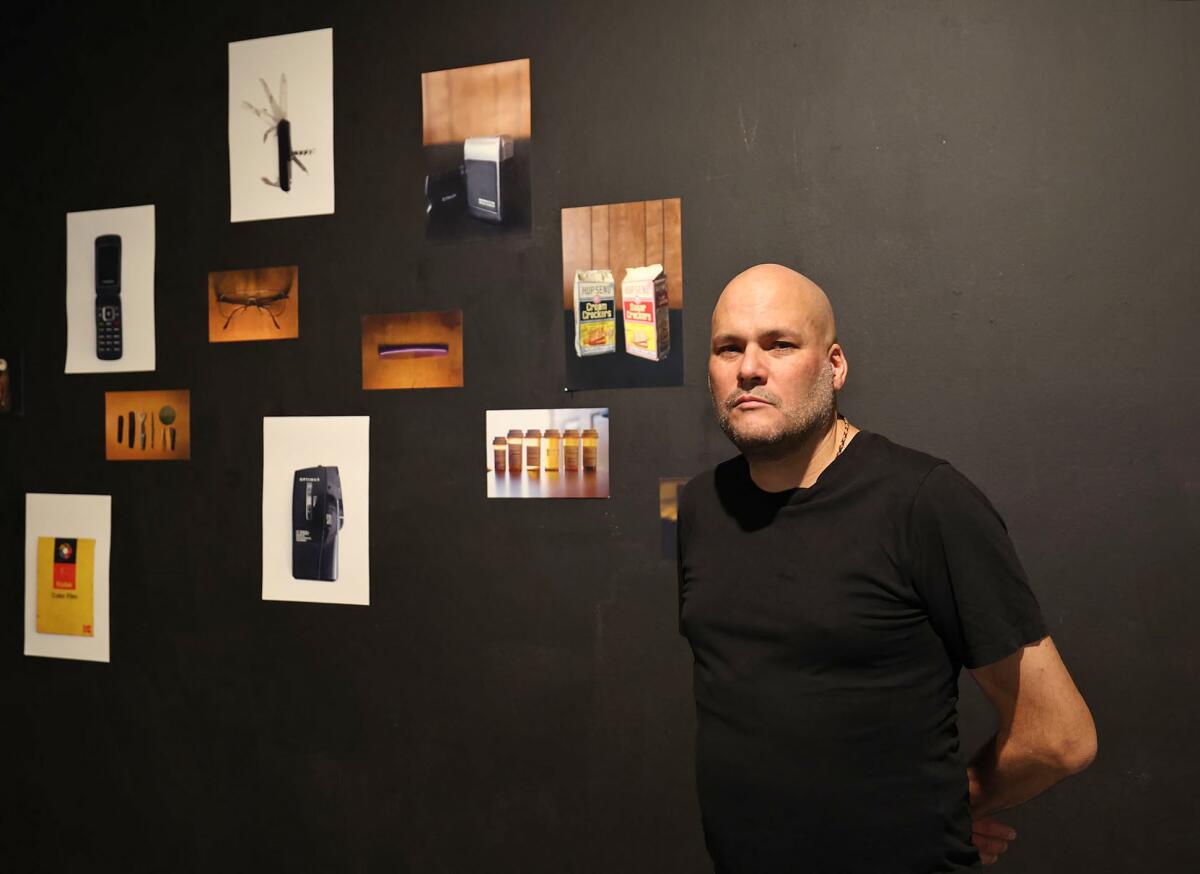
Artist Carlos Viani at his “Next of Kin” exhibition at the Grand Central Art Center in Santa Ana.
(Don Leach / Staff Photographer)
Viani’s new exhibition at Grand Central Art Center in Santa Ana borrows the phrase for the show’s title. In “Next of Kin,” which opened Saturday, Viani unravels his father’s story through an experimental investigation that includes short fiction, video performance and photographs.
Viani is not only a visual artist, but also an author and educator who was born in Lima and currently lives and works in Montreal. His exhibition is reminiscent of a cold case in which the artist employs the methodology of a detective or journalist, searching old photographs for clues, interviewing witnesses and cataloging evidence in a thorough and meticulous manner. But the mystery Viani is hoping to solve through his exploration isn’t what happened to father; but rather who his father was.
Using his father’s collection of business cards, Viani visited places he frequented, including the Golden West College swap meet where he worked selling items, the Walgreens he shopped at and the parking spaces behind a store where his body was eventually found in his car. Viani photographed these spaces and arranged them against a map of Orange County, charting the comings and goings in search of patterns.
Viani also conducted a series of interviews, displayed on clear clipboards along one wall, with people who knew his father; friends, an old roommate, family members and even his own mother. They provided him a look at his father as an individual outside of his parenting role.
“It’s like the moon, you know? You only see one side. Their parent side is what they are offering you. But how about their lover side, their business side? That is why I needed to do these interviews,” Viani said. “Talking to these different people shows me the sides I would never be able to see.”
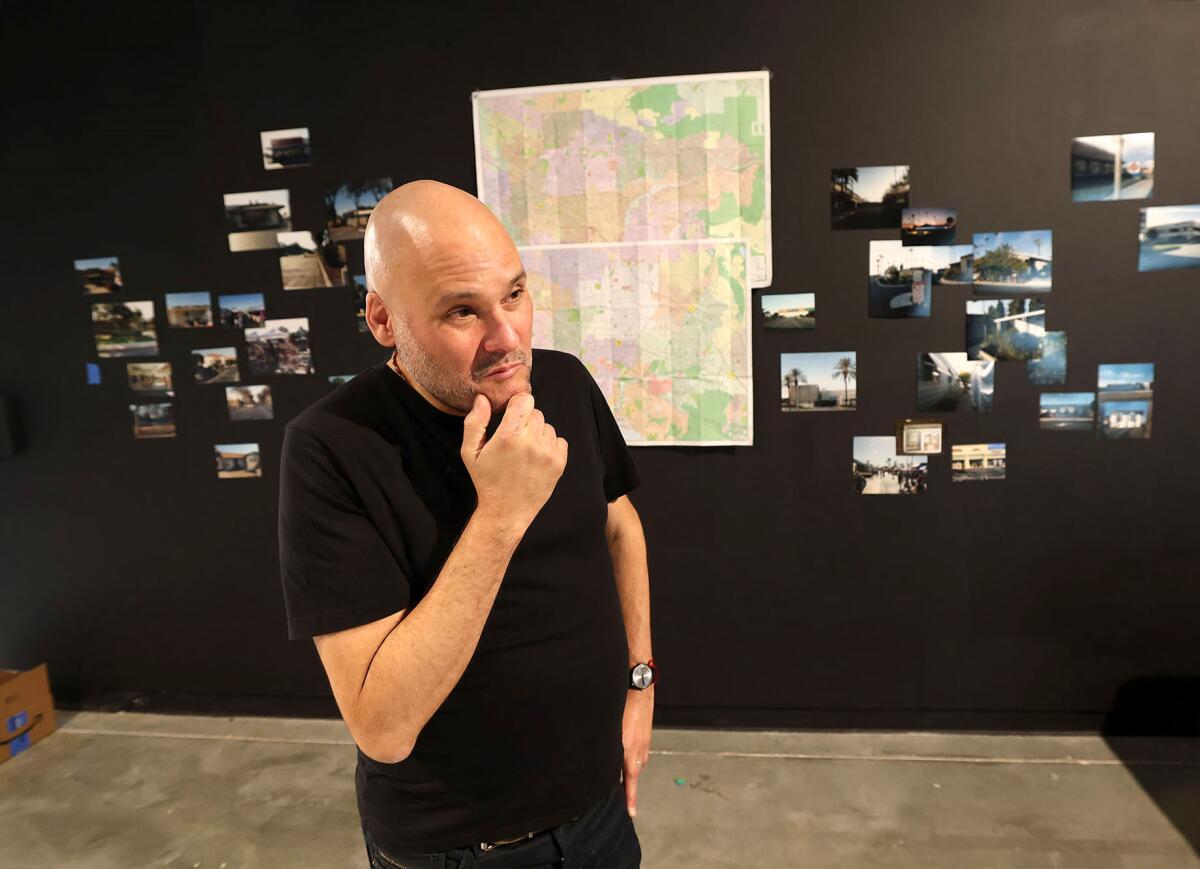
Artist Carlos Viani at his “Next of Kin” exhibition at the Grand Central Art Center in Santa Ana. Viani’s father disappeared in Lima, Peru in 1978, leaving behind a mystery he explores in the show.
(Don Leach / Staff Photographer)
A book of photos produced in 2024 contains images Viani took of his father’s personal belongings, like the keys to a Bank of America safe box, an old black-and-white photo of Viani’s mother and father together, smiling.
“Its a narration made out of images,” said Viani. “There is no text.”
Each item is cataloged in an index at the back of the book, simply and clinically, like a list of evidence. Among the most intriguing is a human skull Viani’s father excavated from the Pachacamac archaeological site as a young man. He left the skull behind in Peru and it was one of the few items the family had to remember him by.
“My mother is a very superstitious person, and she thought that the skull that my father left at home would guard the house,” Viani said.
In a short film Viani created that plays in the exhibition, he digs into sand to bury the skull, finally putting it to rest. It is an apt metaphor for the act of digging deep and the closure of a proper burial.
The exhibition contains one more important piece of ephemera Viani’s father left in plain sight on his nightstand for someone to find. It’s an envelope containing two childhood photographs of Viani and a piece of paper printed from the internet with Viani’s picture and contact information.
“While I was looking for him, my father had already found me,” said Viani.
The show evokes universal feelings of abandonment and the grief of not knowing. Viani said his investigation offers many opportunities for connection.
“The father figure is something we all experience, and the estranged father is another subset of that figure. In a way, I would like people to see something that can happen to anyone,” said Viani.
Viani added that the show is an invitation for viewers to reflect on their own families, their interactions with them, and how those experiences have an impact on their lives. Maybe it can even condition some of their future actions, he suggests. The struggle to really know and understand those we love, even when they are present, can be difficult.
“I am hoping people relate to show at the human level,” said Viani. “Every family has secrets.”
Carlos Viani’s “Next of Kin” opened Saturday and will remain on display through May 15 at the Grand Central Art Center, 125 N. Broadway, Santa Ana.