
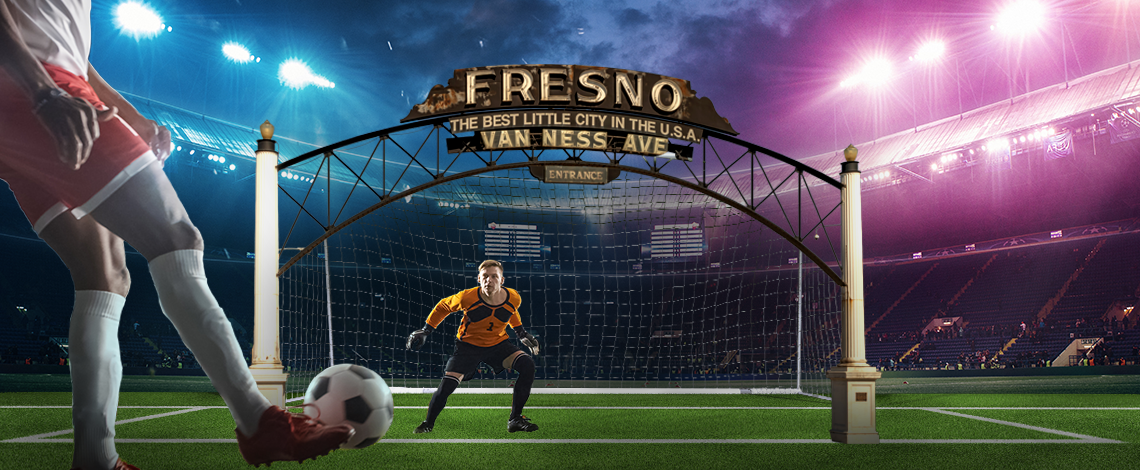
Soccer fans once brought energy and crowds to Downtown Fresno. City officials hope a new stadium will revive that culture by 2028. Photo illustration by Cecilia Lopez
Fresno’s bid to land professional soccer is shaping into a broader economic development play, with a proposed downtown or Chinatown stadium seen as a potential driver of investment and loyal foot traffic.
On Jan 13, city officials announced a one-year exclusivity and due diligence period with the United Soccer League to explore bringing both professional men’s and women’s soccer to Fresno and building a roughly 5,000-seat soccer-specific stadium. While not committing to a specific location or funding mechanism, Dyer said during the news conference that his preferred destination would be in Downtown Fresno or Chinatown.
In recent years, the USL and its teams have seen the completion of several stadiums that could be viewed as potential models for a Fresno stadium that is hoped to be completed by March 2028.
During the news conference, Dyer said he hopes the stadium would be funded with a shared public and private model that is expected to be around $50 million.
Soccer stadiums abound
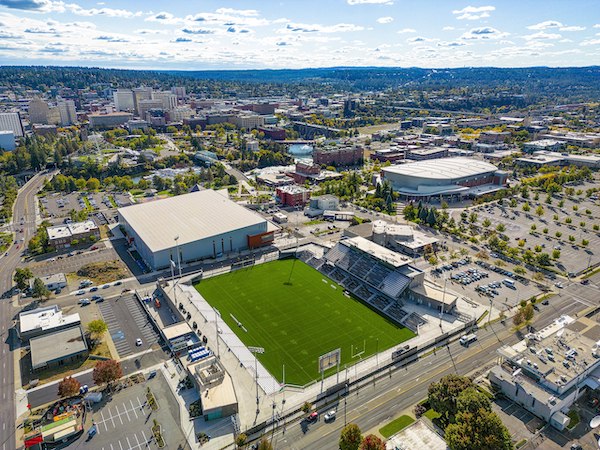 One Spokane Stadium in Washington state could serve as a model for Fresno’s proposed soccer venue. The 5,000-seat stadium was completed in 2023 at a cost of approximately $37 million. Photo by Locke Cole, Creative Commons license
A potential blueprint for Fresno could be One Spokane Stadium in Washington state. The 5,000-capacity stadium broke ground in 2021 and cost around $37 million, according to The Spokesman-Review. It was completed in 2023.
Another stadium with similar capacity opened in Virginia in 2019 and cost $15 million.
Around the same time the Fresno stadium is planned to open, a $175 million stadium in Sacramento is also expected to be completed. In addition to the stadium, Sacramento is also planning to build an area around the stadium that brings the total cost to over $320 million.
Unlike Fresno, Sacramento is hoping to be part of MLS, the most popular soccer league in North America that also includes teams in Canada and has the star power of world superstar Lionel Messi in the league.
Bringing loyal crowds
Like Sacramento’s plan, Fresno envisions creating a gameday destination with restaurants and gathering spaces around the stadium — a key part of the culture officials hope to build in downtown or Chinatown.”
Elliott Balch, president and CEO of the Downtown Fresno Partnership, said that a professional soccer team would position the downtown area as a true gathering place for the community.
“Downtown is this regional center, and you talk about a soccer team, this is going to be the Valley’s team,” Balch said. “Downtown is the crossroads of the central San Joaquin Valley, and right where it belongs to have this amazing, wonderful activity for our community coming in.”
Balch said the potential economic boost for the area depends on how the stadium is designed and connected to the surrounding streets and nearby businesses, calling the potential stadium a “major foot traffic driver”
He pointed to some of the lessons learned from Chukchansi Park, which hosted soccer in the past. He said the stadium access is oriented away from main streets and businesses.
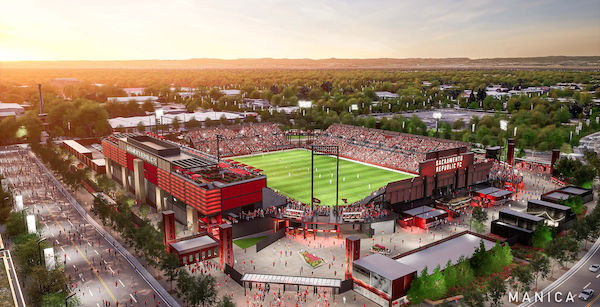 A rendering of Sacramento’s planned $175 million soccer stadium, expected to open around the same time as Fresno’s proposed venue. Unlike Fresno’s $50 million USL project, Sacramento is pursuing an MLS franchise. Image via Sacramento Republic FC
The soccer vibe
One of the most popular destinations for Chukchansi Park events, Tioga-Sequoia Beer Garden was an integral part of the once strong soccer culture in the Central Valley.
Soccer games had directly translated into sales and community energy. President Michael Cruz said that matches brought consistently strong pre and post game crowds.
Cruz said that the predictable timing of soccer games helped the popular beer garden plan for staffing and events. He expects a similar effect if a stadium were built nearby, regardless of where the stadium is located in downtown or Chinatown.
“Anything that happens downtown, people tend to want to come early and stay later, since downtown, for most people, is a destination,” he said.
Cruz pointed out the distinctive atmosphere soccer fans bring.
“The energy is a lot higher with soccer fans,” he said. “From people dressing up to the marches that they do from venue to the soccer field, it’s just a different experience.”
Tioga-Sequoia is looking forward to once again being a strong partner of a soccer team.
“Soccer culture downtown really is part of our ethos,” Cruz said. “We love the soccer community and would love to have it back downtown.”
Where are the sites?
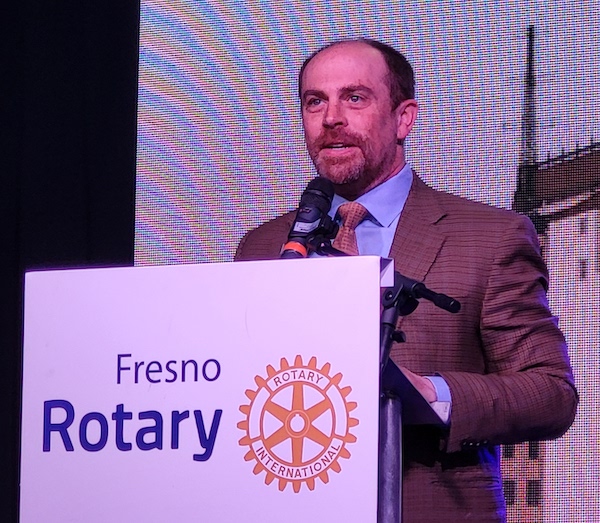 Elliot Balch of the Downtown Fresno Partnership speaks to the Rotary Club of Fresno on April 28, 2025. Photo by Gabriel Dillard
While business owners are excited about the potential of a soccer stadium, there are still some questions that are left unanswered in the weeks following the announcement.
Jan Minami, director of the Chinatown Fresno Foundation, said she would love a stadium in Chinatown but noted that the neighborhood lacks large, contiguous parcels needed for a stadium.
“To build a soccer stadium, you need acres,” Minami said. “Chinatown doesn’t have that many acres, so there’s not a lot of space where it would easily fit.”
She said that much of the open land in the area is already owned by the California High-Speed Rail Authority and that long-established businesses are unlikely to relocate.
“Most of the businesses in Chinatown have been there for decades and decades,” Minami said. “I don’t see them eagerly giving up their space or their building.”
Need to adapt
Minami said Chinatown’s restaurants, many of which focus on breakfast and lunch, would need to adapt to benefit from evening and weekend games and support the pre and post game culture that the USL and the city of Fresno hope to establish.
“They would need coercion,” she said, adding that operating hours and staffing would likely have to change to match game-day demand. Still, she said the neighborhood could evolve over time.
“If there were a soccer stadium that would be five, eight years down the road, the face of Chinatown is going to be much different than it is right now,” Minami said.
Balch said broader issues like safety, cleanliness and walkability will shape the visitor experience.
“The Downtown Fresno Partnership is, seven days a week, out in the field, helping things look better, helping people feel welcome,” he said. “What changes is the attraction that gets you over that obstacle.”
Despite challenges, both Balch and Minami felt optimism about long-term momentum. Balch said a high-profile project like a stadium could act as a catalyst for housing and commercial development, something Dyer has made a key goal of his term, while Minami said infrastructure improvements and stakeholder investment will continue to move Chinatown forward.
“Chinatown is going to get better whether there’s a stadium, whether there’s a high-speed rail,” Minami said. “There is no silver bullet. There’s a lot of us in Chinatown who want it to get better.”