
What’s at stake:
As protests over rising ICE activity ripple through Fresno and beyond, artists are turning their fear and anger into art.
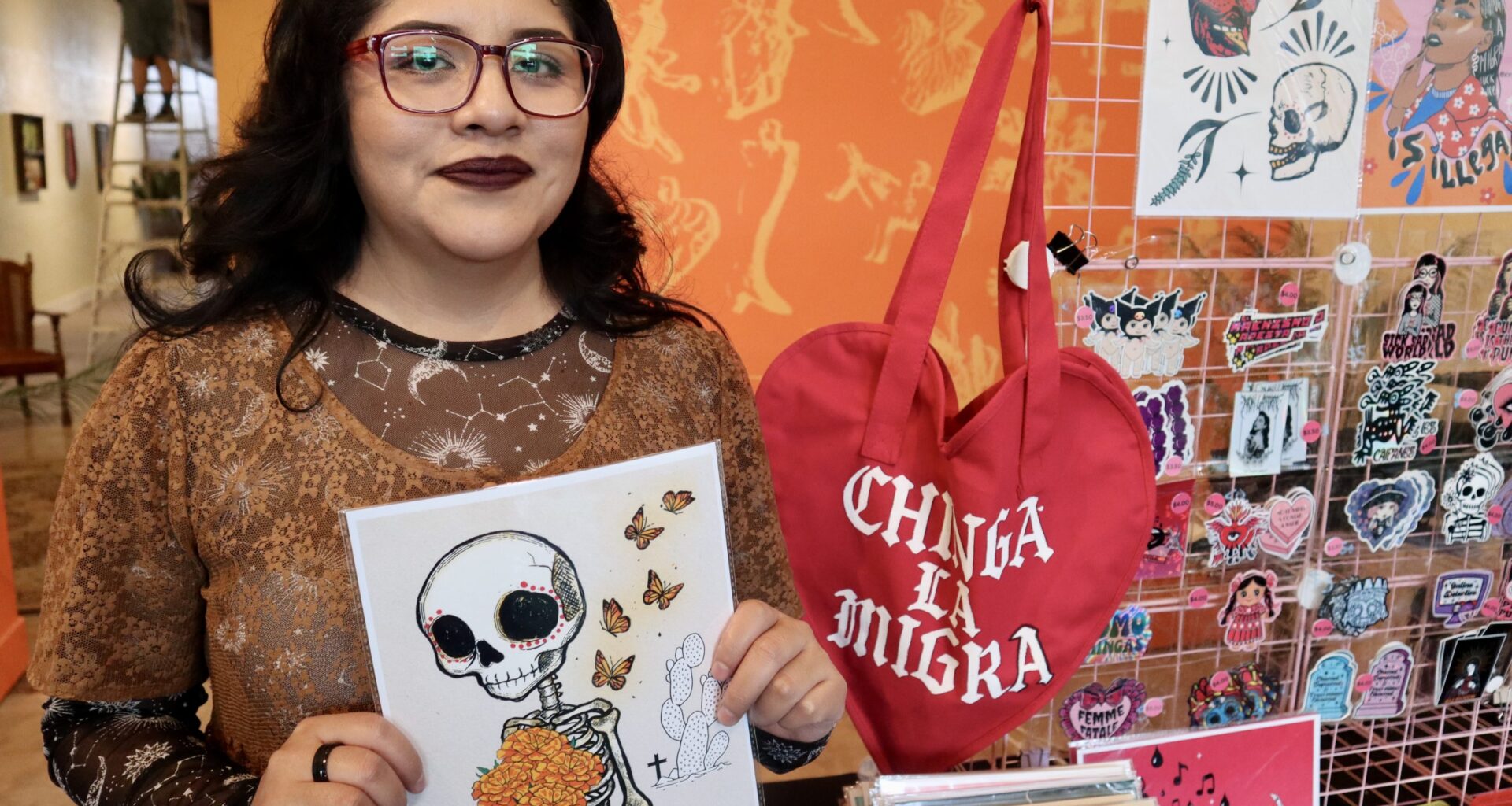
Gabriela Cayetano learned early that art could say what she could not. Creating came to her like breath itself, driven by instinct, necessity and survival.
Raised in Mexico City by parents who were artisans, Cayetano grew up in a home where feelings moved through hands rather than words. When she crossed the U.S.-Mexico border at 16 with her sister, that instinct followed her. English came slowly. Safety never felt guaranteed. Speaking up often felt impossible. So she created drawings and paintings.
Now living in Fresno, Cayetano’s work is rooted in immigration, memory and resistance — not because she set out to make “political art,” but because her life has always been shaped by politics.
“Art became my voice,” Cayetano said. “It was the only way I could express the things I didn’t know how to say. I feel like I was never given the resources that I needed.”
Her images often pull from Mexican traditions like Día de los Muertos, using skulls and skeletal figures to confront the realities immigrants face today, especially children who never make it across the border.
Cayetano was a vendor and screenprinter at St. Dulce, a new art venue on Van Ness Avenue, during an Arthop pop‑up on Feb. 5 as part of the space’s opening weekend. She offered a free screen-printed design reading “Chinga la Migra,” — ‘fuck immigration police’ — featuring a butterfly set within papel picado, and invited community members to bring their own tote bags, shirts, or use provided poster paper.
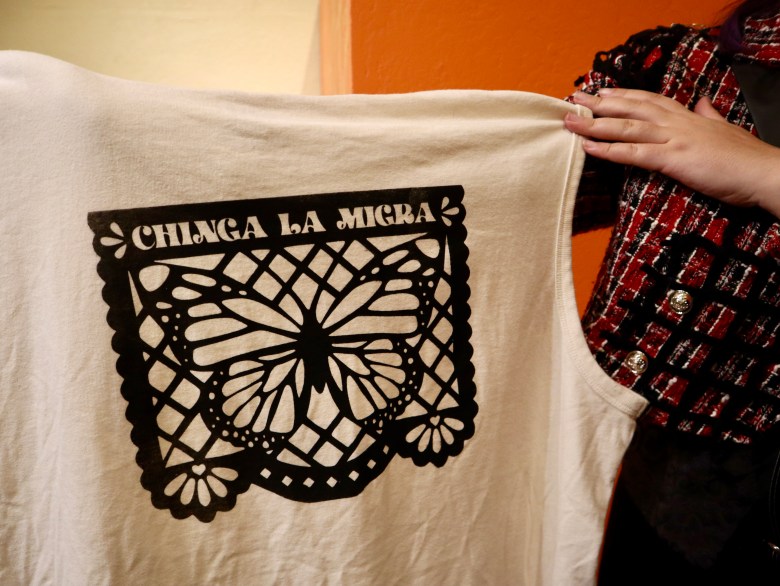 St. Dulce’s Arthop pop‑up on Feb. 5 offered a free screen-printed design reading “Chinga la Migra,” invited community members to bring their own tote bags, shirts, or use provided poster paper. Gisselle Medina | Fresnoland
The pop‑up at St. Dulce, co‑owner Tony Carranza said, was meant to give multi‑dimensional artists a place to gather, create and respond openly to the issues shaping their communities, from immigration to LGBTQ+ rights.
Artists are coming together at a time when people across the country, including in Fresno, are protesting rising Immigration and Customs enforcement activity and the unlawful, violent arrests and killings of U.S. citizens, many artists are channeling their feelings into their work as a powerful form of protest.
How local artists are reckoning with today’s political climate
Tony Carranza, along with his business partner Omé, created St. Dulce as the latest evolution of more than a decade of organizing, art-making and movement work rooted in the Central Valley.
The two are also the founders of Dulce UpFront, a community organization established in 2013, building from the events, murals, and pop-ups, which offers local and visiting artists a home to make and show work, and a network ready to respond when urgent moments arise.
“These smaller community spaces are important,” Carranza said. “The handcuffs are off. Artists can speak plainly about what’s happening around them, immigration, policing, politics, without being told what to say.”
The front of the space will host rotating vendors and pop-ups, the middle of the space will be home to monthly rotating exhibitions for both local and national artists, while a developing theater area is expected to accommodate performances, screenings and small shows.
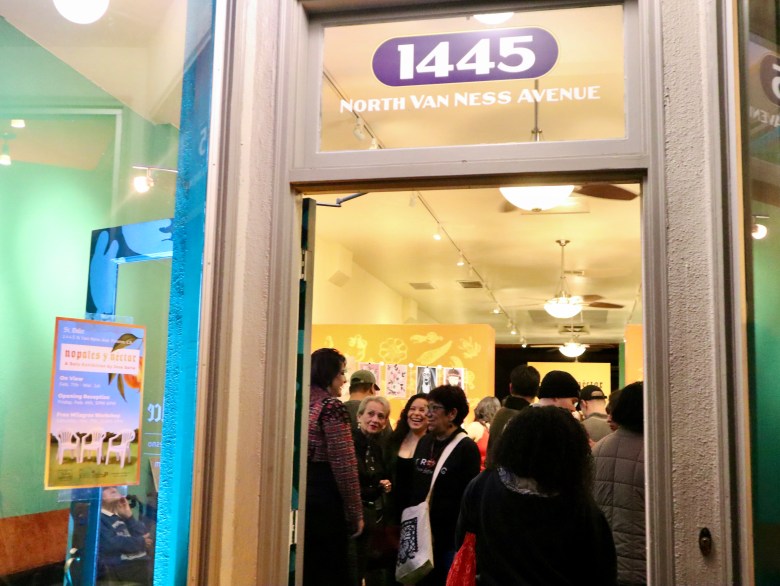 A peak inside St. Dulce during their ‘Abolish ICE’ pop-up. Gisselle Medina | Fresnoland
Carranza said the vision extends beyond the walls: partnering with neighbors on the block and helping turn the area into a creative corridor.
St. Dulce, Carranza added, is still taking shape — but that’s the point. It’s less a finished product than a living extension of the networks that made it possible.
St. Dulce’s inaugural exhibition features 25-year-old Jose Soria, whose identities as Mexican, and Queer, and Catholic, inform work that navigates both personal and collective experiences of love, grief, and pain.
His solo exhibition, “Nopales y Néctar,” first shown in Visalia last October, brings 15 pieces to Fresno, where they will remain on view through March 1.
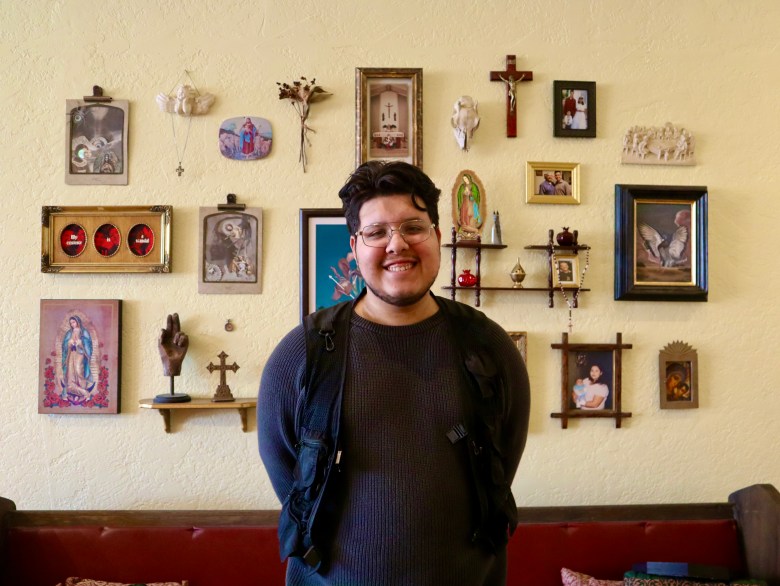 Jose Soria, the artist behind the exhibition “Nopales y Néctar,” features 15 pieces on both personal and collective experiences of love, grief, and pain. Gisselle Medina | Fresnoland
Soria’s work confronts ICE raids, family separations, and systemic violence, rooted in his own experience as the child of an immigrant family. He reflects on the contradictions of hope and harm. His family once voted for Trump to “improve the economy,” only to face a rising tide of violence.
“There’s no way my work is not political,” Soria said. “I talk about these things through art because they need to be talked about.”
One standout piece, “False Prophet,” blends oil on canvas, barbed wire, and found objects. A fox in sheep’s clothing, glinting with gold, deceives the nopales, symbolizing Latino communities, while strands of barbed wire echo the pain inflicted by policies that separate families and target people of color. References to greed, gaudiness, and the American flag underscore the hypocrisy and cruelty he witnesses.
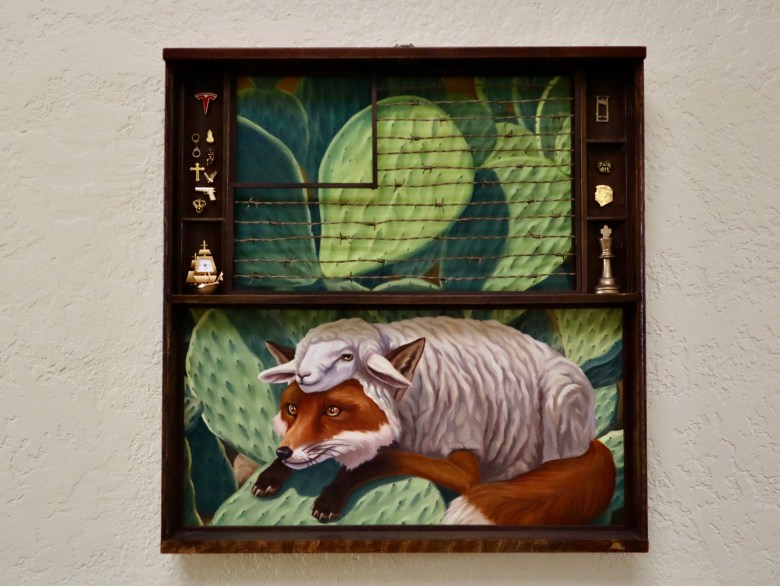 One of Soria’s featured pieces, “False Prophet,” blends oil on canvas, barbed wire, and found objects. Gisselle Medina | Fresnoland
Since earning his MFA at Fresno State in 2024, Soria has balanced his practice with teaching at Fresno City College. Through “Nopales y Néctar,” he hopes to create a space where art becomes both witness and resistance — a place for stories, struggles and shared humanity to be seen.
Krista Aranda, 31, was a featured vendor for the pop-up who sold art ranging from detailed black-and-white drawings to vibrant floral and cultural pieces, often reflecting her Mexican heritage.
Aranda has been drawing since childhood, inspired by her father’s sketchbooks, and is largely self-taught, with only a few formal art classes in high school and college. She began painting in October 2024, experimenting with florals and colorful imagery after creating a haunting portrait of a nun for Halloween.
Recently, Aranda discovered her late grandmother was also a painter, a connection that now inspires her work and helps her push through creative blocks.
At the end of 2025, Aranda began using her art to address urgent social issues, notably creating pieces calling to “Abolish ICE.” Motivated by both personal convictions and a desire to stand up for human rights, she channels frustration and grief into her work.
“That’s when it was getting really more in your face,” Aranda said. “I always was kind of scared to do that, scared to speak up. Then, I found the courage, and, pardon my French, but like, fuck that. I see what’s happening. It’s not taboo for me to speak out and to get a straight message across through my artwork. My way to stand up for my community is through my artwork.”
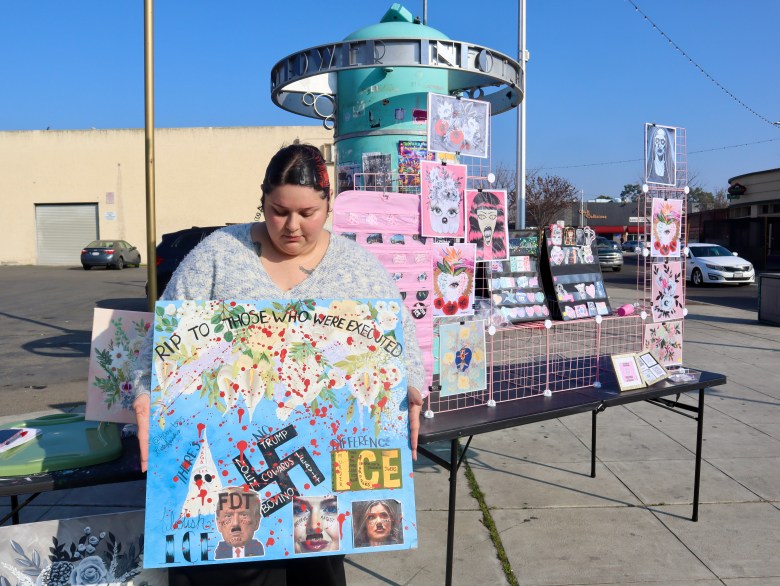 Krista Aranda, who was a featured vendor for St. Dulce’s pop-up, paid homage to those targeted and executed by ICE and other systems of oppression in her recent painting. Gisselle Medina | Fresnoland
One of her favorite recent pieces is a painting that’s both a memorial and a protest. The painting has flowers as clouds, a dove to represent death, and splashes of red to symbolize bloodshed, paying homage to those targeted and executed by ICE and other systems of oppression. Words like “pedophile” and “loser” are scrawled across the work, calling out the perpetrators while forcing viewers to confront the harsh realities behind the headlines.
Beyond painting, Aranda participates in Fresno’s local art scene as a vendor at pop-ups and markets and plans to showcase her work in upcoming exhibitions, including a month-long show at the newly opened gallery called Arts Annex. Her goal is to create art that not only resists injustice but also fosters community, representation, and conversation.
“Art is important because if we’re going to have art for happy stuff, we should also acknowledge all the bad shit that’s going on too,” Aranda said. “It’s in your face: this is happening. The world would be bland if there were no artists capturing what’s happening in real time.”
At the intersection of justice and art
Over the past year, Cam, a 35-year-old textile artist in Fresno, has become a familiar presence at local protests, often carrying a towering, handmade banner that reads “Free Palestine.” The piece, roughly 15-feet tall and 5-feet wide, is stitched from a painter’s canvas drop cloth and recycled fabric scraps, sewn by hand over months.
Cam requested to not use their full name out of concern about digital footprints due their involvement in international volunteer work.
Cam first hung the banner in June 2025 from a second-floor yoga room window at a climbing gym in Sacramento’s Midtown neighborhood, facing a busy thoroughfare near the freeway. They knew it would likely cost them their job. Soon after, Cam’s wife got a new job in Fresno, so the two relocated together. The move unexpectedly gave Cam space to lean fully into activism and art.
Cam, who got sober in early 2020, described the past few years as a period of intense unlearning and relearning after growing up in a conservative Southern environment. They said they didn’t fully educate themselves on Palestine until 2023.
“I’m the kind of person who does big, deep dives,” Cam said. “Everything’s connected. Colonization, land theft, militarization, it’s the same story over and over.”
Since moving to Fresno, Cam has brought the banner to demonstrations, including protests against ICE.
For Cam, art is more than a supplement to protest; it is a strategy. In a fast-moving media landscape where messages compete for attention, art creates pause, Cam said, giving people something to return to, sometimes multiple times before it resonates.
“Maybe it’s an immigrant that’s been terrified driving by and they see the support for what they’re going through,” Cam said. “That’s what art is for — to make you stop and think.”
Cam emphasized that protest takes many forms: graphic designers creating shareable visuals, reporters documenting movements, organizers planning marches.
But they said artists have a particular responsibility right now, not to step away from their work in moments of crisis, but to use it. Progress may be slow, sometimes measured in a single letter stitched per day, but, Cam said, the accumulation matters.
How Cayetano is helping cultivate community spaces through art
Cayetano, now 34, has been making art since she was 12 and considers herself largely self-taught. She took grade school art classes in Mexico but learned most techniques on her own, moving between watercolor, acrylic, papier-mâché and eventually digital illustration.
Before coming to Fresno nearly five years ago, she showed her work at community art events in Los Angeles and San Diego, often centered on Mexican culture: Día de los Muertos, Día de la Raza and Frida Kahlo celebrations. At the time, she sold only original paintings and didn’t see her art as a business.
That changed after she moved to Fresno as a new mother during the pandemic. Isolated at home and searching for herself again, Cayetano began teaching herself digital art after receiving an iPad from her husband. In 2024, she quietly launched her small art business, called Criptidart.
As national immigration rhetoric hardened, her work followed suit. One recent piece, created around Día de los Muertos in 2025, shows a child’s skeleton lying in the desert. She titled it “The End of a New Journey,” a reference to the hope that drives migration, and the lives cut short along the way.
“I crossed as a kid,” she said. “And a lot of children don’t survive that journey.”
Cayetano now uses her art not only to tell stories, but to create space. Through free community screen-printing events, she invites people to bring their own materials and print protest messages.
“I can’t always be out there, I have fear of being racially profiled and I have small children,” Cayetano said. “But I can help people carry something with them.”
Related