
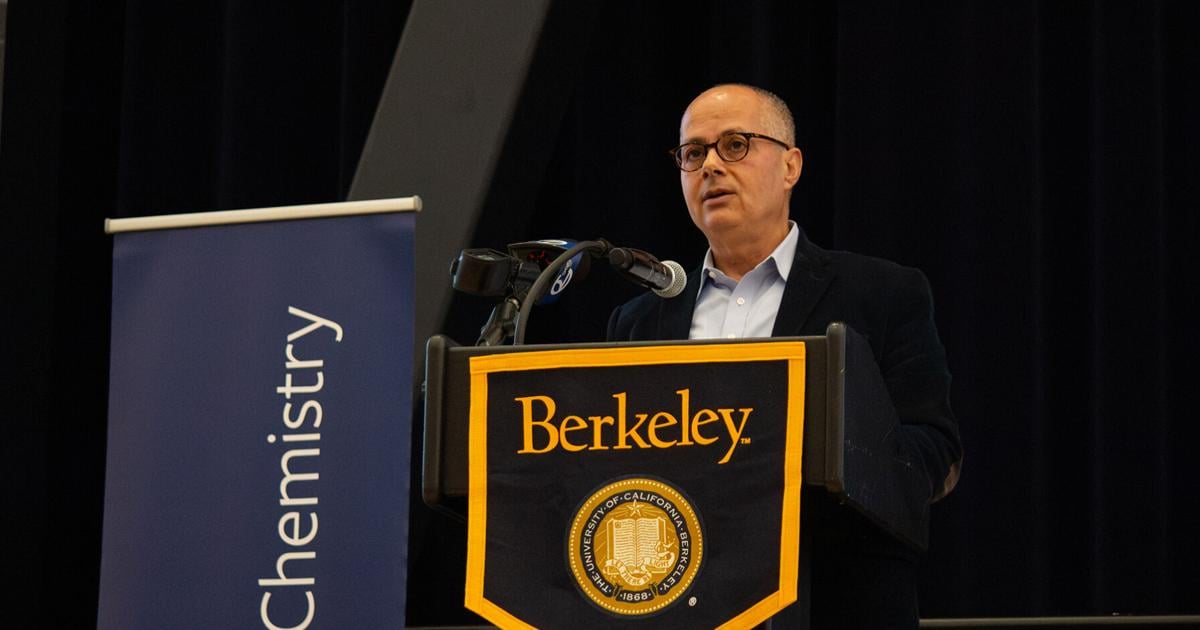
A Berkeley lab led by Nobel laureate and campus professor of chemistry Omar M. Yaghi has created a new material to capture carbon dioxide from the air — and claims to do so faster than ever before.
Published in Nature Sustainability, the material uses covalent organic frameworks, or COFs, to capture carbon. COFs are polymers made entirely of organic materials that act as a net to catch carbon dioxide in the air.
The most recent iteration of the frameworks’ design, dubbed COF-1000, builds upon the previous COF-999 model that was released in 2024. COF-1000 is structured with larger pores, allowing it to capture more carbon dioxide roughly three times faster than the previous model.
“COFs could be the ultimate and ideal materials as they offer a unique convergence of properties — lightweight composition, structural precision, chemical stability, large capacity, and rapid transport — that are all essential for direct air capture.” Yaghi said in an email. “COF-1000 demonstrates how this evolution enables us to design not just for uptake, but for speed.”
The paper was coauthored by five members of Yaghi’s lab, which included one undergraduate student, Neda S. Sabeva.
Yaghi and his team are now beginning to apply this technology within industries through his company Atoco, which applies Yaghi’s research to solve water scarcity and global warming.
“The air is only 0.04% CO2, which is one molecule (out of) 2,500 other molecules in the air,” said Zihui Zhou, the study’s first author and a postdoctoral fellow with the Bakar Institute of Digital Materials for the Planet. “We found this material can be very selective and only captures CO2 from the air (without) being infected by nitrogen, oxygen (and) argon.”
Zhou said the lab is attempting to reduce the cost of manufacturing COFs in order to make industry use more feasible in the future. The team is also looking to use AI tools to discover and synthesize materials faster.
According to Alain Goeppert, a senior research scientist at USC’s Loker Hydrocarbon Research Institute, the paper is not immediately applicable even though it does provide an interesting methodology for carbon capture in COFs.
Goeppert said other materials can absorb the same amount of CO2 from the air and that COFs are currently too expensive to have real world applications now, to the point where researchers would need to “dramatically” reduce the cost.
“This is very nice work, but it’s just not exceptional,” Goeppert said, “And I think if they want to use COF, they will have to … come down with the cost a lot.”