
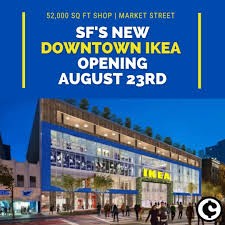
IKEA failed to revive Mid-Market
Is Retail Decline Permanent?
Last week I questioned San Francisco’s top strategy for revitalizing struggling neighborhoods (See “San Francisco’s Top Neighborhood Revival Strategy Isn’t Working”). I called for less emphasis on one-time events and for prioritizing strategies that sustain ongoing retail.
I got an overwhelmingly positive response. But one longtime neighborhood business advocate raised a good point—why should we expect San Francisco’s brick and mortar retail to match pre-online shopping days?
Consider: Many of us saw IKEA’s August 2023 opening in Mid-Market as a game-changer. The wildly popular store would return pre-Covid foot traffic to the area, triggering new retail openings nearby.
That hasn’t happened. After all, customers can order IKEA products online. They don’t need to come to 6th and Market.
Reviving San Francisco’s struggling neighborhoods requires accepting that many spaces will not be filled with traditional retail. Instead, permanent art installations that attract pedestrians can fill these spaces.
San Francisco’s Retail Decline
San Francisco’s ground-floor retail decline preceded Covid. In 2017 I urged the city to allow ground floor spaces under new housing construction to be housing rather than retail (See “Should the Internet Change How SF Uses Land?,” February 7, 2017).
Describing the retail decline as a “national trend,” I wrote:
An intriguing recent story out of New York City found that despite the economic upturn, vacancy rates are up in every Manhattan retail corridor. Some argue that unlike past downturns, this one is not cyclical. Brokers believe that “brick-and-mortar retailers will shrink dramatically during the next few years, so supply of retail space will outweigh demand for it.”
Those brokers were right.
Covid primarily impacted large retailers at the former Westfield Center or those occupying lower Powell Street leading to Union Square. The city’s post-COVID retail decline was then worsened by work form home and City Hall’s allowing open-air drug markets in the Central City.
It increasingly appears that the small business retail spaces that flourish in North Beach, Cow Hollow, Noe Valley, the Inner Richmond, Inner Sunset and other thriving neighborhoods are often not sustainable in Mid-Market, the Tenderloin, Downtown or around Union Square.
The city needs new strategies for bringing ground-floor spaces to life in these areas.
Can Public Art Revitalize Neighborhoods?
Housing is the most economically sustainable replacement for ground floor retail. But housing is not always feasible. And blocks whose ground floor spaces are all used for housing do not attract pedestrian traffic.
We see a lot of such blocks in the Tenderloin. Mid-block retail is absent in many areas, which has always hampered the neighborhood’s economy. This absence puts a premium on filling spaces in the few blocks that have consistent retail, which is why reviving Little Saigon is so essential.
Efforts are ongoing to fill Little Saigon vacancies. But if another year passes with so many vacant storefronts, Little Saigon’s capacity to again attract small businesses must be reconsidered.
Public art may be the key alternative strategy.
Artist Jeffrey Gibson’s 433-foot vinyl art installation “This Burning World” now covers the vacant Bloomingdales along Mission Street between 4th and 5th streets. Organizers “hope Gibson’s mural will bring more foot traffic to the area and encourage visitors to frequent surrounding shops, businesses and amenities.”
Gibson’s mural was funded by the Downtown Development Corporation and Yerba Buena Partnership community benefit district. According to the DDC’s Executive Director Shola Olatoye, “Public artworks like Gibson’s can quickly change how a place feels, especially when a property is in transition.”
While a Mission Street mural might not help Mid-Market, the DDC’s jurisdiction includes Mid-Market. With $60 million raised so far, the DDC is positioned to support art spaces in the critical row of vacant Market Street retail spaces between 7th and 5th Streets.
A row of dynamic public art would get people walking down Market Street again.
The Tenderloin is not covered by the DDC so must find another funding source for public art. Chris Larsen’s generous $5 million donation to revive Little Saigon will hopefully encourage others to support the cause.
Property owners obviously prefer a rent-paying retail tenant. But public and private sources can help incentivize non-retail ground-floor uses.
There are spaces on Market and in Little Saigon that have been vacant for years. At some point owners have to take a more realistic approach to their property.
And if pedestrian traffic is drawn to these areas to see art, whose to say that it won’t encourage new retail businesses? We need to get people to come down to Mid-Market and Little Saigon on a regular basis to then return for dining and entertainment.

Randy Shaw is the Editor of Beyond Chron and the Director of San Francisco’s Tenderloin Housing Clinic, which publishes Beyond Chron. Shaw’s new book is the revised and updated, The Tenderloin: Sex, Crime and Resistance in the Heart of San Francisco. His prior books include Generation Priced Out: Who Gets to Live in the New Urban America. The Activist’s Handbook: Winning Social Change in the 21st Century, and Beyond the Fields: Cesar Chavez, the UFW and the Struggle for Justice in the 21st Century.