
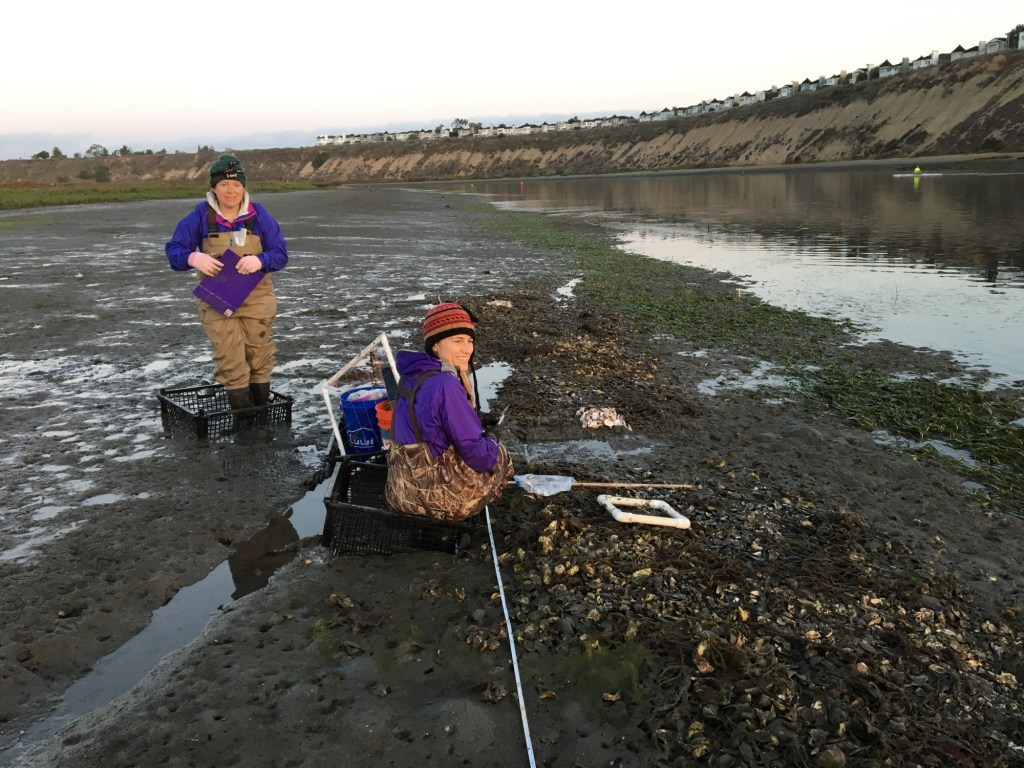
Cal State Fullerton professor and marine ecologist Danielle Zacherl is eager to point out that collaborations with former and current students, as well as the nonprofit Orange County Coastkeeper, have boosted efforts to restore oyster beds of the native Olympia oyster along the Southern California coast.
In the latest development of this long-term project, local restaurants have now gotten involved by donating their discarded oyster shells to help restore oyster beds.
The restaurant shells, after being picked up, cleaned and dried, are put on strings. Zacherl’s students and OC Coastkeeper volunteers “deploy” or drop the oyster shell strings off at public docks during the oyster reproductive season — typically April through September — so that oyster larvae will attach and grow on them.
In early fall, those strings of shells are then pulled up and collected, and oyster larvae are removed and transported to an already-restored oyster bed where they can grow and thrive.
“This spring, OC Coastkeeper, with my students assisting, will deploy shell strings in Alamitos Bay, Huntington Harbor and Newport Bay,” said Zacherl, who has taught marine biology at CSUF since 2003. She teaches undergraduate and graduate courses that include marine biology, evolution and diversity, and invertebrate zoology. She’s been focused on science-based oyster restoration since 2010.
Because of pollution, overharvesting and the destruction of oyster habitats, native Olympia oysters have decreased in local estuaries, according to the Native Olympia Oyster collaborative. Yet the Olympia oyster is the only one that is native to the West Coast, and it plays a key role in the Southern California marine ecosystem.
Olympia oysters filter the water, reduce shoreline erosion and build their own habitats. This happens because oysters cement themselves to each other, year after year. Their shells harden and create a kind of reef or structure that becomes “a living habitat for all kinds of marine life,” Zacherl said.
She jokes that where an oyster settles is the most important real estate decision of its life because it permanently attaches to whatever hard surface it chooses.
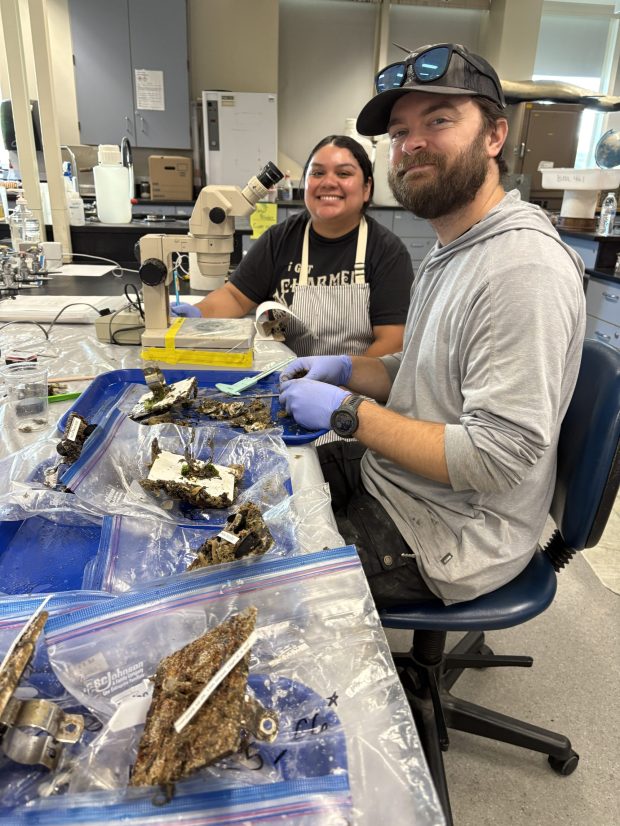 CSUF biology graduate student Leeza-Marie Rodriguez and environmental studies
graduate student Dan Gifford work in the lab to assess oyster recruitment strength on retrieved oyster recruitment plates that were set out last summer within Seal Beach National Wildlife Refuge. (Photo courtesy of Danielle Zacherl)
Olympia oysters are called a foundation species because they are integral to the survival of other marine species. They can and do successfully attach to human-made structures such as sea walls or a dock piling, Zacherl said. But when they attach to dead oyster shells in an oyster bed, they build upon that growing reef habitat where they and future generations can live safely.
One of Zacherl’s goals is to raise awareness about the importance of oysters. “We wanted to get the public interested and learn how important the oyster shell is,” she said. This goal aligns with those of Orange County Coastkeeper, which is dedicated to protecting local waters.
When a former student of Zacherl’s, Kaysha Kenney, was hired as the marine restoration director at OC Coastkeeper in 2024, the two agreed to collaborate on the oyster restoration.
“Kaysha exploded the program,” Zacherl said.
Kenney was the first to approach restaurants about picking up their shells to be used for restoration. “I currently partner with 10 local restaurants and OC Coastkeeper staff,” she said. “A few volunteers pick up from local restaurants.” So far, thousands of pounds of oyster shells from restaurants have been picked up and used in the restoration project.
It is a win-win-win situation: Restaurants can get rid of the shells for a good cause, the restoration project gets free oyster shells to help boost the oyster habitats and students get to study the oysters’ cycle of life up close and be a part of enhancing their survival. The oyster restoration project is part of the OC Coastkeeper’s overall Living Shorelines Project, which has several key participants.
“The Living Shorelines Project is a true collaboration between OC Coastkeeper, Dr. Zacherl at CSUF and Dr. Whitcraft at CSULB,” Kenney said. “It truly would not have happened without all collaborators.”
Christine Whitcraft is a professor in the Department of Biological Sciences at Cal State Long Beach, and her research primarily covers wetland habitats.
Zacherl is pleased at how these collaborations have given a boost to public awareness and the oyster restoration project. She’s also excited about the contributions her students are making to the effort. For example, one student is working to identify the factors that contribute to the breakdown of an oyster bed, one reason for the population’s decline. Another student’s research is focused on the ideal local environments for oysters, the locations in the region where they are most likely to thrive.