
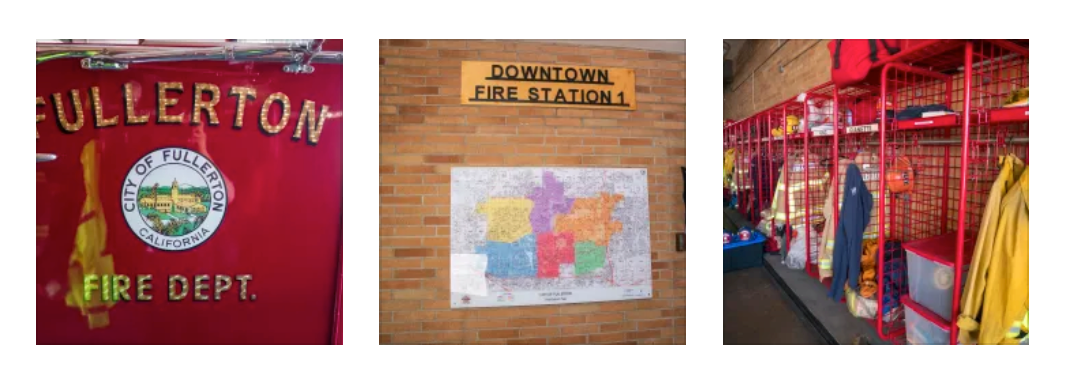

I was scrolling through the City of Fullerton’s website when I discovered that local residents can see inside the Fullerton Fire Department’s historic Station 1, located at 312 East Commonwealth Avenue, by scheduling a free public tour. According to the city’s website, free tours are offered at any of the six Fullerton Fire Department (FFD) Station locations throughout the city, but must be approved by a chief officer first. Schools, groups or families interested in experiencing the FFD’s educational walkabout must submit a request form at least 30 days in advance. So, after submitting the form and giving the fire department plenty of notice, I had the chance to tour the fire department headquarters on Commonwealth with Station 1 Battalion Chief Bryan McConnell and Engine 1 Firefighter Keller in mid-January.
 Ringing the call button next to the historic Commonwealth building’s red front door, I met McConnell, who explained that Station 1 is the Fullerton Fire Department’s largest station. It consists of two stories and a basement. The left side of the station houses administrative offices, while the right side includes dormitory areas, classrooms, a basement gym and living quarters for fire department crews. According to McConnell, firefighters remain “in-service” during tour hours and may have to respond to emergency calls abruptly.
Interestingly, I learned that these free public tours have been taking place for a long time; so long that McConnell said they started before his time. Later, after my tour, I visited the public library’s Local History Room, but didn’t find any historical documents or records indicating when the FFD first started providing public station tours. When I visited the Commonwealth station, the front-line battalion chief vehicle and reserve battalion chief vehicle were stationed inside; Engine 1 later pulled into the station. McConnell said, “We house one engine company, which as of now comes out of the station, with a truck company, which is soon to come back down here May first. That’s when we’ll be getting our Engine Six back.”
He said, “With our shift schedules, we work 48-hour shifts, so we’ll have two days that we’ll spend here as a crew. We have three shifts that constantly rotate out. There’s always an engine company and a battalion chief here at all times. We have one ambulance crew: Ambulance 1, which also works 48-hour shifts, and a day car. It’s twelve hours, from eight am to eight pm … So, there are two ambulances that reside here as well.”
 McConnell then introduced me to what he referred to as “the out floor,” which, from observation, was an outdoor garage area where firefighting and medical vehicles were parked with “turn out bunkers” lining the side of the room for captains, engineers, and firefighters to suit up and gather their personal protective equipment (PPE).
“They used to be in locked lockers, like full wood, fully enclosed, but what we found is that they need to off-gas, because we’re exposed to a lot of carcinogens in our line of work, and so we were noticing that a lot of firefighters were dying at a young age, soon after retirement. We’re trying our best to make it so their exposure to carcinogens is brought down, and this is part of it,” said McConnell.
Outside, on the right side of the station, McConnell pointed me toward the station’s hose tower. He said, “This is where we hang the hose; whenever it’s tested or cleaned, we hang it up here to dry. We train every day…A lot of the stuff we do can be low frequency and high risk, so we always have to be prepared for those situations.”
In back of Station 1 is a tall fire training tower, visible from the street, and a Phase 5 burn box. When training, they light fires in the Phase 5 container. McConnell opened the ground floor of the training tower, which looked like a hollowed-out storage unit with props stored inside, including a door prop used for practicing forcible entry into a building and stretchers, which would soon be used for a medical training academy at the end of January. Firefighters also utilize the tower for stairwell operations and other exercises.
 McConnell explained, “We can rappel out of the windows, off the top of the building. This is also where we hold our fire academies. We have a six-week academy for new personnel, where most of their training takes place. There are some that are off-site, but most of it is done in-house.”
Training grounds can also be found just past the tower, behind a small wall; this is where they can practice using roof props for flat and commercial buildings. A small workshop for building props was located nearby. There was also an area for ventilation practices and an area for cutting into wrecked cars.
“These vehicles are brought to us by local towing agencies; they allow us to practice cutting cars whenever we have a heavy rescue operation, and someone is trapped in their vehicle,” said McConnell. “We have to be prepared to do whatever is necessary to cut them out and to give medical aid. As you can see, these cars are already damaged, totaled vehicles, but it still gives us the ability to practice cutting the doors off, peeling the roof back, just so that when the time comes, we are fully prepared.”
To learn more about the tours, visit https://www.cityoffullerton.com/government/departments/fire/administration/services-programs/tours
Like this:
Like Loading…
Related
Discover more from Fullerton Observer
Subscribe to get the latest posts sent to your email.