
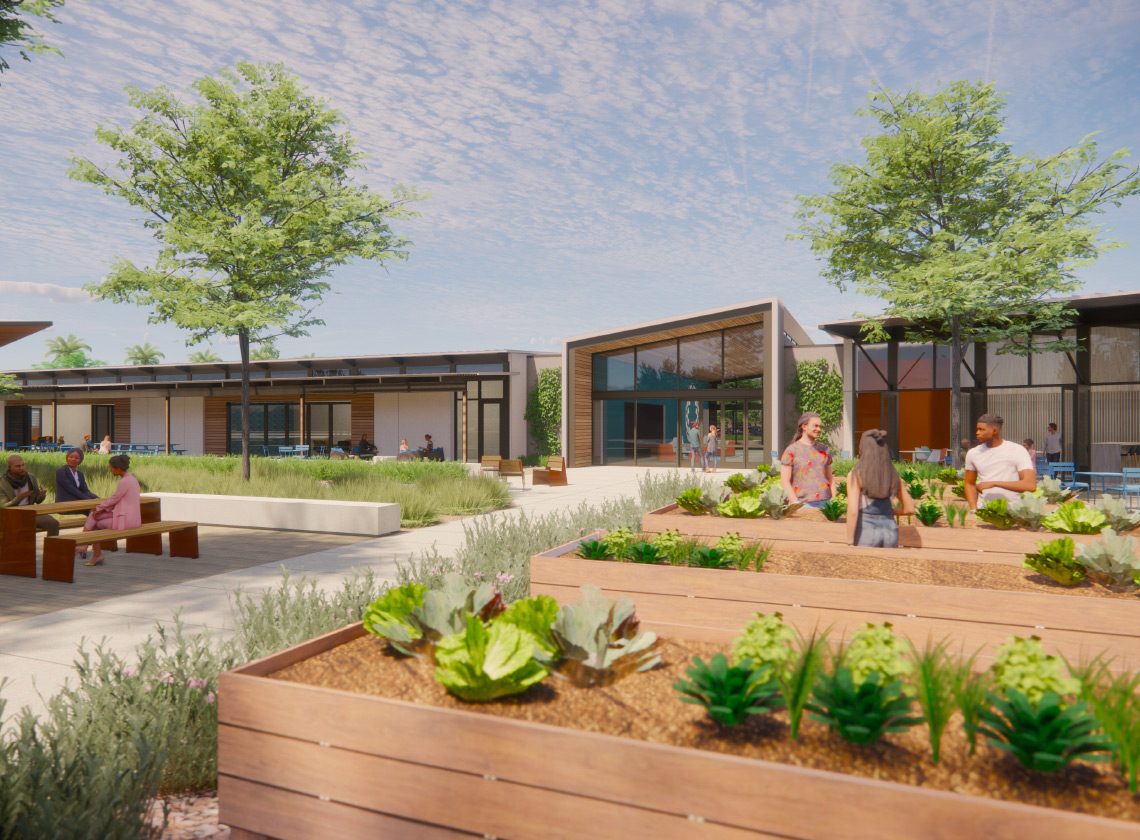
At first glance, Be Well Orange County’s new outpost resembles a modern college campus more than a healthcare facility.
Located on 22 acres of county-owned land adjacent to the Great Park, the new campus—expected to open in the spring—spreads across multiple low-rise buildings set among broad walkways, open green spaces, shaded paths and recreational areas, including pickleball and basketball courts. The environment quietly supports the organization’s efforts to deliver accessible, responsible and compassionate mental health services to OC residents.
“The second you walk in the door, you get a sense of healing and belonging here that you might not get anywhere else,” Phillip Franks, the chief executive of Be Well OC, told the Business Journal during a sneak peek of the new campus.
Strategic Response to a Growing Need
More than one in five U.S. adults experience mental illness each year, according to the National Alliance on Mental Illness. Orange County is no exception. The impact extends beyond individual health, affecting families, employers and the regional economy through lost productivity and rising healthcare costs.
“There is not a family I know, through my work as a Rabbi, as a therapist, as a human being who isn’t affected by a mental health issue,” Richard Steinberg, rabbi for Shir Ha-Ma’alot congregation in Irvine who works closely with Be Well, told the Business Journal.
“This is for all the residents of Orange County—all three million of us.”
Traditionally, individuals in behavioral health crisis were sent to emergency rooms or even jail, settings ill-equipped to provide appropriate care.
Be Well OC was launched in 2019 to offer a community-based alternative—one that integrates crisis response, residential treatment and navigation services. That initiative traces its roots to 2015, when the Orange County Board of Supervisors began a plan to rethink the county’s mental health system. The effort evolved into a public-private partnership led by Mind OC, the nonprofit formed to coordinate the Be Well OC model.
Eventually, it opened a campus in Orange in 2021.
“We met with over 100 stakeholders throughout the community,” said Franks. “We met with our hospital partners. We talked with folks who were already involved with the Orange campus, with first responders. Where did they see the biggest gaps? What were the biggest needs in the community?”
Key partners include the County of Orange, OC Health Care Agency, CalOptima, state and federal programs; major hospital systems, including Kaiser Permanente, Hoag, MemorialCare and Providence St. Joseph; insurance companies Blue Cross and Blue Shield of California; and community groups such as Exodus, HealthRIGHT 360, KCS, MECCA, Straight Talk Clinic and Chapman House.
“This work demonstrates that with strong public-private partnerships and the support of corporations and community leaders, Orange County can come together to make truly collaborative, forward-thinking solutions a reality,” said Dr. Richard Afable, chairman of the board, Be Well OC and retired president and CEO of the former St. Joseph Hoag Health system. He is also one of Be Well OC’s earliest champions.
Bringing Mental Health Care to the Community
The first Be Well OC campus opened in Orange in 2021, creating a stigma-free mental health system accessible to all, regardless of ability to pay. The 60,000-square-foot campus offers crisis stabilization, sobering centers and residential and outpatient programs.
With 91 beds, it can treat up to 100 people daily and accepts walk-ins.
That same year, Be Well OC launched its Mobile Crisis Response Teams (MCRT), now serving Huntington Beach, Laguna Beach, Garden Grove and the UCI campus. These teams provide immediate, on-site support for suicidal thoughts, substance use, welfare checks and non-violent domestic family disputes, offering counseling, mediation and connections to essential services.
In 2025, MCRT completed 16,800 services, logged 8,650 hours and provided more than 900 transports. Notably, 71 percent of calls were handled without involving Emergency Medical Services (EMS), saving law enforcement 2,400 hours, or nearly 101 full days.
“This allows officers to focus on law enforcement,” said Steinberg. “And it allows the experts to help the people who are in mental health crisis.”
Be Well also offers a 24/7 call center staffed with nurses and navigation experts who answered more than 3,200 calls, helping individuals access services and supporting Be Well’s clinical providers.
Expanding Access with the Irvine Campus
The new Irvine campus will have about 75,000 square feet of building space, featuring a crisis urgent care for adults and adolescents, a sobering center, residential treatment for adults and outpatient programming for adults and adolescents.
It’s been in the works for years, with total funding reaching $118 million—supported by county, state, federal and philanthropic sources. The result is a comprehensive, campus-based care model that integrates crisis stabilization, residential treatment, recovery services and community navigation in one coordinated setting.
Area 1 of the campus delivers crisis and adult services, providing 96 beds spanning adult and adolescent crisis stabilization, a sobering center, withdrawal management and short-term residential mental health and substance use treatment, along with a Welcome and Community Care Center, a commercial kitchen and café and a space planned for a future child and youth intensive outpatient clinic.
Area 2 adds 56 beds for adolescent substance use treatment and perinatal residential care, supporting mothers and their young children.
Like the Orange campus, the Irvine campus will provide clinical care and comprehensive support to help families navigate the system of care even after they leave the campus.
It also introduces urgently needed perinatal residential care, services previously unavailable at this scale in the county.
By offering earlier intervention and faster pathways to care, the soon-to-be-open Irvine campus is part of the extensive continuum of care provided by Be Well through its Orange campus, MCRT, and call center. With construction complete, the Irvine campus is expected to welcome clients in spring 2026. A third campus is in the works, though the location has not yet been revealed.
“We have cared for tens of thousands of people at the Orange campus,” said Afable. “We fully intend to do the exact same thing at the Irvine campus.”