
Growing up in Southern California, Victor Ramos didn’t encounter many fellow Puerto Ricans and Dominicans.
“Being born and raised in LA, I always sought representation as a child and young adult for my Afro-Caribbean culture,” Ramos said. “To see Bad Bunny on this grand stage has been very special to me.”
Ramos, aka Chef Vic, and his sister, Gabriela Ramos, operate Casa de Lola, an L.A.-based catering and pop-up company that blends traditional Dominican and Puerto Rican dishes with modern twists. The collective was inspired by their grandmother, Lola, who immigrated from the Dominican Republic, and her recipes have been passed down through generations. Their Caribbean cuisine has earned a strong reputation, even attracting rapper Cardi B.
Chef Vic and his cousin, Massiel Muñoz, have also hosted events called Capicúa, where togetherness and food are top of mind. As the anticipation for Bad Bunny’s halftime show grew among the Latin American diaspora, with fans dubbing it the “Benito Bowl,” they knew they wanted to host a special celebration.
“I just want people to have fun. It’s going to be a huge party,” Bad Bunny said at a news conference hosted by Apple Music, the halftime show’s main sponsor, on Feb. 3. “That’s what I want to bring to the stage. Of course, a lot of my culture, but I don’t want to give any spoilers. It’s going to be fun. It’s going to be easy. I know that I told [people] that they had four months to learn Spanish. They don’t even have to learn Spanish. It’s better if they learn to dance. There’s no better dance than the one that comes from the heart, the heartbeat dance, that’s the only thing they need to worry about and enjoy.”
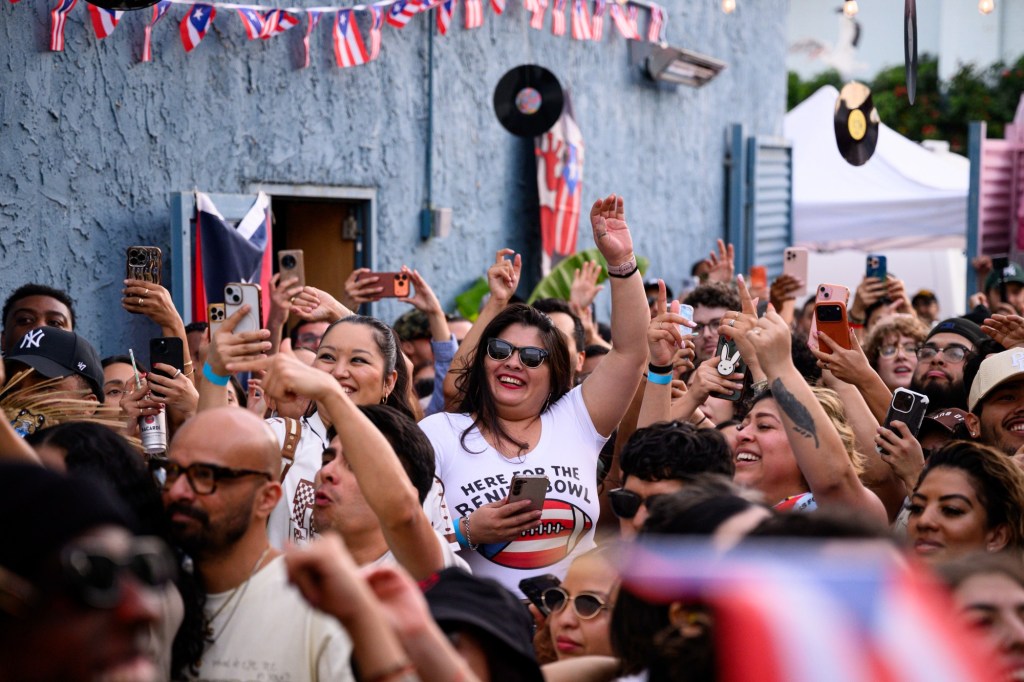
Casa de Lola, which took over High Tide in Los Angeles on Sunday, was among several Bad Bunny watch parties that took over Southern California for Super Bowl LX. The siblings chose High Tide as the venue for its palm trees and Miami Vice vibe. The venue was decorated with Puerto Rican flags inside and out, matching fans who wore shirts featuring the flag or the bandera’s red, white and blue color scheme. Others wore flags and colors from their respective cultural backgrounds, including Brazil and the Dominican Republic.
Case de Lola also curated a tasty food menu featuring Puerto Rican staples that can be found on the island’s streets or resemble grandma’s home cooking. The menu featured pernil, fried snapper, chicken-thigh pinchos, pastelitos, bacalaitos, alcapurrias and yuca fries.
“We were trying to keep it mad authentic, and I feel like we accomplished that,” Chef Vic said.
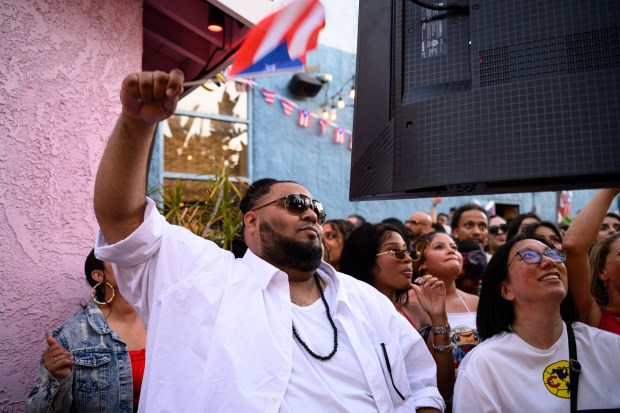 Over 100 people gathered at High Tide, a tropical-themed bar in Downtown Los Angeles, on Sunday, Feb. 8 for a viewing party of rapper Bad Bunny performing during the 2026 Super Bowl halftime show. (Photo by Jacob Lewis, Contributing Photographer)
Tiara Peterkin waited in a long line to get a plate of Puerto Rican food. Peterkin is from Philadelphia, where she said there is a large Caribbean population and something she missed when she moved to Los Angeles. When she heard about the watch party at the High Tide, she knew it was one she couldn’t miss.
“To some people, Puerto Rico seems like something far away or different, but it’s actually a part of America, and there are a lot of Puerto Rican people in this country,” she said. “So it’s huge to have Bad Bunny headlining the Super Bowl because it speaks to the Latino people who are living here, and I was so happy to hear that he was performing at this year’s show.”
Adjacent to the food line were a few tables featuring the artwork of Puerto Rican artist Victor Rivera, aka VMR3. Paintings of the Puerto Rican flag, and el Sapo Concho, the Puerto Rican crested toad, along with other sketches of Bad Bunny, were on full display. Rivera said that having a high-caliber artist like Bad Bunny represent Puerto Rico has trickled down to him, and he has seen increased interest in his art, which he said speaks to the broader importance of representation.
“I’ve seen people get mad that Bad Bunny is going to be at the Super Bowl, but what they don’t understand is that they’ve been represented their whole lives, and it’s these other communities’ turn to be represented, and you don’t really understand what it means until you’re that person on screen,” Rivera said.
Some of the ire he referred to came from conservatives and President Donald Trump. The backlash prompted Turning Point USA to host an alternative “All-American” Super Bowl halftime show, headlined by Kid Rock.
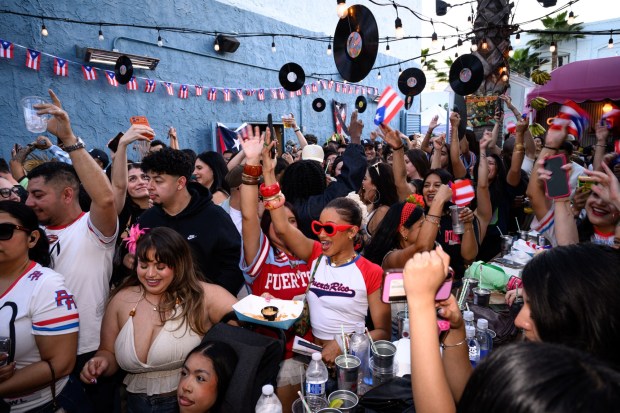 Over 100 people gathered at High Tide, a tropical-themed bar in Downtown Los Angeles, on Sunday, Feb. 8 for a viewing party of rapper Bad Bunny performing during the 2026 Super Bowl halftime show. (Photo by Jacob Lewis, Contributing Photographer)
Halftime History
Before the halftime show began, the crowd inside High Tide was dense, with people standing elbow to elbow in the venue’s courtyard and inside, waiting for the show to start. As the volume turned up, fans erupted with cheers, danced and sang along verse for verse for the whole 13-minute halftime performance.
Bad Bunny opened the show with “Tití Me Preguntó,” starting in a sugar cane field, a crop that was an economic cornerstone of Caribbean countries. He walked past workers cutting the canes with machetes, who wore straw “pava” hats, a reference to the iconic Puerto Rican countryman, or jíbaro. The imagery also served as a callback to the visuals for his “Debí Tirar Más Fotos” album and to his “No Me Quiero Ir de Aquí” concert residency in San Juan.
As he walked through the fields, he nodded to other workers and Latino businesses, including the Coco Frio and piragua stands, nail techs, a gold and silver jewelry stand, and Villa’s Tacos Los Angeles. He also walked past a game of dominoes and the Mexican-American boxer Emiliano Vargas and the Puerto Rican champion Xander Zayas.
Later in his performance of “Nuevayol,” he took a shot of alcohol given to him by Maria Antonia “Toñita” Cay, or Toñita, a pillar of the Puerto Rican community in New York City. She has run and operated the Caribbean Social Club in the Brooklyn neighborhood of Williamsburg for more than 50 years. These sequences in the show acknowledged contributions from Latino communities and offered a glimpse into their everyday lives.
The singer also performed “Yo Perreo Sola,” “Safaera,” “Party,” and “Voy a Llevarte Pa’ PR” from the rooftop of the famed “Casita” (Spanish for “little house”). It is an architectural tribute to Puerto Rican midcentury homes, featuring traditionally bright colors, shuttered windows and a carved-wood door. The casita was first introduced in the short film “Debí Tirar Más Fotos” and in the “No Me Quiero Ir de Aquí” tour, where he invited different celebrity guests to party with him. He kept that tradition alive on Super Bowl Sunday, inviting prominent Latino stars Cardi B, Pedro Pascal, Young Miko, Karol G and Jessica Alba.
Other surprise guests at the Super Bowl included Lady Gaga, who performed a salsa-fied version of her hit “Die With a Smile.” Many fans anticipated Bad Bunny would bring out Cardi B, but if you paid close attention during the 68th Grammy Awards, you might have seen the wholesome exchange he had with Gaga.
He also welcomed fellow Puerto Rican singer Ricky Martin, who sang “Lo Que le Pasó a Hawaii,” an anti-colonial anthem. Martin singing the song in Spanish was significant because it was a callback to his roots and the beginning of his career when he sang in Spanish. To gain traction in the U.S. during the late nineties Latin boom, he began singing in English, which record companies considered the only way to achieve “crossover” appeal with American audiences.
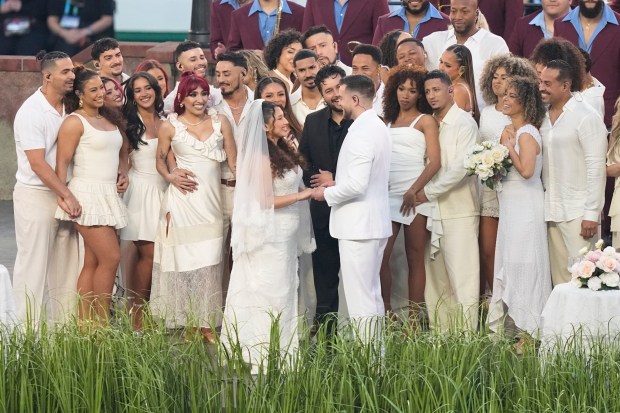 Elly Aparicio and Thomas “Tommy” Wolter dressed as a bride and groom as the participate in the Bad Bunny performance during halftime of the NFL Super Bowl 60 football game between the Seattle Seahawks and the New England Patriots, Feb. 8, 2026, in Santa Clara, Calif. (Frank Franklin II/AP)
Bad Bunny has been at the helm of a new musical direction that is appreciated for its global appeal. He made history as the first-ever Spanish-language album to win Album of the Year at the Grammys and be booked at a Super Bowl. Although he followed other Latin music halftime acts such as Gloria Estefan, Shakira and Jennifer Lopez (a show on which Bad Bunny appeared), he did so authentically, without changing his approach to music or pivoting to English, and Martin took notice.
“I know what it means to succeed without letting go of where you come from. I know how heavy it is, what it costs, and what is sacrificed when you decide not to change because others ask you to. That’s why what you have achieved is not just a historic musical accomplishment, it’s a cultural and human victory,” Martin wrote in an open letter following Bad Bunny’s Grammy achievements. “You won without changing the colour of your voice. You won without erasing your roots. You won by staying true to Puerto Rico.”
During the halftime performance, Bad Bunny also appeared to pay tribute to the next generation in a segment in which he walked into a makeshift living room and handed his Grammy Award to child actor Lincoln Fox, who sat watching the singer’s recent Grammys acceptance speech with his parents.
Another special moment in the show featured the performance of “El Apagón” (Spanish for “blackout”), in which Bad Bunny and the sugar cane workers climbed the electrical poles. The song addresses the frequent blackouts that plague Puerto Rico and all the frustrations that the disruption brings to Puerto Ricans’ everyday lives. The island experienced the longest blackout in American history, lasting nearly a year after Hurricane María.
The song champions Puerto Rican pride and resilience among its citizens, who taught themselves electrical skills and climbed dangerous electrical poles to reconnect loose or damaged power lines and restore power to their towns and homes.
When Bad Bunny won the award for best musica urbana album at the Grammys, he gave a speech calling for “ICE out” and said, “The only thing that is more powerful than hate is love,” and was blasted on a Jumbotron at Levi’s Stadium. The Love was on full display at his halftime performance, whether it was hosting a real wedding onstage, naming every country in North and South America, followed by “God Bless América!” or his deep love for Puerto Rico. The whole show was a love letter to Latinidad. This Spanish-language term refers to the shared attributes of Latin American people and their descendants without reducing those similarities to a single essential trait.
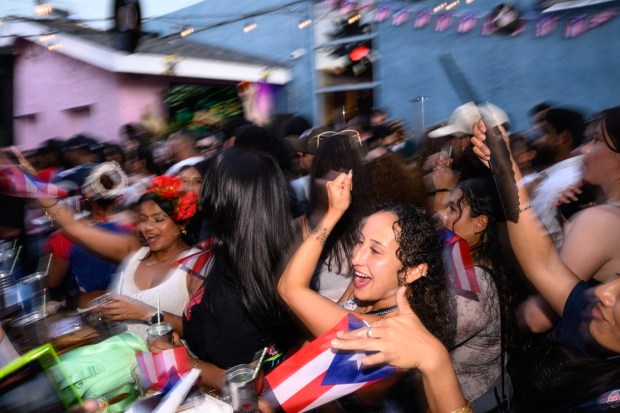 Over 100 people gathered at High Tide, a tropical-themed bar in Downtown Los Angeles, on Sunday, Feb. 8 for a viewing party of rapper Bad Bunny performing during the 2026 Super Bowl halftime show. (Photo by Jacob Lewis, Contributing Photographer)
Post Party Perro
After the halftime performance, some of the crowd began to thin out. For those who stayed for the rest of the game, the party continued with a DJ who played more Bad Bunny, reggaeton and dembow.
People remained in a celebratory mood, including Isabella Garcia and her sister Christina.
“I loved that he shouted out all of Latin American countries,” she said. “I know that in New York, there is more Boricua and Dominican representation, but on this coast, we sometimes get lost or lumped in with other Latino communities, and we’re not the same. To hear a shout-out like that by Bad Bunny, where he name-dropped all of us as part of a broader culture but individually at the same time, made me want to cry.”
Sebastian Torres and Jose Lopez came out with a group of friends to watch the Super Bowl. They are both Bad Bunny fans and were excited to see what he would do on stage. Torres is from Puerto Rico and Lopez is Salvadoran-American, and they have been friends for nearly 10 years.
“I took him to Puerto Rico with me when Bad Bunny had his residency and got to show him around,” Torres said. “My grandma even cooked for him when I told her we were stopping by, but that’s just how it is out there. Everyone’s looking out for you, even if they know you’re just visiting.”
“I’ve invited Sebastian to family stuff before, too, and my family loves him, maybe more than me,” Lopez joked. “Even though we’re from different parts of the world, it’s cool how much we have in common and how much we care for people. I think if you look at the halftime show and what Bad Bunny did, it shows how much love there is for each other in Latin America and around the world, if you can look past the negativity we see these days. I hope people can see that.”
And when asked about his impression of the halftime show, Chef Vic said it best:
“The importance of a Latino artist performing on this grand stage in this very special way while representing a demographic of people that’s being attacked at this very moment is so special and shows how amazing we are as people and that we’re not criminals or aliens. We belong here, and we have something to offer.”