
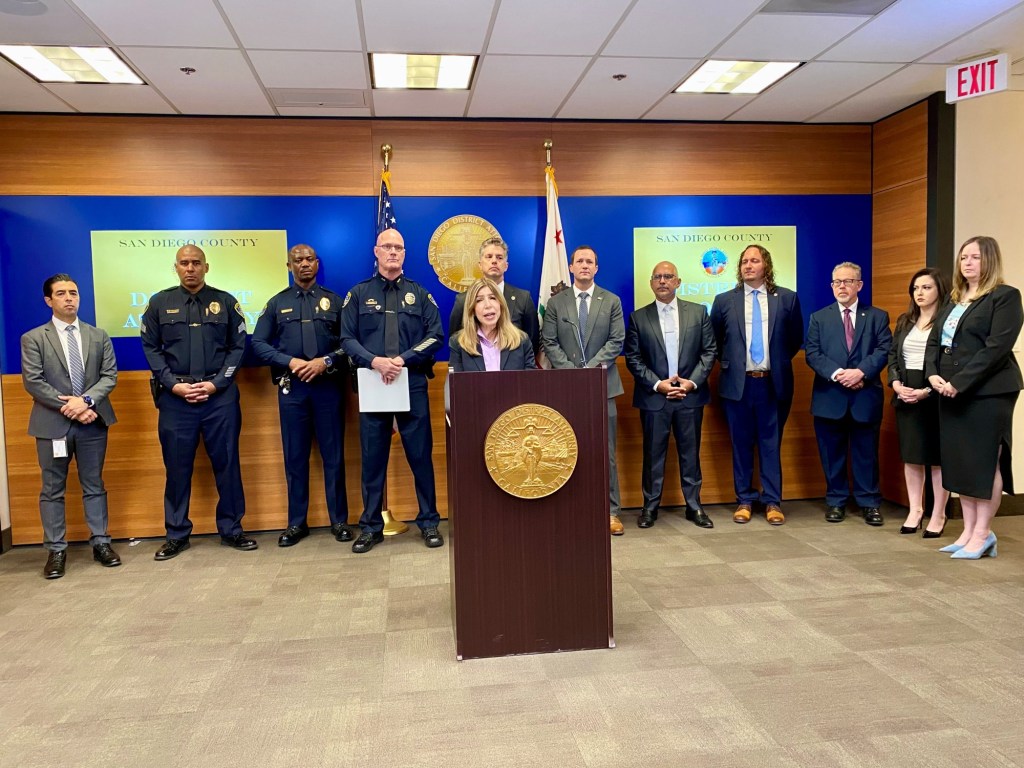
An undercover operation targeting street-level drug dealing in downtown San Diego has resulted in criminal indictments against 37 individuals, mostly for selling fentanyl, methamphetamine and crack cocaine out in the open in the East Village neighborhood, authorities announced Monday.
The operation, dubbed “Street Sweeper,” involved surveillance and controlled drug purchases by undercover officers from the San Diego Police Department and a federal anti-fentanyl team last September and October. On Thursday, law enforcement officers arrested 23 of the 37 defendants against whom prosecutors had built cases and obtained indictments.
“This operation focused on hand-to-hand drug sales; this was brazen drug dealing happening out in the open, over and over, on our sidewalks, near homes and near businesses,” District Attorney Summer Stephan said at a Monday morning news conference.
“When drug dealing festers, the big concern for public safety … is not just about drug dealing, it is the violence and the crime that come along with it,” Stephan said. “This is the chaos that we wanted to stop through Operation Street Sweeper.”
Authorities charged 34 of the defendants in San Diego Superior Court. The other three were indicted on federal charges in U.S. District Court, two on gun counts and one on a drug charge.
Stephan said that while San Diego law enforcement agencies often go after organized crime groups and bulk drug suppliers, the operation announced Monday was focused specifically on street dealers. She said drug buyers and users were not targeted.
“A striking feature of this operation was just how easily (undercover officers) were able to buy … toxic drugs like it’s candy,” Stephan said. “There was no hesitation, no secrecy, almost like this behavior is normalized. Well, it’s not going to be normalized in San Diego County.”
A map provided by the District Attorney’s Office showed most of the controlled purchases happened a few blocks east of Petco Park, along Island and Imperial avenues, K Street, 16th Street and 17th Street. Others happened several blocks north along Broadway and C Street.
Stephan described these areas as “open-air drug markets … where drug dealers felt way too comfortable,” where residents expressed feeling unsafe and where businesses were struggling.
Few specific details of the operation were released by authorities or at Monday’s arraignments of a handful of defendants, beyond where the controlled purchases were made. A criminal complaint for one of the defendants charged in federal court showed that San Diego patrol officers stopped him Sept. 19 for a minor traffic violation and arrested him after allegedly discovering drugs and a handgun in his car.
The man told police that he purchased the gun for $300 a few days earlier at the McDonald’s on Park Boulevard and A Street, according to the complaint. Federal prosecutors charged him with being a felon in possession of a firearm, alleging that he had a 2015 conviction for drug possession with intent to distribute.
“To the people who live and work downtown, you don’t have to apologize for wanting clean streets and clear sidewalks,” San Diego-area U.S. Attorney Adam Gordon said Monday. “You don’t have to accept open drug use, blatant dealing or overdoses happening while you walk down the street. We aren’t going to surrender our public spaces to drug dealers, period.”
Gordon said the operation was about enhancing the quality of life in downtown. He said that it was also about “restoring order,” and while it was aimed at street-level dealers, he said it was part of a broader anti-drug effort that has been successfully bringing down fentanyl overdose deaths over the past several years.
“Enforcing the law doesn’t just restore order, it saves lives,” he said, citing both national and local statistics that show that overdose deaths have been falling in recent years.
In San Diego County, overdose deaths peaked at 1,309 in 2021 but have dropped steadily each year since then, according to the most recent report issued in August by the San Diego County Substance Use and Overdose Prevention Task Force. In 2024, the most recent year for which data is available, overdose deaths dropped to 945, the lowest number since before the COVID-19 pandemic.
Gordon pointed to a January study published in the journal Science as highlighting the reason behind the decline in overdose deaths. The study suggested that “a major disruption in the illicit fentanyl trade,” including the Chinese government’s crackdown on fentanyl precursor chemicals, has led to a decrease in overdose deaths.
Gordon said the “supply shock” can also be attributed to aggressive prosecutions of Mexican cartels and the destruction of local drug-dealing networks.
“Winning is fentanyl being harder for the cartels to make, and then less potent and less available on our streets,” Gordon said. “That’s the reality right now in San Diego County.”
Stephan said operations similar to the one in East Village have been successful in the past, highlighting one dubbed “Operation Mic Drop” that targeted drug, fraud and gang activity around Mike’s Market on Ocean View Boulevard in Mountain View. In 2021 and 2022, three men were fatally shot and others were shot and wounded in close proximity to the store, which authorities described as a “crime den.”
The operation targeting that criminal hot-spot resulted in convictions for all 22 defendants, the District Attorney’s Office announced last year. Stephan said Monday that reports of crime in that area have dropped 50% since the operation, and there have been no homicides.