
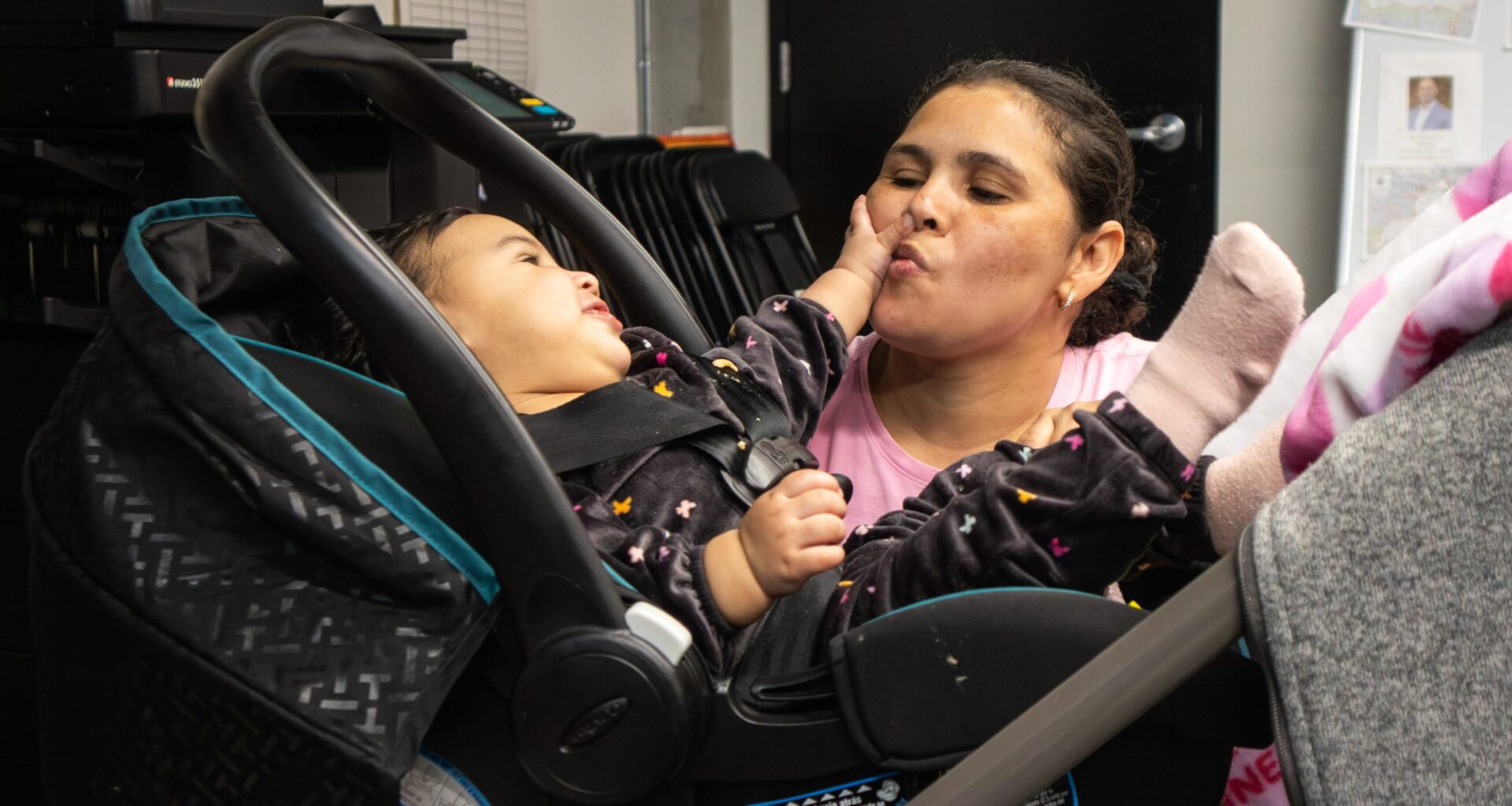
On a recent day, Roxana waited with her stepdaughter, Karina, to take the No. 49 bus to her work cleaning offices.
When Karina, 20, saw a black SUV idling with its hazard lights on across the street, she panicked. “They are ICE,” Karina told her stepmother in Spanish.
Just seven months earlier, Karina had watched ICE agents handcuff her father and load him into a black van outside their home near Lake Merced. He had screamed and yelled “Hija!” — Daughter in Spanish. Karina ran to get her stepmother “but when I arrived, they started up and took him away,” said Roxana.
That was the last time they saw Joel. It was June 17.
This time, at the bus stop on 16th and Mission, Roxana, 40, tried to calm her stepdaughter.
She had seen a couple get out of the car to buy coffee from a street vendor, she explained. They were not Immigration and Customs Enforcement agents.
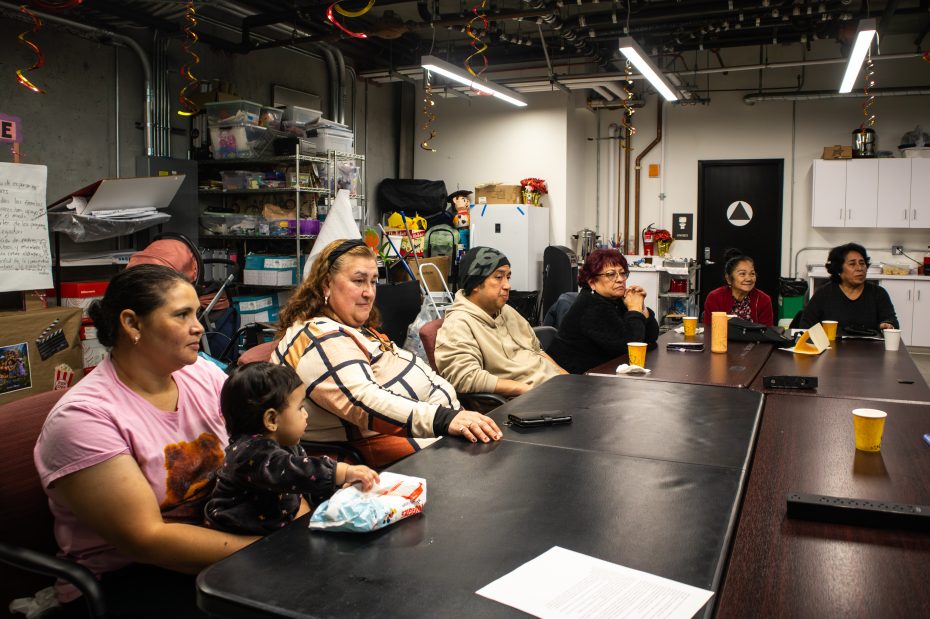 Roxana and her daughter listen during a Faith in Action meeting in the Mission District on Jan. 27, 2026. Photo by Mariana Garcia.
But Roxana’s comfort can only go so far. At home near Lake Merced, she cares for her four children, all of whom she says remain traumatized after watching the father of their household detained and deported. ICE pick-ups have left families without their main source of income — and separated indefinitely.
“One of the most important things for me is that I don’t want more children to be separated from their mom or dad. I don’t want other kids to go through what happened to [my children],” said Roxana.
Month in detention, then deported to a country he barely knew
San Francisco’s sanctuary-city status is limited: It prevents local law enforcement from cooperating with federal immigration agents, or conducting immigration enforcement. But federal officials are not bound by the law, and can operate freely.
Although San Francisco has not been a hotspot for immigration enforcement like other cities across the country, Roxana’s husband is one of at least 4,559 arrests in the San Francisco “area of responsibility” between January and October 2025, according to records published by the Deportation Data Project. That area includes Northern California, Hawaii, Guam, and Saipan.
Data shared with Mission Local by the San Francisco Rapid Response Network, a coalition that seeks to verify reported immigration enforcement, shows that from July 2024 to the end of June 2025, there were an average of 337 calls per month. Between July and November 2025 there was an average of 618 calls per month. That’s an 83 percent increase.
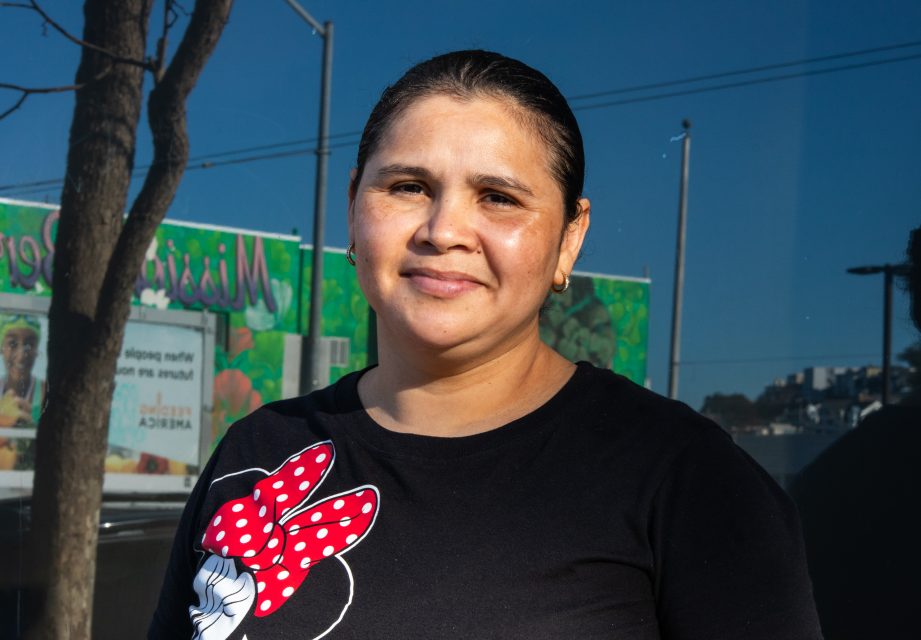 Roxana is an immigrant mother from Honduras. Her partner was detained in June 2025 and later deported, leaving her to look after four kids on her own. Photo by Mariana Garcia.
Mission Local has tracked at least 130 people who have been detained at immigration court in the city since May, but attorneys say many more have been arrested. Detentions at ICE check-ins, marriage-based green card interviews, and across the city are difficult to track.
“A lot of people say there are no detentions in San Francisco, because supposedly San Francisco is a sanctuary,” Roxana said. “But they did go to detain my husband in front of the house.”
The detention and deportation of a husband and father has meant less income, less help around the house and more emotional strain on Roxana’s family.
The surge in deportations, especially of men, leaving women behind, is a “mass atrocity” for Latino families, said Kristina Lovato, an assistant professor of social welfare at U.C. Berkeley and director of the Center on Immigration and Child Welfare. Depression and anxiety are common in these households, she said.
Deported to a country that’s no longer home
After being picked up by ICE, Joel, 42, was first transferred from the family’s home to an ICE detention cell at 630 Sansome St., and then eventually to Mesa Verde, a detention center in Bakersfield. He was deported to Honduras, his birthplace, in July, after a month in detention. He had not lived there permanently in 23 years.
Joel has not been able to send money to Roxana since. He sold a piece of family land in Honduras in an effort to return to the United States, but was stopped at the border and spent three more months in detention.
“He feels like he’s eating something he doesn’t want to eat, he’s in a country where he doesn’t feel at home,” said Roxana.
For his family, Joel’s expulsion is what psychologists call an “ambiguous loss,” meaning there is no closure or formal acknowledgement of the loved one’s departure. The results can include high levels of anxiety, and poor educational outcomes for children.
Making ends meet without the primary breadwinner
Roxana’s life is complicated. Her one-year-old, Briana, whom she had with Joel, was only four months old when he was detained and deported. Roxana also has two teenagers: Daniela, 17, who will graduate this year from Mission High School, and Lisandro, 15, who attends the San Francisco School of the Arts.
Daniela and Lisandro both walked across the border and arrived in the United States in 2023. Karina, Joel’s daughter from a prior relationship, arrived in 2024 the United States and has been living with them ever since.
The family pays $3,100 a month for a two-bedroom apartment. It’s been a struggle to make ends meet each month without the support of her husband, a window installer who was the primary breadwinner. On top of that, Roxana was just notified that her rent is going up another $300. The family survives mostly on what she and Karina make cleaning offices.
Lovato, assistant professor of social welfare at U.C. Berkeley and director of the Center on Immigration and Child Welfare, said her research has shown it is common for the eldest daughter to step in to help support the family after a father is deported. Before her father was deported, Karina was not working.
Fortunately, Roxana gets some assistance from Bay Area nonprofits, including a $3,000 check from the Mission Asset Fund, which is a nonprofit that provides low-interest loans and financial support to immigrants. Marie Vincent, her attorney, works for her pro bono through Pangea Legal Services, a nonprofit legal service provider that works on a sliding scale.
Roxana sends her one-year-old, Briana, to a city-funded daycare near Daly City while she works. Out of the family of six, Brianna is the only one who is a U.S. citizen. The rest are at varying stages of seeking permanent legal status.
Roxana, for her part, is seeking asylum. She came to the United States from Honduras in 2018 after being attacked multiple times by gang members. Her trip to the United States was a harrowing journey that involved days of walking, multiple planes, an escape from a man who tried to traffic her to Ohio, and a lucky encounter in Dallas with a distant family member who gave her a start here.
From grief to activism
What’s surprising, said Lovato, the researcher, was the resilience of women left behind. Many are able to re-configure their entire family structure relatively quickly, and people come together — through extended family, churches, or other community groups — to support each other.
Roxana is a case in point. Though she worries about being deported, she is politically active. On a recent Tuesday, Roxana pushed Brianna in a stroller into the Faith in Action office in the Mission where she joined a meeting to plan political actions related to immigration, such as attending school
Inside, a group of mostly elderly immigrants sat around a table enjoying pupusas and curtido, a spicy cabbage slaw, before the start of the meeting. Various depictions of the Virgin Mary hung on the wall.
That day, Brianna turned one, and Roxana held up her cell phone so that Joel, now in rural Honduras, could wish their daughter a happy birthday. Often, his cell phone reception is too weak, but on this day, he was able to see and speak to his daughter clearly.
The other volunteers tried to make the best of it, cooing at the baby and offering birthday wishes. “Happy birthday to you, princesa,” said Brenda Cordoba, the co-president of La Mesa Directiva at the organization.
It wasn’t Roxana’s first time organizing with Faith in Action. She and other parents successfully lobbied for a city-funded universal basic income for homeless families in Everett Middle School in 2023, when one of her children was enrolled.
Family demands pulled her away but, in July, after Joel was deported, Cordoba told Roxana that she was not alone. “We are your community,” Cordoba said to her. Roxana returned to Faith in Action and now attends meetings weekly and speaks at public press conferences across the city.
This winter, she was invited to attend a support group for people in the Bay Area who, like her, had spouses detained. She sat in a room in San Mateo, where about 25 people shared their stories.
Maria, a San Francisco mother of six, described her husband’s detention at immigration court.
“You could feel the pain they were experiencing from having their partners detained or deported, but they realized that they had things in common that united them, they were united by love, faith, family, their children, and the desire to move forward,” said Violeta Roman, a community organizer at Faith in Action.
In the past two weeks, Roxana has attended meetings at Everett Middle School where she is working with parents to raise funds to help families who need legal help, a school board meeting, and a rally for educators. “It feels good to spend time with my community, it gives me hope,” said Roxana.
She is working with other immigrant parents to create what they call a “fund of hope.”
She already met with John Jersin, a tech entrepreneur who gave $15,000 to the cause.
At a recent meeting at Everett middle school, Jersin listened to the stories of parents affected by the immigration crackdown.
“It’s a tragedy and it’s an embarrassment to this country,” said Jersin.
ICE did not respond to multiple requests for an explanation why Joel was detained last June, but Roxana hypothesized that it may have been because of a prior DUI. He had paid his fine and attended driving courses, thinking the matter was done, but federal immigration officials across the country have detained individuals with DUIs.
The more time passes, the more difficult it is for Roxana to imagine continuing her life without Joel.
When she goes to bed each night, she has a hard time falling asleep without him. “I am always in fear. But if we let fear take us over, we are giving victory to the president,” she said.
So she continues to wake up at 5:30 a.m. each day. She goes to work, cares for her family, and attends meetings, where she shares her story with others.