
Construction to begin March 2
The day that Alameda residents have long anticipated with a mix of apprehension and cautious optimism is just around the corner.
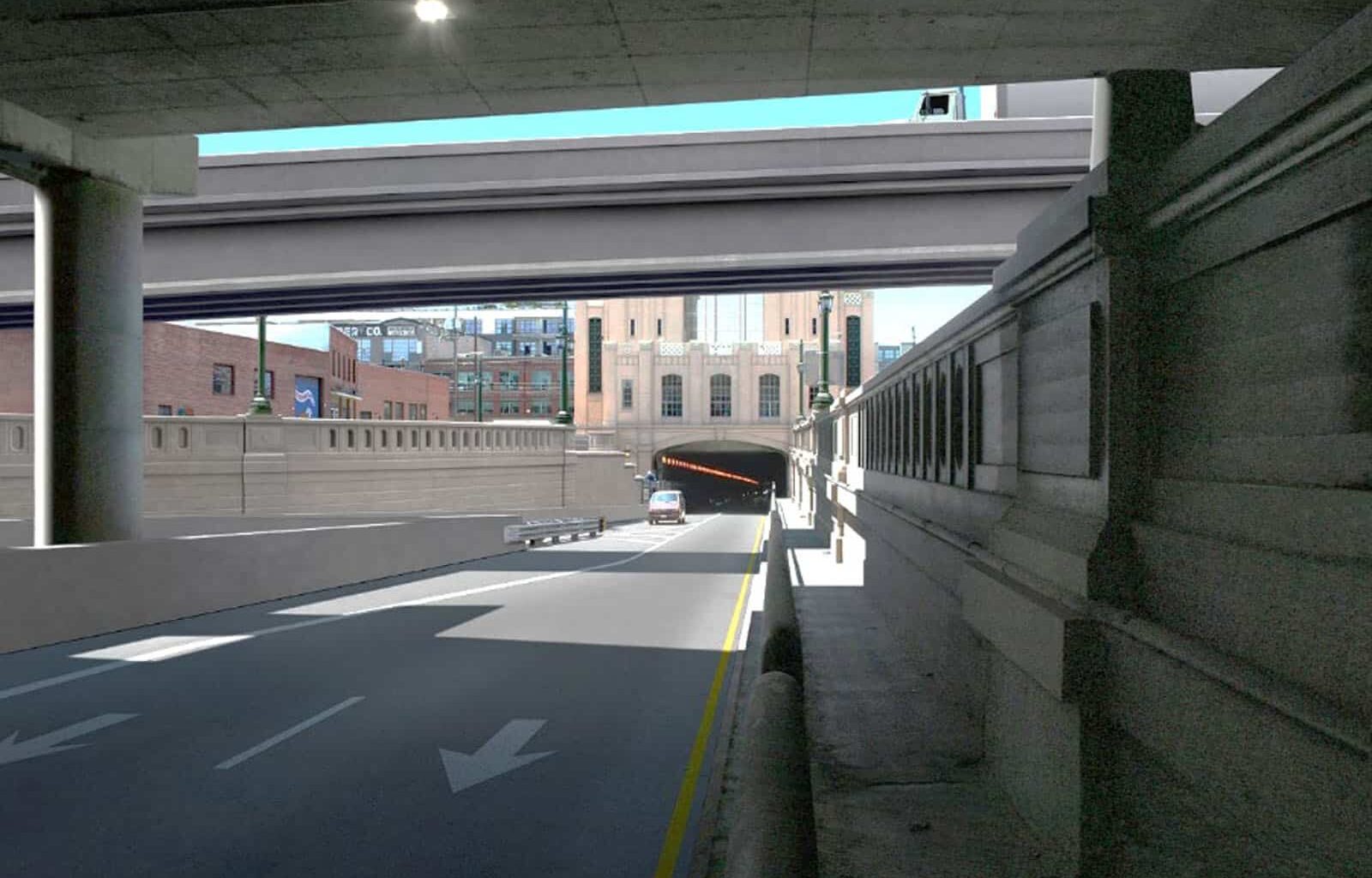
 The exit of the Posey Tube, which will feature a new on-ramp to northbound Interstate 880. Rendering by Alameda County Transportation Commission.
At a science fair-style open house event at Alameda City Hall on Wednesday, February 4, Caltrans project experts explained to attendees that work will begin Monday, March 2, on the Oakland Alameda Access Project (OAAP), a major infrastructure project that is intended to improve transportation safety, accessibility, and regional connectivity in Alameda and Oakland.
At the core of the project is the construction of a new on-ramp that will take drivers directly from the exit of the Posey Tube onto northbound Interstate 880 (I-880). Other elements include the demolition of the northbound I-880 off-ramp to Broadway to create a continuous, multimodal Sixth Street in Oakland, as well as numerous upgrades to surface streets around the Posey and Webster Tubes.
The first phase of construction is set to take place over six months in spring and summer 2026 and will primarily affect the Webster Tube and several local streets in Oakland and Alameda. The work will widen the existing Webster Tube maintenance path to create a new bicycle and pedestrian facility, which will require full overnight Webster Tube closures on Sundays to Thursdays, from 10 p.m. to 5 a.m. each night.
 Residents and stakeholders review the latest project information at an open house at Alameda City Hall on Wednesday, February 4. Photo by Ken Der.
Notably, this is a major change from the previously announced plan for continuous daytime one-lane closures in the Webster Tube, which are now off the table following input from residents and stakeholders, as well as a creative reorganization of the construction schedule.
Details for the subsequent phases of construction that affect the Posey Tube are still being finalized. For now, Caltrans Public Information Officer Hector Chinchilla told the Alameda Post the upcoming phase will have a “minimally visible” impact to Alameda, and it provides an opportunity to work out the kinks before the more complicated construction happens.
 Construction activity in spring and summer 2026 will primarily affect the Webster Tube and surface streets in Oakland and Alameda. Graphic by Caltrans.
 Modifications to the Webster Tube include a new bicycle and pedestrian facility. Graphic by Caltrans.
Attendees generally welcomed the change in scheduled closures and agreed it would be less disruptive to their travel habits, but many still expressed some concern about future phases and the length of the project.
“Four years—it feels like a long time,” commented Brooks Wong, who lives on the West End. “It’ll be worth it in the long-term but it’s going to be painful.”
Emily Capello, another West Ender, said she would have to be more deliberate about travel planning but said she felt “generally positive” about the project. “It can make this area of Oakland nicer and safer,” Capello said, pointing on a map to the Chinatown and Jack London Square districts of the city.
Caltrans construction manager Bill Bornman concurred, noting that the project will help redirect freeway-bound traffic from local Oakland streets and will have “measurable benefits” on traffic safety.
 Project scope in Oakland. Graphic by Caltrans.
“If the closure is strictly from 10 to 5, then it’s probably no problem,” added Alexander Kwok, who works in the Marina Village area and commutes from Uptown Oakland. But he noted that if construction crews are unable to clean up in time for the morning commute, it could become an issue.
San Francisco Bay Ferry Customer Experience Specialist Rafael Regan reminded attendees of the transit agency’s routes, including the Oakland Alameda Water Shuttle, which will return to its expanded summer operating schedule starting in March. Chinchilla also confirmed that Caltrans agreed with AC Transit’s request to end the Webster Tube closures earlier—at 5 a.m. instead of 6 a.m.—to eliminate the need for early-morning trips (such as on Lines 30 and 51A) to detour around the closure, which could have impacted service reliability later in the day.
Caltrans will perform additional coordination and outreach ahead of future project stages. On one of the poster boards, the agency asked residents to “Stay Tuned!” and offered an indisputable—if not somewhat ominous—reminder of the nature of construction projects: “The best laid plans often change.”
Ken Der is a contributing writer for the Alameda Post. Contact him via [email protected]. His writing is collected at AlamedaPost.com/Ken-Der.