
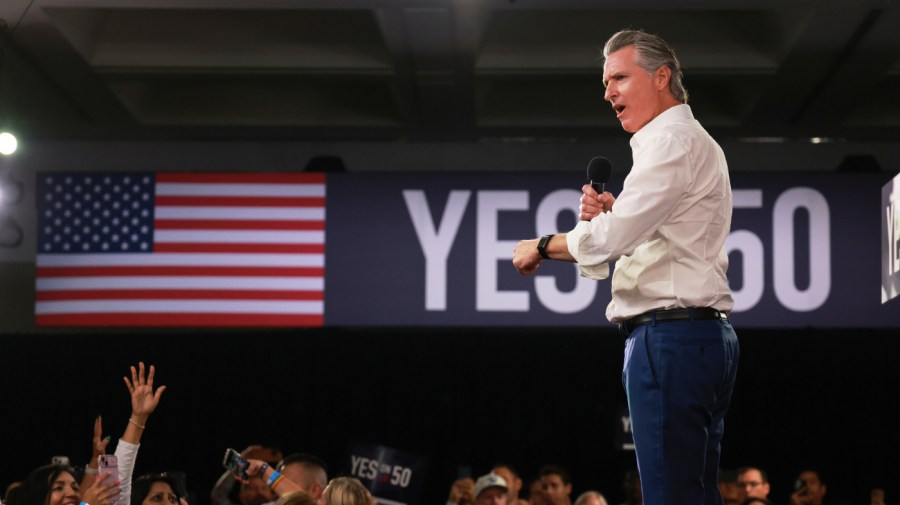
With hotly contested House races on the horizon come November, the Supreme Court last week gave California Democrats the chance to pick up as many as five blue congressional seats next November. The court on its “shadow docket” turned down a MAGA emergency application seeking to block California’s Democrat-friendly congressional redistricting map.
The court’s unsigned order did not include a vote count or a recitation of the court’s reasoning, which is the hallmark of its “shadow docket” decisions. But the justices rejected an emergency request by the California Republican Party to override a federal court and block the map before the November vote. A divided three-judge panel in federal court in Los Angeles had upheld the map.
The decision is a victory for Democrats, who had devised the plan after President Trump pushed Republican-led states to move their goalposts, redrawing their own maps to help Republicans gain seats in the midterm election. His effort to have Indiana’s legislature change the rules, however, failed passage in a Republican-dominated state Senate.
Trump desperately needs to preserve his congressional majority to push ahead the MAGA agenda and avoid accountability for his conduct in office. In Texas, Gov. Greg Abbott (R) obediently engineered a gerrymander of that state’s congressional districts to pick up as many as five Republican House seats. The court’s ruling on California’s redistricting plan comes just two months after it cleared the way for the Texas map.
Democrats in California broke out the Champagne. “Donald Trump said he was ‘entitled’ to five more Congressional seats in Texas,” Gov. Gavin Newsom (D) gloated in a rub it in your eye X post. “He started this redistricting war. He lost, and he’ll lose again in November.” Trump has called the California plan “unconstitutional” and a “giant scam.”
In January, Trump’s lawyers weighed in with a cynical brief supporting the state Republican Party. Solicitor General D. John Sauer argued that the justices should treat California’s map as different from the Texas map because California’s map was “tainted by an unconstitutional racial gerrymander.”
Sauer argued that the state’s new district boundaries had been drawn to bolster Latino voters. California replied that it would be “strange” to redistrict to help Latino voters and then adopt a map with the same number of majority-Latino districts.
California Democrats faced allegations of racial gerrymandering, as Republicans did in Texas. However, the high court’s majority appeared to conclude that politics, not race, was the driving factor in both states.
“With an eye on the upcoming 2026 midterm elections, several states have in recent months redrawn their congressional districts in ways that are predicted to favor the State’s dominant political party,” said the court’s December order in the Texas case. “Texas adopted the first new map, then California responded with its own map for the stated purpose of counteracting what Texas had done.”
The “impetus” for adopting both states’ maps was “partisan advantage pure and simple,” wrote Justice Samuel Alito in a concurring opinion — in short, a Mexican standoff.
Legal fights are still playing out over other new congressional maps, as Republican-led Florida and Democratic-led Maryland take steps to join the fray.
In New York City, Rep. Nicole Malliotakis (R) is appealing a state judge’s order for a new redistricting plan that would redraw her district in ways that could tip it into the Democrats’ column.
In Utah, two House Republicans filed a federal lawsuit claiming that a new state court-selected congressional map, which could help Democrats win an additional House seat, violates the Constitution. Utah’s Republican-controlled state legislature has asked the state’s highest court to block that map for this year’s election.
And in Virginia, a judge ruled that a proposed constitutional amendment on congressional redistricting violates state law because the process Democratic state lawmakers used to advance it was improper.
The Supreme Court has yet to rule on a challenge to Louisiana’s voting map, but October oral arguments hinted that the conservative majority is likely to continue undercutting the 1965 Voting Rights Act. Such a ruling could lead to new rounds of congressional gerrymandering — and the largest-ever decline in representation by Black members of Congress.
The California decision is likely to stand, at least for the forthcoming congressional election. California’s primaries are in June, and the court has often invoked the ”Purcell principle” — that it is loath to upset the applecart too close to the start of elections.
The California ruling was released as March deadlines loomed for candidates to get on the June primary ballot. Democrats are counting on California’s map to help them push back against Republican gerrymandering in Texas and other states.
With rulings upholding both the Texas and California maps, the result is that the two states may essentially cancel out each other’s partisan gains, and we are back to a level playing field — at least for the time being.
James D. Zirin is a former federal prosecutor in the Southern District of New York and a published legal analyst.
Copyright 2026 Nexstar Media, Inc. All rights reserved. This material may not be published, broadcast, rewritten, or redistributed.
For the latest news, weather, sports, and streaming video, head to The Hill.