
Visitors can always view the new Lightwall piece of art on the wall at the California Center for the Arts from a distance.
Consisting of hand-scappled geometric shapes and prisms on a white background with three rows of four clear acrylic cubes, it is an interesting piece of abstract art on its own merits.
However, when the visitor walks up to Lightwall, it becomes something else altogether.

The rotating acrylic cubes reflect light that is projected from points around the wall’s
frame. (Photo courtesy of Cal State Fullerton)

The piece incorporates light, sound and texture for an interactive AI experience. (Photo courtesy of Cal State Fullerton)

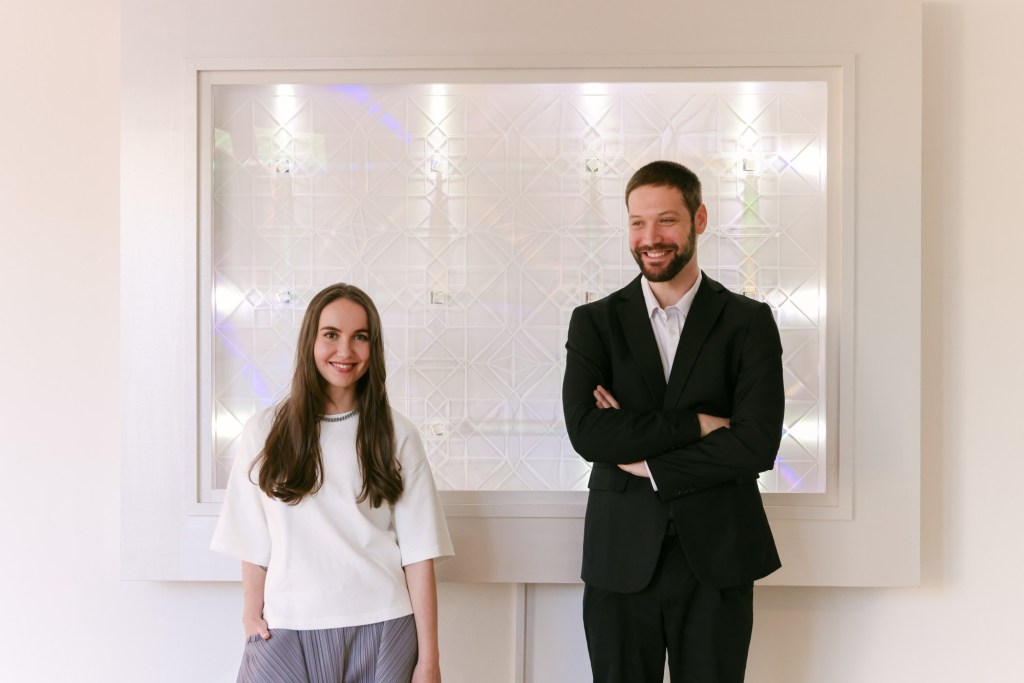
Developed by artist Rita Sus, left, in collaboration with technologist Zach Rattner and students from Cal State Fullerton, Lightwall
integrates kinetic sculpture, custom electronics and artificial intelligence to create an environment that responds in real time to
visitors’ movement and sound. (Photo courtesy of Zach Rattner)
Show Caption
1 of 3
The rotating acrylic cubes reflect light that is projected from points around the wall’s
frame. (Photo courtesy of Cal State Fullerton)
Equipped with radar, sensors, flashing lights that glint off the rotating acrylic cubes and real-time artificial intelligence that initiates dialogue with the viewer, the artwork is anything but static.
A collaborative piece by artist Rita Sus, technologist Zach Rattner and the College of Engineering and Computer Science at Cal State Fullerton, Lightwall is an interactive composition that responds to the visitor’s movement and voice.
A sign next to Lightwall invites visitors to “Talk to the wall. It’s listening.”
“Hello, it’s good to see you,” Lightwall says in a clearly robotic voice when approached.
Lightwall can tell you its name, who created it and answer more esoteric questions about its purpose.
“The art is responding to us,” said Christopher Ryu, a computer science professor who oversaw the project as one of the faculty leaders.
Behind its simple exterior and plain frame, Lightwall is abuzz with activity. Unlike many AI art installations elsewhere, it requires no cloud dependency and runs off a single Mac minicomputer.
As a result, the information and interactions with Lightwall remain offline, on-site, personal, private and unique to the visitor and those in the room.
Organizers say the self-contained design makes Lightwall portable and available for tours, collaborations or future institutional partnerships.
Reanimation
Art installations using digital art, computers and AI programs are nothing new. In the 1960s, artist Harold Cohen developed a program named Aaron using artificial intelligence software to create fine art that he debuted in 1974. His work has toured museums such as the Tate Gallery in London and the San Francisco Museum of Modern Art.
Since then, AI-generated art, including “interactive” pieces, has proliferated from small museums to large public art displays.
A presentation of work by the late Cohen and Aaron ran until last year at the Whitney Museum in New York and let visitors watch the computer “create” art.
However, Rattner said the CSUF project veers away from existing projects.
“We’re trying to create a new space,” he said.
By integrating one-on-one personal relationships, particularly with discussion and dialogue between the art and the viewer, Rattner said, “I think we’re exploring where no one is going.”
It is a space about which Rattner, an AI innovator for the past decade in business uses, has thought about a lot.
Rattner says it’s about “Using AI not to replace creativity, but to make human experiences richer.”
Ryu said one of the exciting possibilities of AI is its ability to interpret objects and reanimate them by “imagining” what the artist thought and even how the object might see itself.
This is part of the reason he is intrigued by the interactions Lightwall will have with visitors as it grows and evolves.
“People love art,” Ryu said. “It’s interesting to imagine what the artist is thinking.”
Rattner said AI can add a dimension to art appreciation.
He likes the idea “to have paint have a personality and have a conversation with it. If you could reanimate a rock, what would it do?”
Or as Ryu put it, “Any dead object we care to communicate with, we can get any object to communicate if we enable it.”
Role of the artist
Sus, who is the creative force of the physical shell of Lightwall, was intrigued by the “balance of human touch, craft and the machine.”
“This is my first project in six years as a visual artist that has used AI,” she said.
“AI is a tool, and there is no universal use,” she said.
While as an artist, Sus is limited to scalpels and brushes and other physical implements, she says “AI doesn’t have that limitation. You can utilize it as a tool in any way you want.”
Currently, although AI is able to amass massive amounts of data that has been expressed by humanity over the ages through its art, debate about creative spark, the soul of art and artist and its relationship with AI remains in flux.
Ryu said he is interested in studying AI and so-called creativity.
Akshat Desai, a graduate research assistant, worked on the architecture of Lightwall’s “brain,” specifically, the “personality engine and hardware bridge.”
It has its own knowledge,” Desai said of Lightwall, as well as a kind of lyric nature.
“Sometimes it will answer in a poetic way if the question is out of its domain,” Desai said. “It might hallucinate if a question is out of context.”
In a demonstration of an interaction with Lightwall, Rattner asked, “Are you happy?”
“A spectrum shifting a quiet grace, stillness found in this luminous space,” Lightwall answered.
Artists!