
This partial transcript was computer-generated. While our team has reviewed it, there may be errors.
Alexis Madrigal: Welcome to Forum. I’m Alexis Madrigal. We’re talking about the Bay Area rental market this morning—specifically what looks like a real divergence between San Francisco and Oakland. We’ll discuss a number of factors that may be contributing to this widening gap in rents, especially for one-bedroom apartments, and consider what these trends tell us about our strategies for addressing the housing crisis.
Joining us this morning, we have Chris Salviati, chief economist at Apartment List, who researches economic trends in the housing market. Thanks for joining us.
Chris Salviati: Thanks for having me on.
Alexis Madrigal: We’re also joined by J.K. Dineen, San Francisco Chronicle reporter covering housing and real estate. Welcome back, J.K.
J.K. Dineen: Thanks, Alexis.
Alexis Madrigal: And Tim Thomas is with us as well, research director at UC Berkeley’s Urban Displacement Project. Welcome, Tim.
Tim Thomas: Good morning. Thank you.
Alexis Madrigal: Thanks so much. So, Chris, you’re working with Apartment List data. Tell us what you’re seeing in the rental market in San Francisco and Oakland.
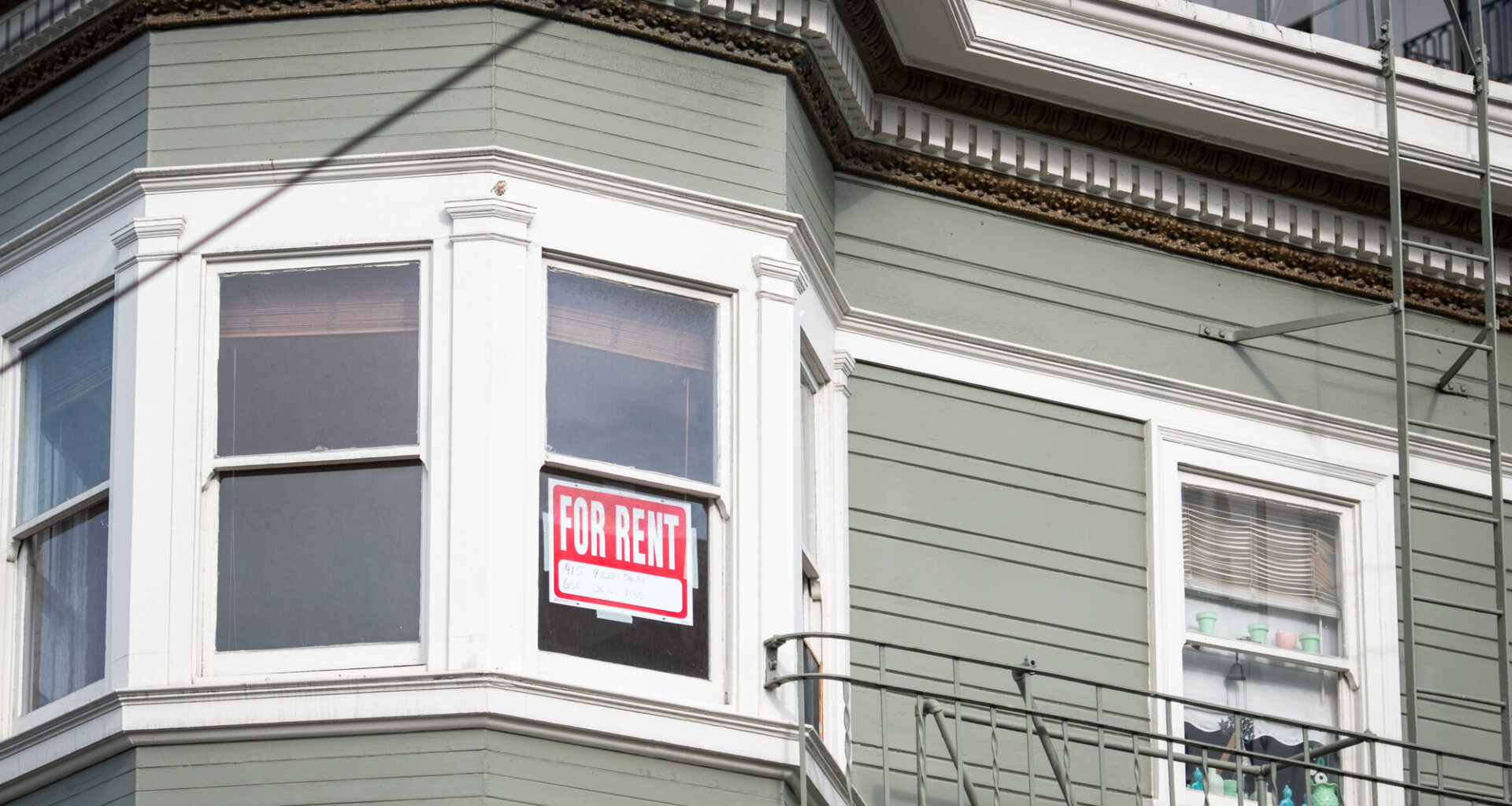
Chris Salviati: Yeah. Right now, we’re seeing a real divergence between the two cities. Over the past year—the last 12 months—we’ve seen a 13 percent increase in median rent in San Francisco. That’s a huge spike. In Oakland, rents are only up about 2 percent. Oakland has always been more affordable than San Francisco, but that gap has really widened.
Right now, our median one-bedroom estimate in San Francisco is about $3,150. In Oakland, it’s about $1,850. That’s almost a 70 percent gap, which is really significant.
Alexis Madrigal: Yeah. For places that are, in some cases, 10 or 15 minutes apart—and in some cases, parts of Uptown Oakland are closer to downtown San Francisco than to other parts of San Francisco. So tell us about the methodology here, because median one-bedroom data is a pretty specific slice of the rental market, right?
Chris Salviati: Totally. This is an important methodological caveat. What Apartment List primarily sees is large, professionally managed apartment complexes—think 50-plus-unit buildings, often high-rises. That’s not exclusively our sample, but it makes up the bulk of what we track.
So we’re really talking about downtown areas in both cities. And when we talk about the softness we’ve seen in the Oakland rental market—where prices are actually down quite a bit from five or six years ago—a lot of that decline is concentrated in downtown Oakland specifically.
Alexis Madrigal: That makes sense. J.K., when you hear these numbers, as someone who does a lot of qualitative reporting on what’s being built and how these cities are functioning, what stands out to you?
J.K. Dineen: The first thing I think is that there’s not going to be new market-rate development in Oakland for a long time. A lot of apartments that opened between 2019 and 2023 are now going back to their lenders. They’re being foreclosed on and selling for around $400,000 per unit, which is about half of what it costs to build a unit in Oakland.
You’ve got projects like the old CCA campus in Rockridge—one of the nicest neighborhoods in Oakland. It’s a beautiful site: woodsy, hillside, great views. It’s entitled for 445 units, but the developer, Emerald Fund, has said, “I can build it, but it’s going to be worth a lot less than it costs to do so.”
Alexis Madrigal: Some of this story, right, Chris, is how long it took for Oakland’s pandemic-era rent decline to bottom out. For this type of apartment, you had the pandemic, which disrupted everything, and then a wave of new supply coming online. From your data, it doesn’t really bottom out until 2024.
Chris Salviati: That’s right. While rents are up 2 percent over the past year, if you go back to 2023 or early 2024, Oakland rents were declining 5 to 10 percent year over year.
What we’re really seeing is that a big construction boom in Oakland—started before the pandemic, when the market was strong—continued, and all of that inventory hit just as the city was hollowing out due to remote work and other pandemic effects. Oakland had both a supply surge and a demand slowdown, and demand hasn’t come back as quickly. That’s driven a lot of the ongoing softness we’re seeing.
Alexis Madrigal: Tim Thomas, you focus on urban displacement issues. Do you think this is good news from a displacement perspective, or is this a slice of the market that doesn’t necessarily affect the people you’re most concerned about?
Tim Thomas: I think it’s generally good. Historically, rents don’t usually go down. Right now, to avoid being rent-burdened in an $1,800 apartment, you need to make about $74,000 a year. Median income in the Bay Area is about $128,000. When you multiply that by 0.8—80 percent—you get what HUD defines as low income, which in the Bay Area is shockingly about $102,000.
So when prices drop from pre-pandemic Oakland rents of $2,600 or $2,700 down to $1,800, that creates a real opportunity for people who aren’t in the tech industry to stay in place.
Before the pandemic, I moved to Berkeley in 2019. When I was looking for an apartment, I was competing with nurses from San Francisco because they couldn’t afford to live there. What happens at the epicenter of San Francisco affects the entire region—Marin County, Alameda County, and definitely Oakland.
Before the pandemic, Oakland was experiencing a revival. During the pandemic, I saw a lot of U-Haul trucks as people were locking down, and the population never really recovered. The economy didn’t fully recover either.
What’s interesting now is that the divergence we’re seeing is largely due to the AI boom in San Francisco. About $30 billion in venture capital was invested there in the third quarter of 2025. That’s led to falling office vacancy rates, falling apartment vacancy rates, and a return-to-office push that’s concentrating people back in San Francisco.
During the pandemic, San Francisco hollowed out, but now population growth there has been significant. I think before too long, we’ll likely see population growth return to Oakland as well.
Right now, though, many downtown businesses aren’t getting much foot traffic. People often cite crime as the main reason. However, homicides are down, vehicle thefts are down 65 percent, and burglaries are down 42 percent.
Alexis Madrigal: That’s also because 2023 was such a bad year. It was anomalous.
Tim Thomas: Sure, but things are getting a lot better. When people realize that, there’s probably going to be another revival in Oakland.
Alexis Madrigal: We’re talking about the Bay Area rental market and why San Francisco rents have risen so much faster than those in Oakland.