
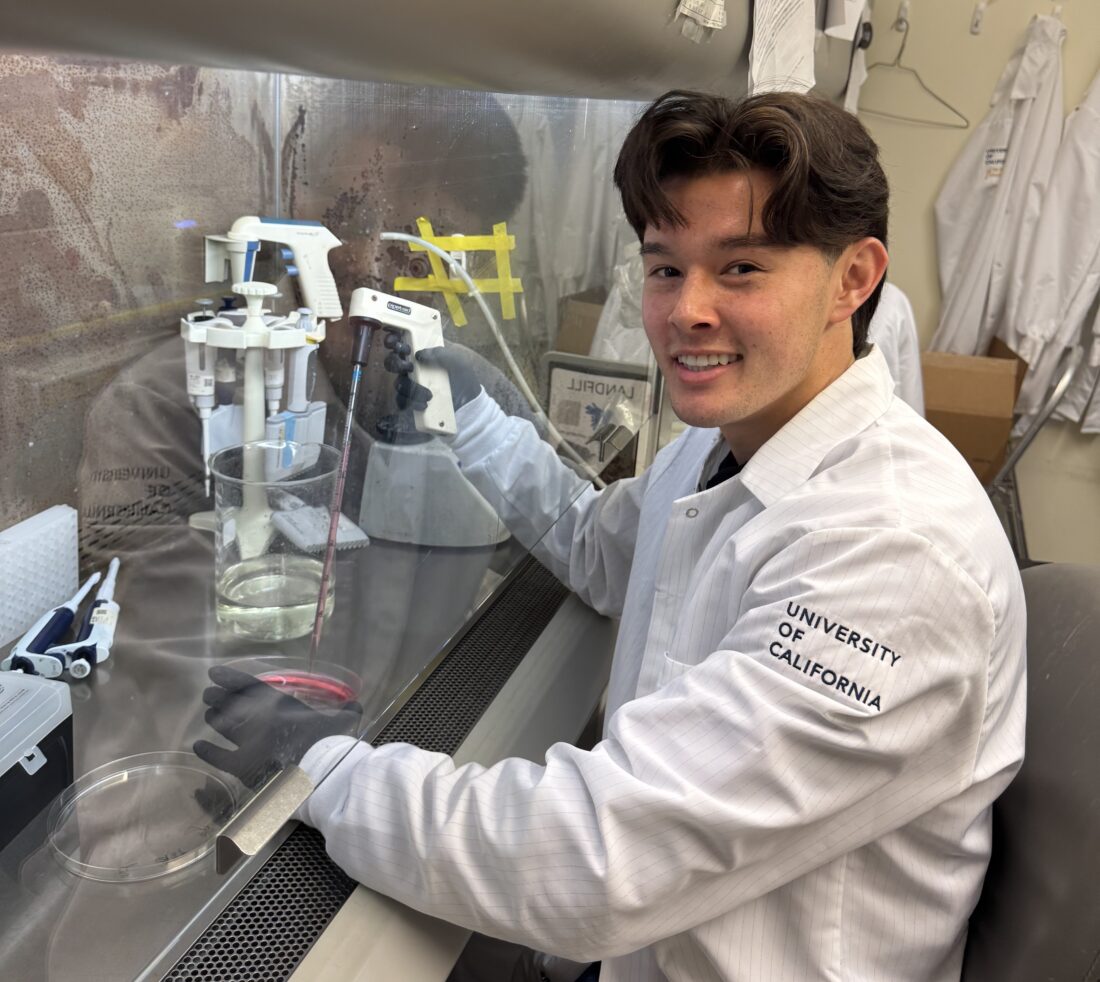
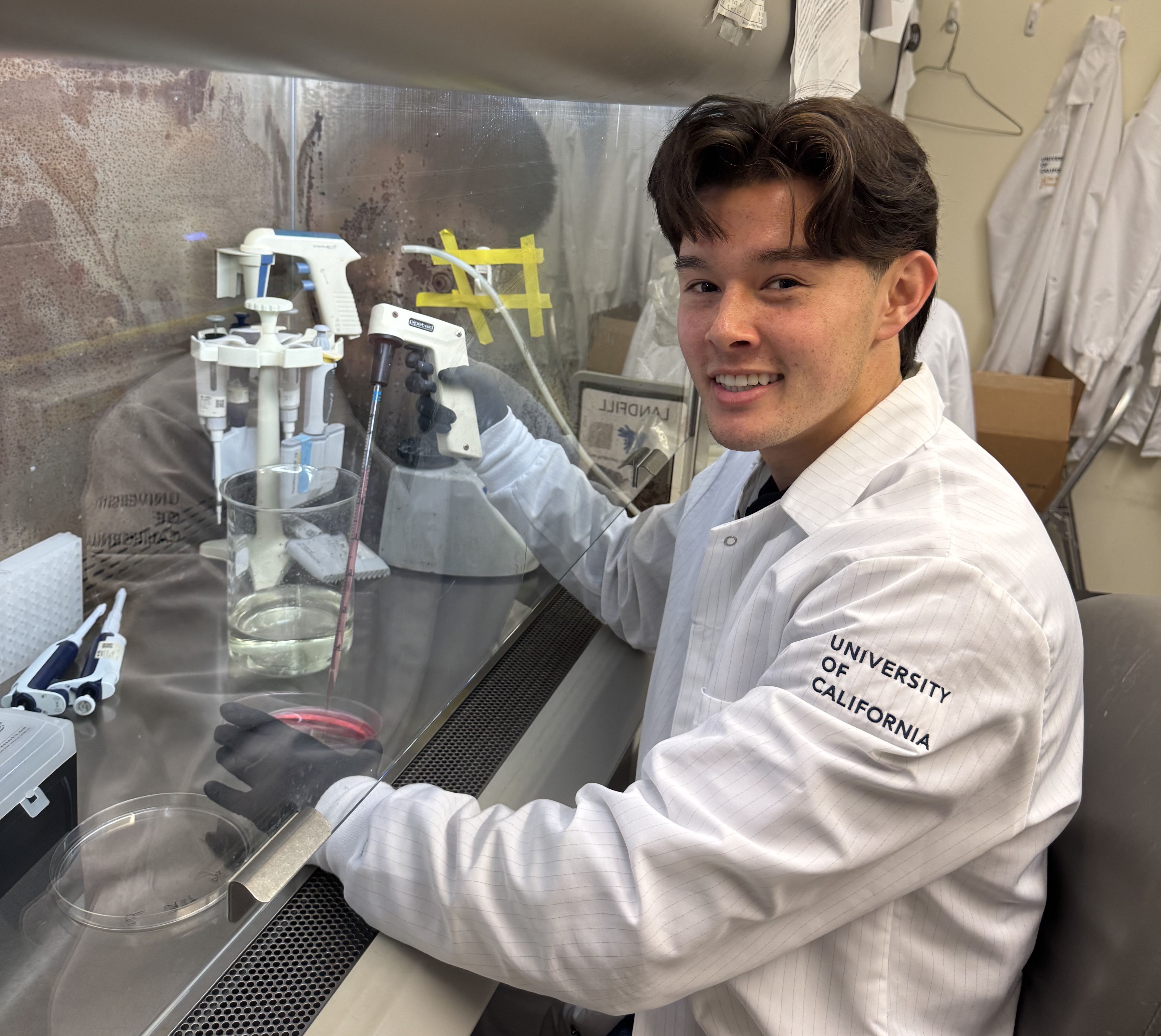
 Zachary Cooper, a junior in the Robinson Life Science, Business, and Entrepreneurship Program (LSBE) at Haas, received a scholarship to work at the Schaffer Lab, which focuses on stem cell and gene therapeutics research.
Long before the sun rose and his first class began last week, Zachary Cooper, BS 27/BA 27, made his way to the Schaffer Lab at UC Berkeley to check the progress of his viral engineering experiment.
“The hours can be incredibly long,” said Cooper, a junior in the Robinson Life Science, Business, and Entrepreneurship (LSBE) Program, a partnership between Haas and the UC Berkeley Department of Molecular and Cell Biology. “But the science I get to participate in is next-level—and staying focused on my objectives and the ‘why’ I am here is incredibly important and is really what keeps me excited.”
The stakes are high for Cooper. His early-stage research at the Schaffer Lab could contribute to the lab’s long-term discovery of new medical therapies and therapeutic delivery modalities for people with diseases such as Huntington’s, Parkinson’s, and certain cancers.
Run by David Schaffer, a UC Berkeley professor of Chemical and Biomolecular Engineering, Bioengineering, and Molecular and Cell Biology, the Schaffer Lab’s research focuses on stem cell and gene therapeutics and on novel ways to investigate and better control stem cell behavior.
Cooper has been working on two projects at the lab, which Shaffer says is both unusual and ambitious for an undergraduate student.
The first, which he started last May under postdoc Mimi Guo, focuses on improving how adeno-associated viruses deliver therapeutic genes to the central nervous system’s glial cells. Glial cells support and surround neurons. Many brain diseases aren’t caused by dying neurons; they’re caused by glial cells that fail to protect the brain. “I’ve always been fascinated by the way viruses work and the idea that you could potentially harness these things that we consider ‘bad guys’ to be used therapeutically, especially for things like cancer,” Cooper said.
A second project, which Cooper is independently spearheading alongside PhD candidate Chris Allen, involves tuning genes in the oncolytic vaccinia virus for cancer therapeutic development. Cooper is building a platform to screen vaccinia genes to better understand how these genes affect the virus’s ability to kill cancer cells.
“Nobody has ever done this before, so I was starting from square one and had to do dozens of iterations of experiments just to figure out what would actually show something, let alone if the technology could work,” Cooper said.
A pivot to cancer research
Cooper grew up in Palo Alto, California, playing soccer and snowboarding, and honing a love of nature. When he was in high school, his mother’s shocking breast cancer diagnosis changed his family’s life and motivated him to narrow his focus to cancer research at Berkeley.
 Cooper will earn two degrees through the LBSE program: a BS in Business Administration from Haas and a BA in molecular and cell biology.
For years, he had his eye on the Schaffer Lab. which has developed technologies that are now in a dozen human clinical trials, including three that have made it to large-scale final-stage studies. A successful entrepreneur, Schaffer co-founded seven companies from his lab, including 4D Molecular Therapeutics, Ignite Immunotherapies, which was acquired by Pfizer, and Rewrite, which was acquired by Intellia.
Schaffer said he was drawn to Cooper’s scholarship application because he was an excellent student who had already been accepted into the LSBE Program, which students apply to during their sophomore year to earn two bachelor’s degrees. “LSBE sets a very high bar for admissions, so right off the bat it’s impressive,” he said.
Becoming a mentor
An only child, Cooper said he always had to seek out mentorship. As a UC Berkeley freshman, he met Jacob Williams, a senior in the LSBE program, who inspired him to aim higher. Their interactions changed his life and trajectory, he said, motivating him to become a mentor himself. During his first year, Cooper launched a supportive mentorship program for Haas students that connected first-years with upperclassmen.
Now he’s taking those efforts a step further by teaching a Haas-sponsored spring DeCal course “UGBA 198: Intro to Research and Biotech Recruiting,” to help students break into academic and biotech labs. “I’m excited to bridge the gap and increase access for underclassmen who want to join research labs but lack the roadmap to get there,” he said. “By increasing access, these programs empower more people to contribute to the lifesaving research that patients like my mother depend on.”
Cooper also credits his development to the experiences and professional mentor network he’s built over the past few years. He first interned in the lab of a small biotech company before joining the Desai Lab at Stanford University. Then he joined biotech startup ReRx Therapeutics as a business development intern. ReRx spun out of the Näär Lab at UC Berkeley, which Cooper later joined as a researcher.
The experience showed him how biology and business could converge. “It was the first time I was exposed to this idea of being able to spin technology out of an academic institution, and it was a core motivator for my pursuit of LSBE,” he said. “I knew the program would equip me with the tools to do the same in the future.”
Balancing business and science
There’s a bit of shapeshifting involved in being an LSBE student as you move from science to business classes, and vice versa, Cooper said.
“The way that the professors expect you to learn is very different, and the way they expect you to participate is very different,” he said. “My genomics class and my accounting class aren’t inherently related. But I do think that the soft skills you learn in those business classes differentiate you among biology students, and your technical abilities and biology background definitely differentiate you from the business students.”
While Cooper still finds time to play club soccer, most of his effort is split between classes and the lab. His long-term plan includes pursuing a PhD and then a career as a biotech entrepreneur.
“That is what motivates me to my core,” he said. “It’s not just about discovery. Discovery is cool, but I’ve always been driven by the translational process of moving a breakthrough out of the lab and into the clinic where it can actually save lives.”