
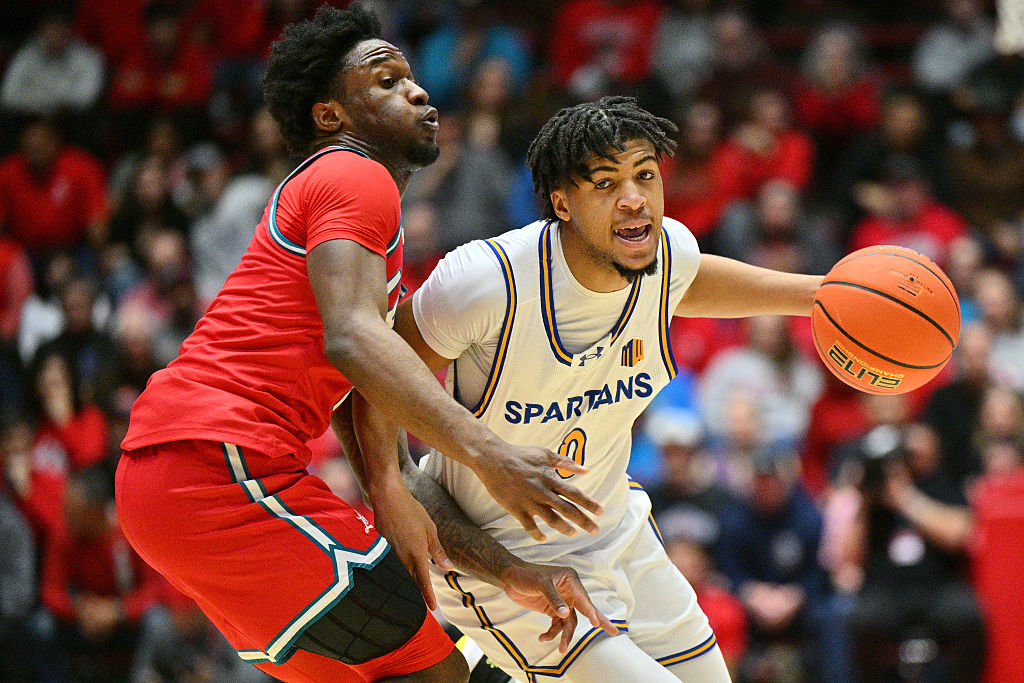
Dan Johnson takes you through his preview, prediction, and pick for tonight’s college basketball game between the UNLV Runnin’ Rebels and the San Jose State Spartans.
Pittsburgh is stuck in the mud, and this spot is where the season can start to feel merciless. Duke walks into the Petersen Events Center at 21–1 and 10–0 in the ACC, still carrying the posture of a top seed. Pitt is 9–15, living game-to-game, hoping the home floor can cover for thin margins. The only real intrigue is whether the Panthers can turn this into a street fight before the talent gap opens. Below is my preview, prediction, and pick for tonight’s college basketball game between the UNLV Runnin’ Rebels and the San Jose State Spartans.
Here’s how I’ll play it. I’ll be pumping out these predictions for individual games all season, with plenty of coverage here on DraftKings Network. Follow my handle @dansby_edits for more betting plays.
UNLV plays at 74.1 possessions per game, while San Jose State sits at 67.3, so the tempo tug still leans toward a live total. UNLV is scoring 78.3 points per game, while San Jose State is at 67.7. UNLV is giving up 77.4 per game, and San Jose State is allowing 80.2. UNLV’s defense has been the problem all year, and TeamRankings pegs the opponent effective field-goal rate at 56.9%, which is the kind of leak that keeps underdogs breathing. That leak shows up inside the arc too, with opponents hitting 58.5% on twos and 36.3% from three. UNLV also gives up 33.2% opponent FTA per play, so even empty trips can turn into free points and a stop-start game that drifts toward the number. UNLV’s opponents are getting 19.0 free-throw attempts per game anyway, which keeps the whistle lane warm. The other side of the coin is that UNLV’s defensive efficiency sits at 1.082, better than San Jose State’s 1.150, and that gap matters when the favorite decides to press the gas.
Spartans’ Colby Garland (G) is sitting at 18.4 points per game, ranked 78th nationally, and he also brings 4.2 assists, ranked 143rd, so San Jose State can create shots without playing frantic. He’s also shooting 48.8% from the field, which is strong efficiency for a high-usage lead guard. On the other side, Dra Gibbs-Lawhorn (G) is at 18.5 points per game, tied 69th nationally, and he just dropped 29 in an 80–78 win over Grand Canyon, which tells you his ceiling can tilt a game’s temperature by himself.
Yaphet Moundi (F) gives San Jose State a real interior spine at 12.5 points and 7.6 rebounds on 52.0% shooting, and those touches matter because they can punish over-help. The sneaky separator is rim protection, because UNLV is allowing only 5.1% opponent block rate, while San Jose State has been living without that eraser at the other end. UNLV is also blocking 4.0 shots per game with a 7.0% block rate, while San Jose State sits at 1.7 blocks with a 3.1% rate. UNLV’s pressure shows up as well, with 7.8 steals per game and a 9.4% steals-per-play rate.
San Jose State vs. UNLV pick, best bet
UNLV can win the foul math because it gets to the line at a 0.443 FTA/FGA rate, and that’s a top-tier free-points profile that can turn a normal half into a fourteen-point half. That volume is real: UNLV is getting 25.9 free-throw attempts per game and making 17.8. If San Jose State can’t control the glass, the avalanche comes fast, because UNLV is already built to stack extra possessions with 9.8 offensive rebounds per game and a 30.2% offensive rebounding rate. San Jose State’s defensive rebounding rate is 65.6%, which is exactly how putbacks and second shots become a habit. San Jose State’s defensive profile also invites paint stress, with opponents hitting 58.5% on twos and scoring 38.5 points per game on two-pointers. The free-points lane is live too, because San Jose State is allowing 27.5 free-throw attempts per game. That’s how a spread gets covered without a three-point heater, just by living at the rim and living at the stripe.
I’m taking San Jose State +11.5 (-105) as the best bet, with the total sitting at 151.5 and the moneyline priced like a formality. The cover logic is simple and cashable: UNLV’s defense bleeds efficiency, and San Jose State has a real lead creator with a national scoring tag, plus an interior finisher who can keep the offense from going all jumpers. UNLV is allowing 56.9% opponent eFG and 49.5% opponent shooting, so clean looks should be available if San Jose State values the ball. San Jose State also has enough perimeter competence to cash threes, sitting at 34.1% from deep on 7.3 makes per game. The fragility is obvious too: it loses if UNLV strings together “rim + free throws” possessions early and forces San Jose State into a rushed game it can’t organize. The turnover pressure is real, because UNLV is forcing 13.2 opponent turnovers per game in this matchup profile. The methodology still prefers the points because UNLV’s closing profile is shaky at the line, sitting at 68.9% FT shooting, and that keeps late separation from feeling automatic.
Predicted final score: UNLV 81, San Jose State 72.
Best bet: San Jose State +11.5 (-105) at UNLV
Tail it with me in the DKN Betting Group here!