

Over the last few weeks, school leaders across Oakland have called emergency meetings with parent leaders to share some tough news: some of their school’s beloved staff are on the chopping block for next year. At some schools, PTAs are scrambling to fill the budget gaps, but at others, the district’s planned cuts leave too big a hole for community fundraising to cover.
The district’s $100 million deficit and the plan to resolve it mean school sites are taking a hit. Though the school board has pledged to focus on cutting costs at the central office, the approved budget plan includes reducing school site budgets by up to 10%. And in a district where 80% of spending goes toward staffing costs, cutting $100 million adds up to massive layoffs.
Since the district’s budget plan includes moving budget lines from the general fund to more restricted revenues, schools that don’t qualify for those specialized funding streams are slated to lose staff who were previously paid through the general fund.
Over the last month, school leaders have received what are known as “one pagers” from the district — a spreadsheet outlining their school’s budget and staffing allocations for the next school year, based on enrollment and the special needs of that school’s student population. And many are suddenly facing the prospect of losing crucial staff — with little time to find funding to keep them. The state requires districts to issue notices by March 15 to staff whose roles will be eliminated for the following school year.
This month, principals will be broaching difficult conversations with some staff members to inform them that their roles aren’t funded for next year, or that their position is going from full-time to part-time. For many people trying to make a living in Oakland, a part-time position just isn’t feasible.
An attendance strategy ‘disconnect’
Attendance specialists, community school managers, case managers, and literacy coaches could be cut for the 2026-2027 school year — roles principals told The Oaklandside have been essential to school leaders and students alike. At a time when the district is counting on increasing attendance to stabilize its budget, principals said, removing the people who do that work seems contradictory.
“There’s a total disconnect in terms of stated strategy and funded resources,” said Carmelita Reyes, the principal of Rudsdale High School, a continuation school in the Oakland Hills. “On the other hand, I don’t know a way of cutting $100 million from this district in a way that doesn’t hurt children.”
Many of the roles being cut were funded by one-time federal or state money during the pandemic, or by grants that are expiring, said Rachel Latta, chair of the school board’s budget and finance committee.
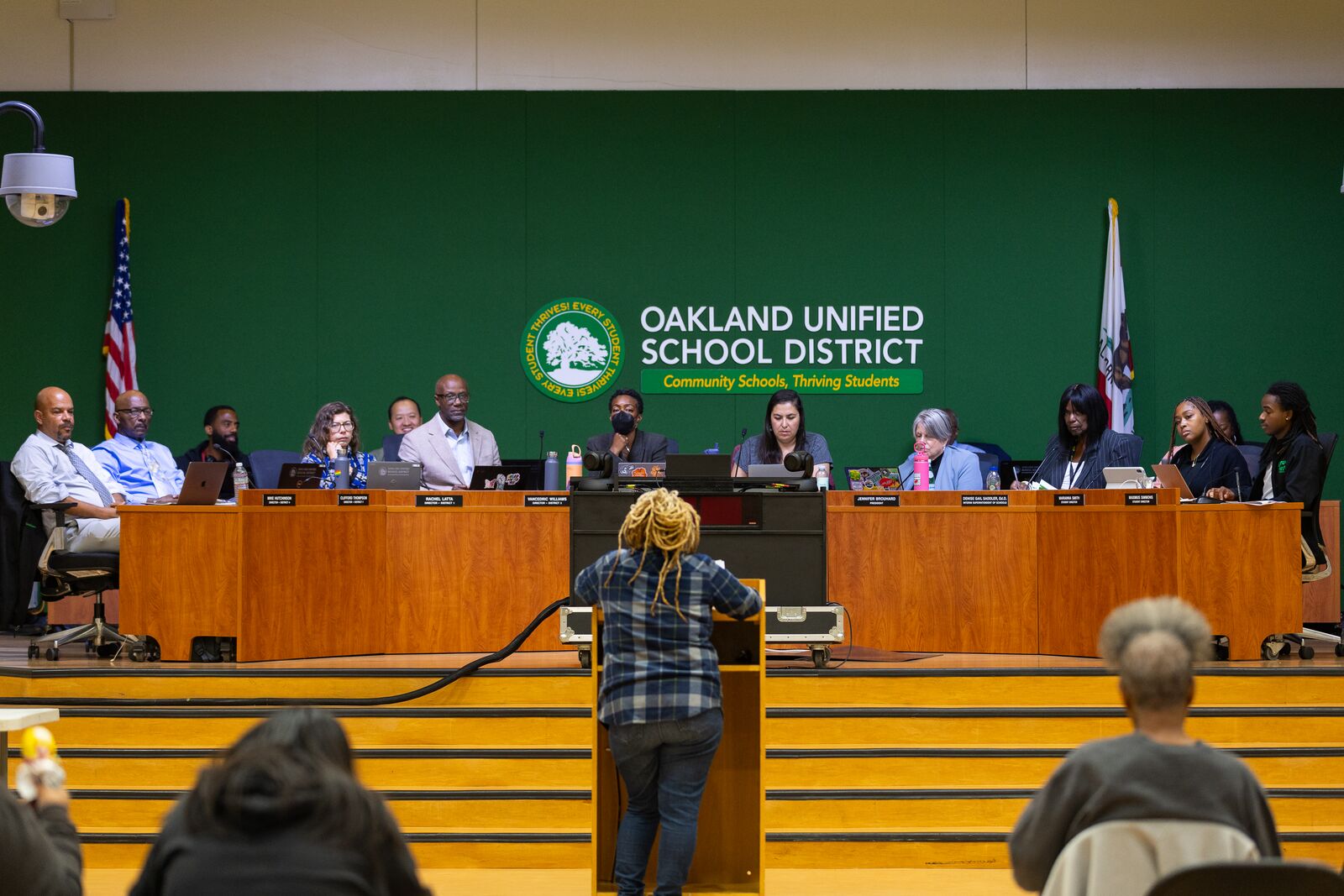 The school board has less than a month to finalize and vote on staff reductions. Credit: Estefany Gonzalez for the Oaklandside
“Losing any adult at a school is horrible,” Latta, who represents North Oakland, said. “We’re making very difficult decisions at the school site level, and it’s a question of, what can we continue to afford as some of these one-time funds, like the Community Schools Grant, go away?”
Some schools are turning to community fundraising through parent teacher associations, but the condensed timeline, thanks to a lack of clarity from the school board over the last several months, has made the planning process more challenging this year.
“Usually we get the information before winter break, and after winter break we meet with the community,” said Peter Van Tassel, principal of Cleveland Elementary School. “Between the chaotic processes at the board level and the very abrupt changes of staff — the change in superintendent and the loss of [former chief budget officer Lisa] Grant-Dawson — it has been more difficult to predict what was happening.”
‘Bare bones staffing’
As a continuation school, Rudsdale High serves students who have gaps in their academic careers and are at risk of not graduating on time from a comprehensive high school. At Rudsdale, which endured a campus shooting in 2022, three-quarters of the students are learning English, half have immigrated to the U.S. in the last four years, and a third of the student body came to this country as unaccompanied minors.
For the upcoming year, Rudsdale, like other continuation schools, could lose its attendance case managers and the attendance clerk’s role has been cut from full time to half-time, principal Carmelita Reyes said.
“The impact on a continuation school — which, by definition, serves kids who have really struggled with attendance — is extraordinary,” Reyes told The Oaklandside. “Instead of getting more services because you are concentrating the neediest kids in one place, you’re peeling off resources.”
The attendance clerk serves on the front line, Reyes said. If a student doesn’t come to school, the clerk calls home to find out why; it’s the clerk who discovers that the student is dealing with mental health challenges or has to work to support their family. The attendance case managers then work alongside the clerk to problem-solve and help remove those barriers, Reyes said. The team approach is crucial to supporting students in getting to school.
 Rudsdale students commemorate slain OUSD carpenter David Sakurai, who was shot on the campus in 2022. Credit: Amir Aziz/The Oaklandside
“Teachers cannot do their jobs if we’re not getting kids in the door,” she said. “I have no idea how OUSD thinks schools are going to be able to serve all students with such bare bones staffing.”
At Cleveland Elementary, east of Lake Merritt, Van Tassel, the principal, is trying to figure out how to keep his community school manager, literacy coach, and eco-literacy teacher fully funded. The community school manager role is being cut to a half-time position, the literacy coach has been defunded, and the eco-literacy teacher — who runs an award-winning environmental education program — has also been cut to part-time.
Community school managers serve as essential parts of a school’s attendance teams, as they host affinity groups for students and families and help families get connected with critical services, such as food assistance, medical care, or legal aid. Literacy coaches support teachers in reading instruction and pull students out for small-group tutoring.
In previous years, Van Tassel has been able to use Title 1 funding to fund a single position the district has cut. But with $93,000 in Title 1 funding for next year, there’s no way that money will cover all three of those positions.
“We’re going to have to say goodbye to more than one beloved educator,” Van Tassel told The Oaklandside.
PTAs hit a fundraising wall
With a fundraising goal of around $200,000 each year, the parent teacher association at Cleveland has traditionally funded student enrichment programs such as field trips and staffing for art, music, and physical education classes. The budget cuts on the table mean the group would have to try to raise an additional $40,000 to restore the full-time eco-literacy teacher position, said Ronak Davé Okoye, the PTA president.
That 20% increase is a steep ask, she said.
“We’re not fundraising professionals, we’re working parents,” she told The Oaklandside. “When 50% of our [school] population is under the poverty level, and we don’t require or pressure people to donate, it’s not easy for a school like Cleveland to come up with $40,000 and to say we could sustainably do that year over year.”
The rapid timeline adds to the pressure on schools to figure things out for the fall. Dozens of Cleveland parents have signed a letter to the school board and district leadership opposing the cuts.
“This hundred million dollar deficit is not new news, we were talking about this last year,” Van Tassel said. “They spent a year arguing over it and the details were not worked out. Now it’s fallen on our school community to have two weeks to make this totally impossible choice.”
At Joaquin Miller Elementary, in the Oakland Hills, the PTA in past years has funded the school librarian, lunchtime supervisors, tutors, aides, and some teacher positions. This school year, the PTA contributed around $175,000 toward staff positions. Next year, the PTA plans to contribute $290,000 to fund the community school manager and literacy coach, which have been cut by the district, as well as some of the previous roles.
While they’re able to dip into the reserves and fundraise enough for one year of coverage, the PTA leaders have made it clear that they can’t keep that up.
“We can’t do this every year, we just don’t have the fundraising capacity, we don’t have the reserves,” said Jay Beerman, the president of Joaquin Miller’s PTA. “I’m fearful for what our school’s educational outlook will be like two years from now. I’m really fearful for other schools next year and what they’ll be able to do.”
At its next meeting on Feb. 11, the school board is expected to receive another budget update from the fiscal advisors the district hired from Hazard, Young, Attea & Associates. At its Feb. 26 meeting, the board will have to vote on the slate of positions being eliminated, in time for notices to go to impacted staff by March 15.
“I don’t feel confident enough in the district and its leadership to do what’s right for all students in our district,” Okoye, the Cleveland PTA president, said. “That’s what got me involved. Everyone needs to step up in order to make it as best an experience for the students and children as possible.”
“*” indicates required fields