
Roxanne Elkassis was surprised to find the first ticket on her RV.
She’d been living in the vehicle for months, ever since finishing a program at a halfway house, and hadn’t initially run into problems. Yet one morning last year, the 36-year-old returned from a night shift at a towing company to discover that she owed the city of San Diego money.
Elkassis estimates that the price tag of that and other citations have since swelled to more than $2,000.
“I get that there are people who do things deserving of” tickets, she said in an interview. “Just take into account the situation.”
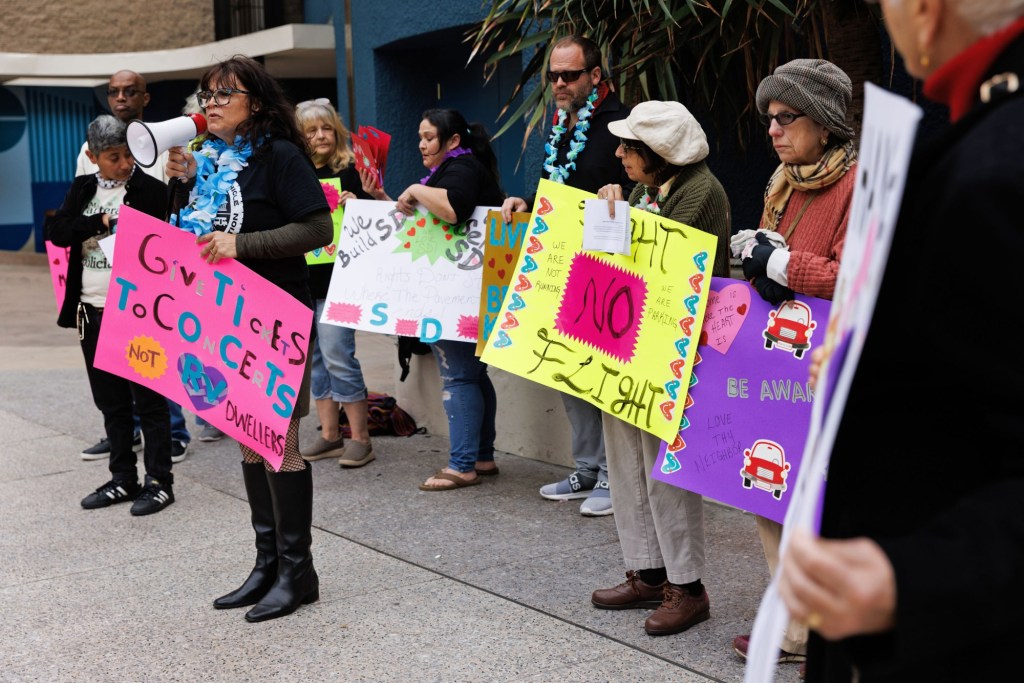
Elkassis was one of about a dozen people who gathered Tuesday in Civic Center Plaza to protest the city’s decision to resume ticketing people living out of their vehicles. The group included lawyers, activists and residents sleeping in RVs, many of whom are now forming an advocacy organization — they’re calling it an RV Tenants Union — to push back.
“Enough of the city trying to balance the budget on the backs of their poorest residents,” said attorney Ann Menasche.
Local leaders argue that they’ve already provided a viable alternative: Safe parking sites around the city, including the massive H Barracks lot by the airport.
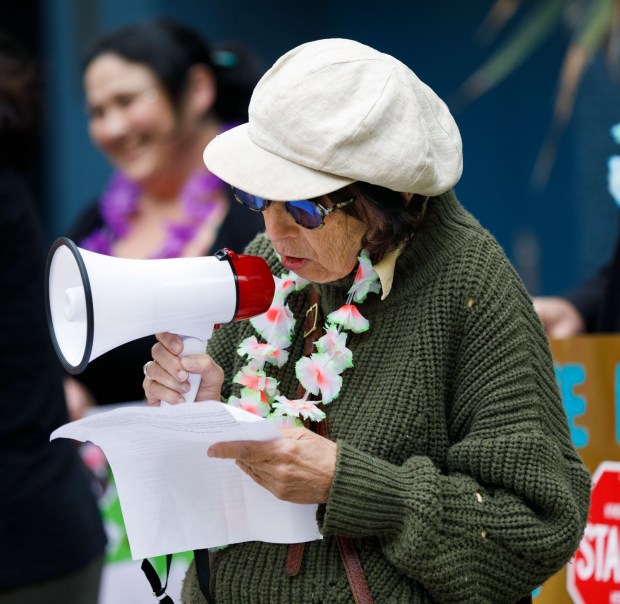 Attorney Ann Menasche speaks to members of the media during a rally against tickets RV owners have received at Civic Center Plaza in downtown San Diego on Tuesday, Feb. 10, 2026 in San Diego. (Kristian Carreon / The San Diego Union-Tribune)
“While we empathize with their situations, the City has a responsibility to insist people living in their RVs avail themselves of these resources,” spokesperson Matt Hoffman wrote in an email. “There is capacity for them today, and participation comes with case management, housing navigation, and other critical supports.”
That back-and-forth is also playing out in court. Years ago, Menasche sued the city over the same issue, and the case, Bloom v. City of San Diego, seemingly ended in 2024. That was when officials agreed to stop citing RV dwellers as long as there was nowhere else for them to go.
But once H Barracks opened last year, police resumed writing tickets.
Menasche believes the lot, which is only open overnight, is an ineffective offering, especially for disabled and low-income individuals who may not be able to afford the gas required to drive in and out every day. Indeed, public data show that sites open 24 hours have had more success bringing people in.
Those lots can cost more, however, and the state permit San Diego has for H Barracks currently bars daytime parking.
The judge has not yet weighed in.
Several people who attended Tuesday’s protest said the tickets were only making it harder to find housing. Andre Parish, 57, moved into an RV with his wife ahead of a hoped-for transition to a retirement complex. (Parish still works, although his wife, who is 67, is retired.) But he estimated that their two vehicles had so far racked up more than $4,000 in citations.
“The tickets are killing us,” he said.
The couple did stay for a time at one of the city’s safe lots, Parish added. But one of their Akitas jumped on a neighbor and tussled with another’s pit bull, which led to an ultimatum: Give up the dogs or leave the site. The two chose the dogs.
Yvonne “Eve” Macias, 52, said she works regularly at a local yacht club but can only afford to live in a trailer. Macias noted that she could move somewhere cheaper but was loathe to leave her high school daughter, who lives in the area with a relative.
 Yvonne “Eve” Macias displays Valentine’s Day cards for city officials, including Mayor Todd Gloria, that contain a poem asking for leniency on tickets people have received for living in their vehicles at Civic Center Plaza in downtown San Diego on Tuesday, Feb. 10, 2026 in San Diego. (Kristian Carreon / The San Diego Union-Tribune)
Macias worried that her work shifts might prevent her from making it to H Barracks each evening by the 10 p.m. curfew. (Hoffman, the city spokesperson, said curfews could be adjusted for those working late.)
In addition to tickets, Macias added that her trailer had once been towed, leading to charges worth more than $400.
Hoffman said seven vehicles citywide have so far been seized amid the increased enforcement. Five were towed because of expired registrations and two had violated the local 72-hour parking limit, according to the city.