
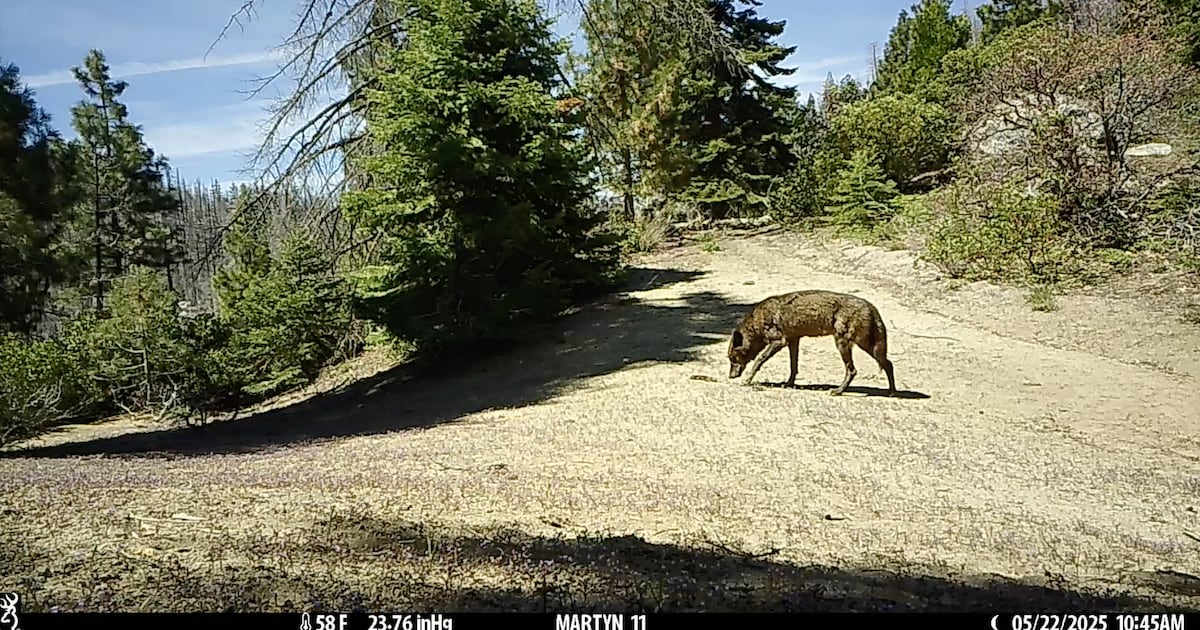
For the first time in over a century, a wolf was seen in L.A. County. The 3-year-old female made her way south, after leaving her pack in Plumas County in northern California last spring, according to the California Department of Fish and Wildlife. Her 10 month journey has been tracked by wolf specialists, who say her over 300 mile journey to northwest L.A. County is notable.
“They’re part of our California heritage, and it’s just an exciting thing to see them come into their native and natural habitats,” said Jacob Keeton, director of education engagement at the California Wolf Center. “Even though that part of L.A. County is probably about as far south as they would have historically ever been.”
The wolf, named BEY03F, was born into a pack that consisted of only her parents and other wolf pups in her litter. This forced her to disperse and find a suitable mate, according to Kent Laudon, the former senior environmental scientist specialist for the California Department of Fish and Wildlife (CDFW), who identified her pack.
Last spring, experts tracked the wolf as she moved 200 miles south from her pack. She then joined California’s southernmost pack, the Yowlumni pack. She was unable to assimilate socially and likely co-existed with the pack, Keeton said. He continued that like humans, wolves are social animals driven by their need to find a mate.
“Whenever we go somewhere, we don’t look to just survive. Where can we thrive? Where can we reproduce? Where can we persist and have a life?” Keeton said. “She probably saw that there are wolves here, but it’s not necessarily, for me, [that] this is a close pack.”
Before the grey wolf’s arrival, its species had been completely erased from most of the United States, including California, by the mid-1940s due to widespread eradication efforts, according to the National Park Service.
Laudon said the wolves in California came from reintroduction efforts in Yellowstone and Idaho in the late 1990s. Wolves, who naturally disperse from their packs to find new mates, eventually came to Northern California in 2011.
Cort Klopping, an information officer for the California Department of Fish and Wildlife, said that the biologists he works with view the wolf as a “natural correction” after their populations were killed off a century ago.
“Because of human involvement, they were gone for a long time, so as far as the biologists are concerned, it’s seen as a success, right?,” Klopping said. “It’s nature kind of coming back to where it technically belongs.”
Keeton said he is excited to see the wolves come back, but that overcoming the stigma humans have around wolves will be hard.
“A history of wolf conservation in the world is a history of human tolerance,” Keeton said. “And so as wolves go into these historic, natural habitats that they’ve been in the past,there are a little bit of growing pains of how we can coexist.”
Keeton said he’s glad the CDFW is working on a management plan to bring wolves back into Southern California. The California Wolf Center is committed to increasing the wild wolf population, protecting wolves and advocating for the co-existence of wolves and humans, according to their website.
Laudon, the former wolf specialist for CDFW, said there’s a key issue to wolves moving south into L.A. County.
As wolves disperse south, they run into freeways which are more highly trafficked near L.A. Laudon said he’s surprised BEY03F made it across the I-80 freeway, or that she was even brave enough to cross it. Wolves need a wide-space, free from barriers like highways to thrive, according to Laudon.
Laudon said wolves shouldn’t be wanted in an area as urban as L.A. anyway.
“You don’t have that habitat for them, you have too many roads. They’re gonna get hit by cars,” Laudon said. “If society wanted to expand wolves, what really would happen is the habitat that’s already there.”
Laudon said the home ranges of wolves, such as the Yowlumni pack, are usually 350 to 700 square miles and that there’s not much room for a habitat to thrive further south than the Yowlumni without running into high traffic roads.
Laudon said he is worried about the wolf being run over, which was the fate of a wolf in 2021 who made it to Ventura County.
“The chance that she’ll end up in that kind of scenario is reasonable. It’s pretty high,” Laudon said. “I hope she goes north back along the spine of the Sierra, where there’s lots of habitat.”
Keeton and Laudon both said that they don’t think the wolf plans to stay because.finding a suitable mate in a region with so few wolves could force her to keep moving.
“Breeding season is going to end around March, April…The drive to keep looking for [a] mate will dissipate a little bit,” Keeton said. “I don’t think she’s looking for a good place to live just by herself, or she’s looking for a place to just survive.”
Laudon said that the wolf’s journey shows us how a wolf navigates a world that is sparse of her kind.
“The story is really about the vantage point of this lone wolf that we can only imagine on her journey and how she navigates a very very human world,”Laudon said. “An overly human world for a wolf.”